

40 Baiocchi – Roman Republic
Italy
Context
Year: 1849
Country: Italy 
Issuer: Roman Republic
Period:
Currency:
(since 1849)
Demonetized: Yes
Total mintage: 125,900
Material
References
KM: #Click to copy to clipboard27
Numista: #24298
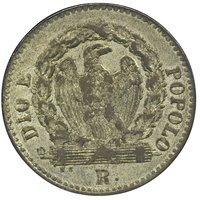
Obverse
Description:
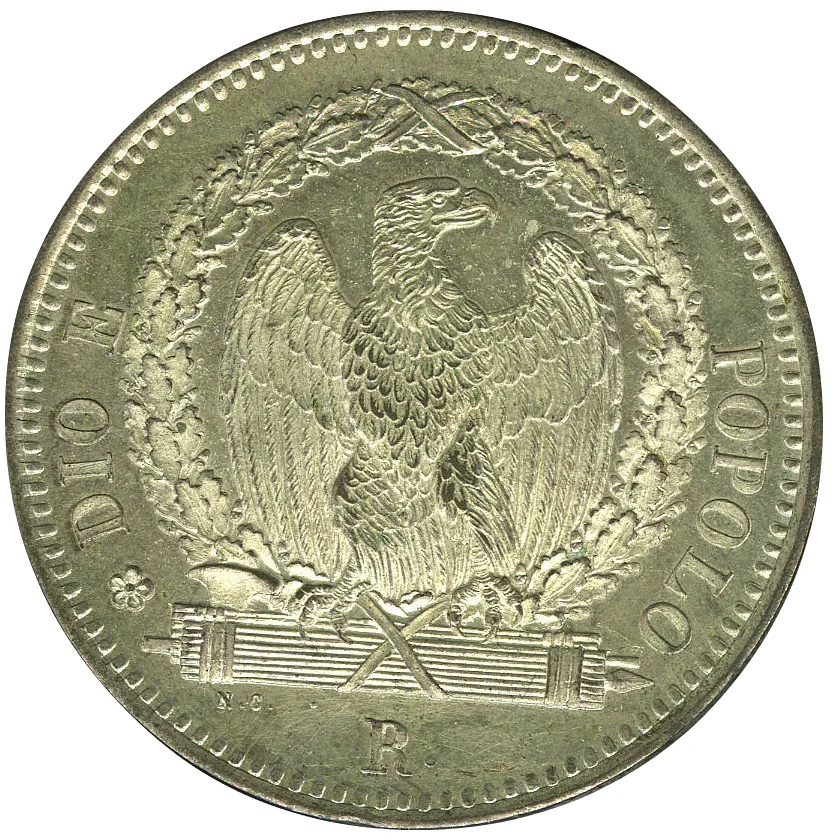
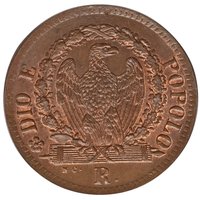
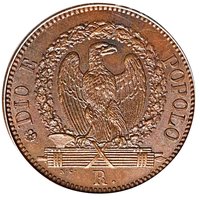
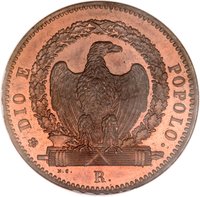
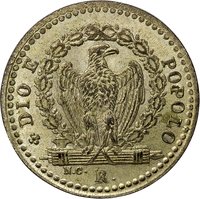
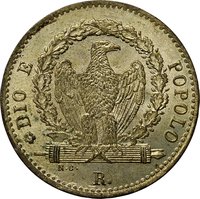
Eagle on fasces within wreath.
Inscription:
DIO E POPULO
N.C.
R.
N.C.
R.
Translation:
God and the People
Script: Latin
Language: Latin
Engraver: Niccolò Cerbara
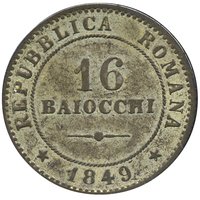
Reverse
Description:
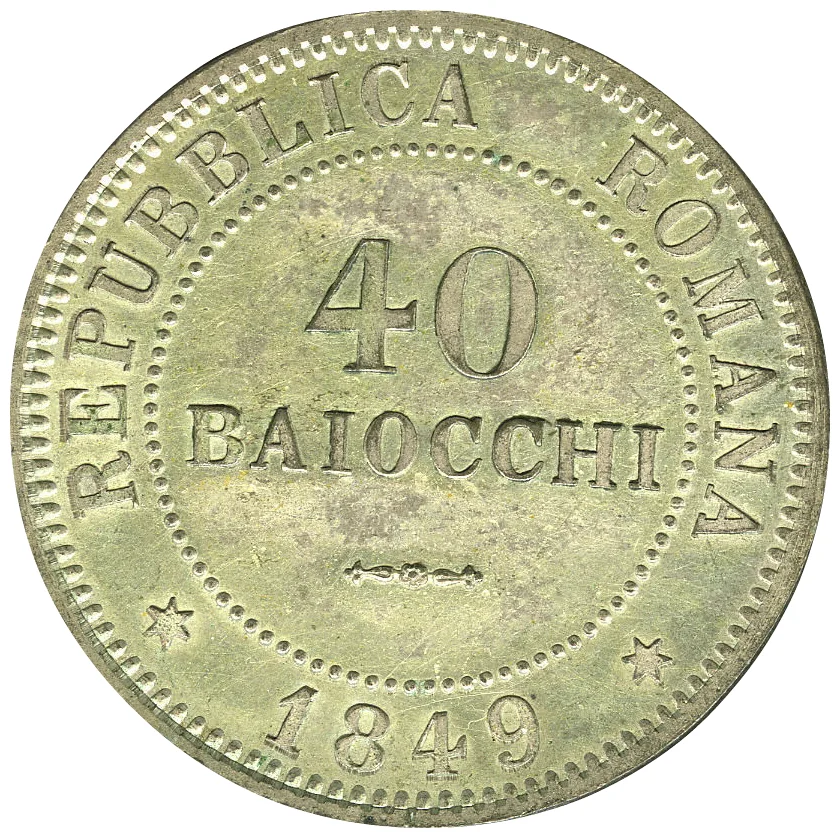
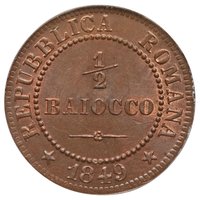
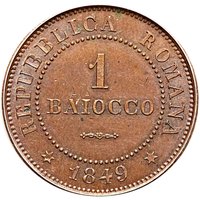
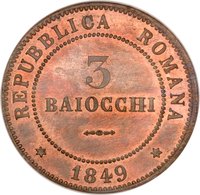
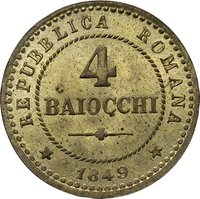
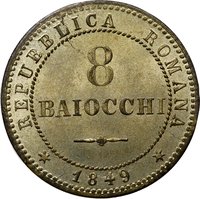
Beaded circle with value, date beneath.
Inscription:
REPUBBLICA ROMANA
40
BAIOCCHI
* 1849 *
40
BAIOCCHI
* 1849 *
Translation:
ROMAN REPUBLIC
40
BAIOCCHI
* 1849 *
40
BAIOCCHI
* 1849 *
Script: Latin
Language: Italian
Engraver: Niccolò Cerbara
Edge
Plain
Mints
| Name | Mark |
|---|---|
| Rome | R |
Mintings
| Year | Mint Mark | Mintage | Quality | Collection |
|---|---|---|---|---|
| 1849 | R | 125,900 |
Historical background
The currency situation of the Roman Republic of 1849 was defined by profound crisis and revolutionary necessity. Proclaimed in February 1849 after the flight of Pope Pius IX, the Republic inherited the monetary systems of the Papal States, which were in a state of severe disruption. Widespread hoarding of gold and silver coinage, driven by political uncertainty, had caused a critical shortage of specie in circulation. This scarcity crippled daily commerce and undermined the new government's financial stability from its inception, creating an urgent need for a stable and trustworthy circulating medium.
Facing this emergency, the Republican government, under the leadership of Finance Minister Carlo Armellini, took decisive action by authorizing the issuance of paper money. These state notes, known as "biglietti di banca del Tesoro" (Treasury banknotes), were introduced in denominations ranging from 1 to 100 scudi and were declared legal tender. This was a radical departure from the papal system, representing a fiat currency backed not by precious metal reserves but by the promise of the state and the future sale of confiscated ecclesiastical properties. The design of the notes was explicitly political, often adorned with republican symbols like the Phrygian cap and the motto "Dio e Popolo" (God and People), visually cementing the break from papal rule.
Ultimately, the currency experiment was cut short by the Republic's military defeat. The notes went into rapid depreciation as French troops besieged Rome in the summer of 1849, and their value collapsed entirely upon the Republic's fall in July. The restored Papal government immediately declared the revolutionary paper money void, rendering it worthless and leaving holders with significant losses. Thus, the currency of 1849 stands as a poignant symbol of the Republic's bold, pragmatic reforms and its tragic, abrupt end, a fleeting financial instrument born of idealism and extinguished by force.
Facing this emergency, the Republican government, under the leadership of Finance Minister Carlo Armellini, took decisive action by authorizing the issuance of paper money. These state notes, known as "biglietti di banca del Tesoro" (Treasury banknotes), were introduced in denominations ranging from 1 to 100 scudi and were declared legal tender. This was a radical departure from the papal system, representing a fiat currency backed not by precious metal reserves but by the promise of the state and the future sale of confiscated ecclesiastical properties. The design of the notes was explicitly political, often adorned with republican symbols like the Phrygian cap and the motto "Dio e Popolo" (God and People), visually cementing the break from papal rule.
Ultimately, the currency experiment was cut short by the Republic's military defeat. The notes went into rapid depreciation as French troops besieged Rome in the summer of 1849, and their value collapsed entirely upon the Republic's fall in July. The restored Papal government immediately declared the revolutionary paper money void, rendering it worthless and leaving holders with significant losses. Thus, the currency of 1849 stands as a poignant symbol of the Republic's bold, pragmatic reforms and its tragic, abrupt end, a fleeting financial instrument born of idealism and extinguished by force.
💎 Extremely Rare