

100000 Lira (Republic of Turkey) – Turkey
Circulating commemorative coins
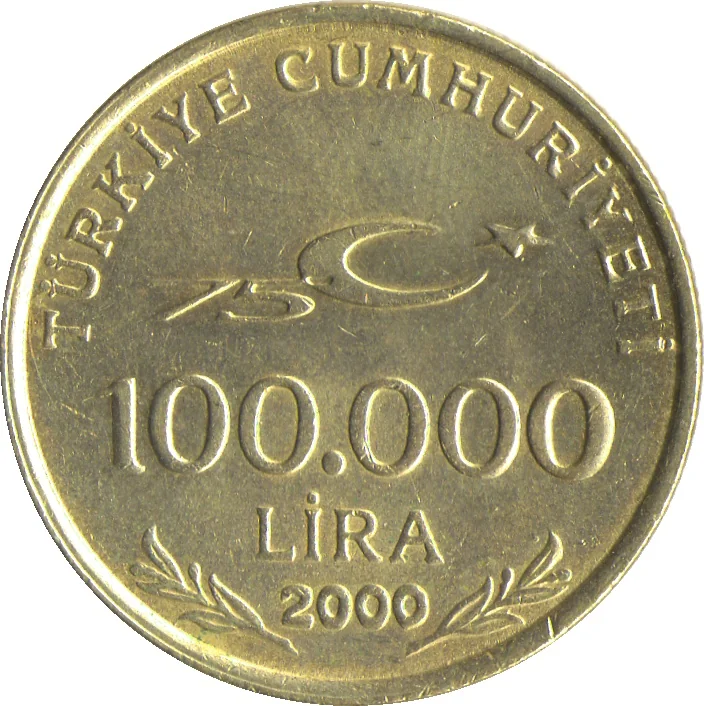
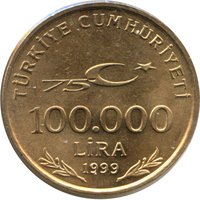
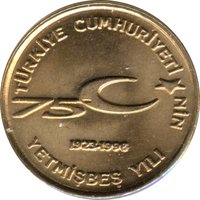
Commemoration: 75th Anniversary of the Republic of Turkey
Turkey
Context

Material
References
KM: #Click to copy to clipboard1078
Numista: #1321
Value
Exchange value: 100000 TRL
Inflation-adjusted value: 17965226.00 TRL
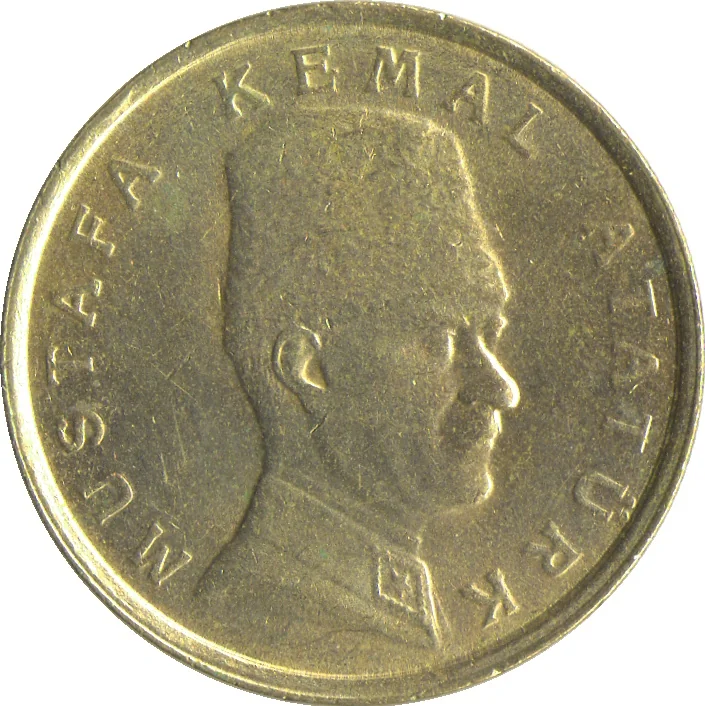
Obverse
Reverse
Edge
Reeded
Categories
| Person> Politician |
| Symbol> Moon |
Mintings
| Year | Mint Mark | Mintage | Quality | Collection |
|---|---|---|---|---|
| 1999 | — | 87,189,000 | ||
| 1999 | — | 1,292 | Proof | |
| 2000 | — | 101,439,000 |
Historical background
In 1999, Turkey's currency situation was defined by a fragile and crisis-prone economic environment, culminating in the final, turbulent year before a major stabilization program. The Turkish Lira (TRL) was under severe pressure due to a combination of high public debt, chronic double-digit inflation (averaging around 65% annually), and massive short-term borrowing by the government to finance its deficits. This created a vicious cycle where high inflation led to a rapidly depreciating lira, and the government's reliance on high-interest domestic debt to attract capital only exacerbated the fiscal burden and market instability.
The core vulnerability was a deeply flawed exchange rate regime. Following a 1994 financial crisis, Turkey had adopted a "crawling peg" system, where the lira was loosely tied to a basket of currencies but allowed to devalue at a pre-announced rate. However, this rate consistently lagged behind actual inflation, leading to a significant overvaluation of the lira. This overvaluation encouraged excessive imports, widened the current account deficit, and created a speculative bubble, as markets increasingly believed a large, discrete devaluation was inevitable.
By late 1999, the situation had become untenable. Under the guidance of the International Monetary Fund (IMF), the government designed a radical disinflation program centered on a new exchange rate-based anchor. Announced in December 1999 and launched in January 2000, this program committed to a pre-fixed, rigid crawling peg (transitioning to a full peg in 2001) to break inflationary expectations. Thus, the currency situation at the end of 1999 was one of precarious imbalance, setting the stage for a high-stakes gamble on a new monetary regime intended to end decades of instability.
The core vulnerability was a deeply flawed exchange rate regime. Following a 1994 financial crisis, Turkey had adopted a "crawling peg" system, where the lira was loosely tied to a basket of currencies but allowed to devalue at a pre-announced rate. However, this rate consistently lagged behind actual inflation, leading to a significant overvaluation of the lira. This overvaluation encouraged excessive imports, widened the current account deficit, and created a speculative bubble, as markets increasingly believed a large, discrete devaluation was inevitable.
By late 1999, the situation had become untenable. Under the guidance of the International Monetary Fund (IMF), the government designed a radical disinflation program centered on a new exchange rate-based anchor. Announced in December 1999 and launched in January 2000, this program committed to a pre-fixed, rigid crawling peg (transitioning to a full peg in 2001) to break inflationary expectations. Thus, the currency situation at the end of 1999 was one of precarious imbalance, setting the stage for a high-stakes gamble on a new monetary regime intended to end decades of instability.
🌱 Very Common