

50000 Lira – Turkey
Circulating commemorative coins
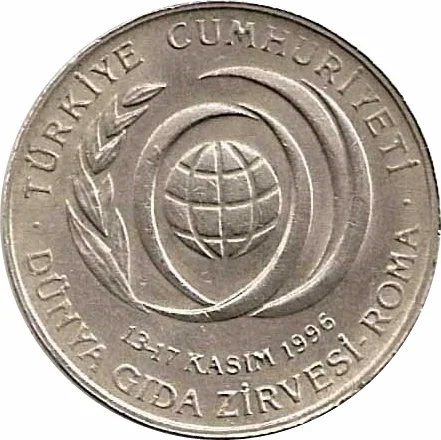
Commemoration: FAO - World Food Summit in Rome
Turkey
Context

Material
References
KM: #Click to copy to clipboard1050
Numista: #23027
Value
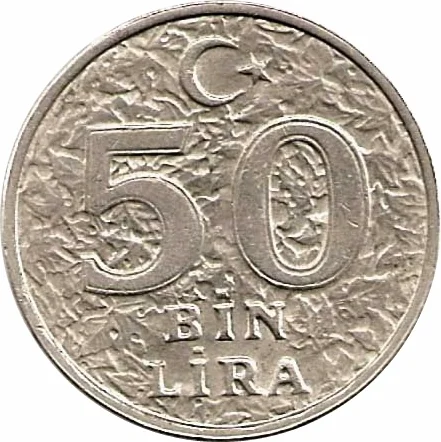
Exchange value: 50000 TRL
Inflation-adjusted value: 55555983.00 TRL
Obverse
Edge
Letters "T.C." and fleur des lis repeated four times
Legend:
++++ T.C. ++++ T.C. ++++ T.C. ++++ T.C.
Translation:
T.C. T.C. T.C. T.C.
Language: Turkish
Categories
| Organization> FAO |
| Symbol> Moon |
Mintings
| Year | Mint Mark | Mintage | Quality | Collection |
|---|---|---|---|---|
| 1996 | — | 500,000 |
Historical background
In 1996, Turkey's currency situation was characterized by chronic high inflation and a vulnerable, overvalued Turkish Lira (TL), operating under a "quasi-currency board" arrangement. Following a severe financial crisis in 1994 that saw the lira lose over half its value, the government had implemented a stabilization program backed by the IMF. This program formally pegged the lira to a basket of the U.S. dollar and German mark, but in practice, the Central Bank of the Republic of Turkey (CBRT) maintained a tight, pre-announced crawling peg, devaluing the lira daily at a rate slightly below the prevailing inflation. This "crawling peg" was intended to anchor expectations and slow price rises, but it created a rigid system vulnerable to speculative attacks.
Despite these measures, underlying economic fundamentals remained weak. Public sector deficits were financed heavily by short-term borrowing, leading to exorbitantly high real interest rates that stifled productive investment. Annual consumer price inflation, though reduced from the triple-digit peaks of 1994, persisted at a debilitating 70-80% range throughout 1996. This environment created a pervasive "dollarization" of the economy, where both businesses and individuals preferred to hold foreign currency (primarily US dollars and Deutsche marks) as a store of value, undermining confidence in the lira. The growing current account deficit further exposed the economy to external shocks.
Consequently, 1996 represented a fragile and tense calm before a storm. The crawling peg regime was becoming increasingly difficult and expensive to defend as the gap between the official exchange rate and market expectations widened. The high cost of financing the government's debt via domestic borrowing created immense pressure on the banking system and crowded out private credit. While the year did not see a dramatic currency collapse, the persistent imbalances and lack of structural reforms—particularly in the state-owned enterprises and the banking sector—set the stage for the more severe crises that would follow in the late 1990s and early 2000s.
Despite these measures, underlying economic fundamentals remained weak. Public sector deficits were financed heavily by short-term borrowing, leading to exorbitantly high real interest rates that stifled productive investment. Annual consumer price inflation, though reduced from the triple-digit peaks of 1994, persisted at a debilitating 70-80% range throughout 1996. This environment created a pervasive "dollarization" of the economy, where both businesses and individuals preferred to hold foreign currency (primarily US dollars and Deutsche marks) as a store of value, undermining confidence in the lira. The growing current account deficit further exposed the economy to external shocks.
Consequently, 1996 represented a fragile and tense calm before a storm. The crawling peg regime was becoming increasingly difficult and expensive to defend as the gap between the official exchange rate and market expectations widened. The high cost of financing the government's debt via domestic borrowing created immense pressure on the banking system and crowded out private credit. While the year did not see a dramatic currency collapse, the persistent imbalances and lack of structural reforms—particularly in the state-owned enterprises and the banking sector—set the stage for the more severe crises that would follow in the late 1990s and early 2000s.
🌱 Fairly Common