

5 Dollars – Singapore
Non-circulating coins
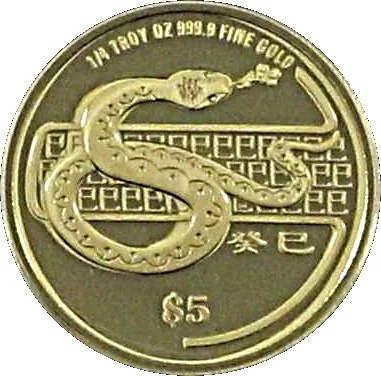
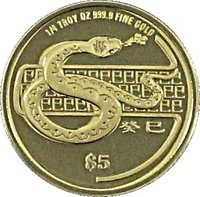
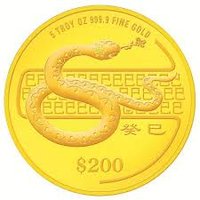
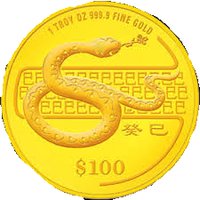
Commemoration: Year of the Snake
Singapore
Context
Material
Diameter: 21.96 mm
Weight: 7.78 g
Gold weight: 7.78 g
Thickness: 1.5 mm
Shape: Round
Composition: 99.99% Gold
Standard: Silver quarter ounce
Magnetic: No
Technique: Milled
Alignment: Medal alignment
flip
References
KM: #Click to copy to clipboard307
Numista: #132079
Value
Exchange value: 5 SGD = $3.96
Bullion value: $1297.03
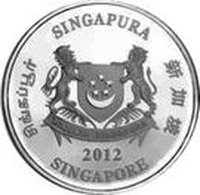
Obverse
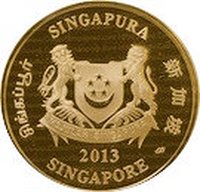
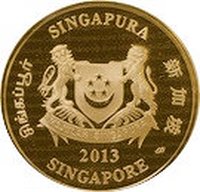
Description:
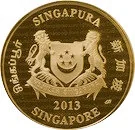
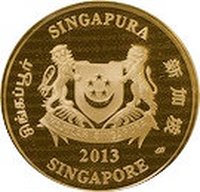
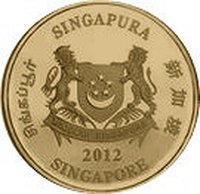
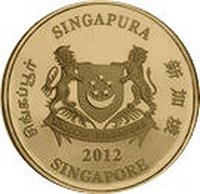
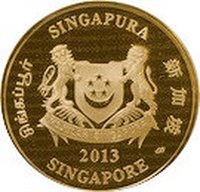
Emblem with date; 'Singapore' encircles it in English, Tamil, Chinese, and Malay.
Inscription:
SINGAPURA
சிங்கப்பூர் 新加坡
2013
SINGAPORE
சிங்கப்பூர் 新加坡
2013
SINGAPORE
Translation:
Singapore
Singapore Singapore
2013
Singapore
Singapore Singapore
2013
Singapore
Engraver: Christopher Ironside
Reverse
Edge
Reeded
Categories
| Animal> Reptile |
| Symbols> Coat of Arms |
| Astrology> Chinese calendar |
Mints
| Name | Mark |
|---|---|
| Singapore Mint | (sm) |
Mintings
| Year | Mint Mark | Mintage | Quality | Collection |
|---|---|---|---|---|
| 2013 | sm | 910 | Proof |
Historical background
In 2013, Singapore's currency situation was primarily defined by the Monetary Authority of Singapore's (MAS) ongoing management of the Singapore Dollar (SGD) within its unique monetary policy framework. Unlike most central banks that use interest rates, the MAS employs an exchange rate-centered policy, steering the SGD against a basket of currencies of its major trading partners within an undisclosed band. This approach, designed to ensure price stability in an import-dependent economy, remained firmly in place, with the central bank continuing its policy of a "modest and gradual appreciation" of the SGD Nominal Effective Exchange Rate (S$NEER) to curb imported inflation.
The year saw the SGD perform robustly, reaching record highs against several major currencies. This strength was driven by Singapore's solid economic fundamentals, persistent inflationary pressures, and global monetary conditions, particularly the quantitative easing programs in the US and Japan which led to capital inflows into Asian assets. The strong currency helped mitigate the cost of imported goods and services, a critical factor as core inflation hovered around 2-2.5% for much of the year. However, this appreciation also posed challenges for export-oriented sectors and tourism by making Singapore's goods and services more expensive internationally.
Looking forward, the MAS maintained its tightening stance throughout 2013, keeping the slope, width, and center of its policy band unchanged in its semi-annual reviews in April and October. The policy was deemed appropriate to balance growth with inflation risks in a year of moderate economic expansion. The currency's strength and stable policy stance underscored Singapore's reputation as a safe-haven financial hub, but also reflected the central bank's constant balancing act in a small, open economy vulnerable to global capital flows and trade dynamics.
The year saw the SGD perform robustly, reaching record highs against several major currencies. This strength was driven by Singapore's solid economic fundamentals, persistent inflationary pressures, and global monetary conditions, particularly the quantitative easing programs in the US and Japan which led to capital inflows into Asian assets. The strong currency helped mitigate the cost of imported goods and services, a critical factor as core inflation hovered around 2-2.5% for much of the year. However, this appreciation also posed challenges for export-oriented sectors and tourism by making Singapore's goods and services more expensive internationally.
Looking forward, the MAS maintained its tightening stance throughout 2013, keeping the slope, width, and center of its policy band unchanged in its semi-annual reviews in April and October. The policy was deemed appropriate to balance growth with inflation risks in a year of moderate economic expansion. The currency's strength and stable policy stance underscored Singapore's reputation as a safe-haven financial hub, but also reflected the central bank's constant balancing act in a small, open economy vulnerable to global capital flows and trade dynamics.
✨ Legendary