

½ sovereign – British colonies
Add to wishlist
Australia
Context
Years: 1871–1887
Country: Australia
Issuer: British colonies
Ruler: Victoria
Currency:
(1788—1966)
Total mintage: 2,192,025
Material
References
KM: #
Numista: #24197
Value
Bullion value: $569.63
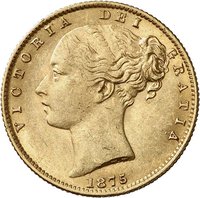
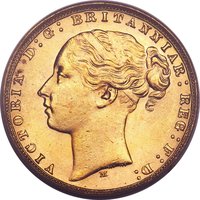
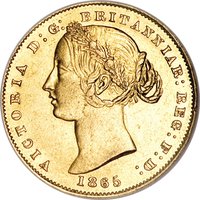
Obverse
Description:
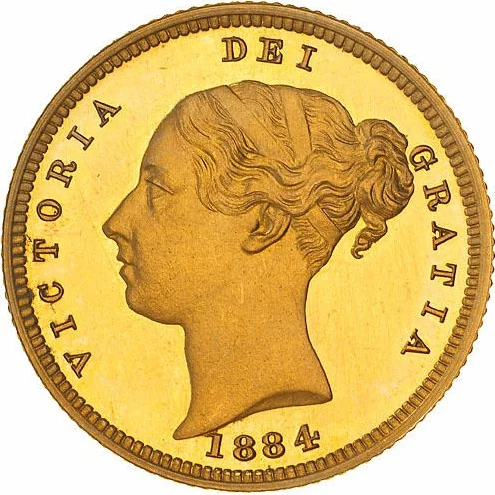
Young Victoria facing left, hair tied with a fillet.
Inscription:
VICTORIA DEI GRATIA
1884
1884
Translation:
Victoria by the Grace of God
Script: Latin
Language: Latin
Engraver: William Wyon
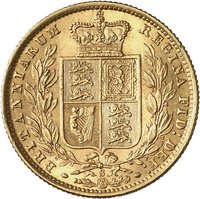
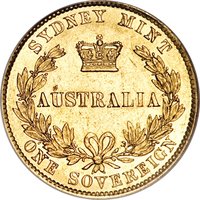
Reverse
Description:
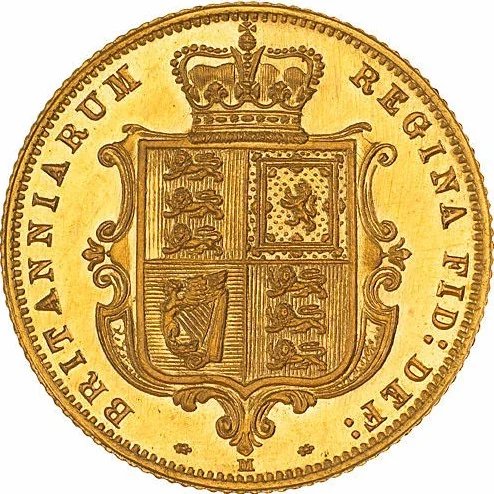
Crowned, lined, and garnished shield.
Inscription:
BRITANNIARUM REGINA FID: DEF:
M
M
Translation:
Queen of the Britains, Defender of the Faith
Script: Latin
Language: Latin
Engraver: Jean Baptiste Merlen
Edge
Milled
Mints
| Name | Mark |
|---|---|
| Royal Mint | M |
| Royal Mint | S |
Mintings
| Year | Mint Mark | Mintage | Quality | Collection |
|---|---|---|---|---|
| 1871 | S | 180,000 | ||
| 1871 | S | — | Proof | |
| 1872 | S | 356,000 | ||
| 1873 | M | 165,000 | ||
| 1875 | S | 252,000 | ||
| 1877 | M | 80,016 | ||
| 1879 | S | 220,000 | ||
| 1880 | S | 80,000 | ||
| 1880 | S | — | Proof | |
| 1881 | — | — | Proof | |
| 1881 | S | 62,000 | ||
| 1881 | M | 42,009 | ||
| 1882 | S | 52,000 | ||
| 1882 | M | 106,000 | ||
| 1883 | S | 220,000 | ||
| 1883 | S | — | Proof | |
| 1884 | M | — | Proof | |
| 1884 | M | 48,000 | ||
| 1885 | M | 11,000 | ||
| 1886 | — | — | Proof | |
| 1886 | M | 38,000 | ||
| 1886 | S | 82,000 | ||
| 1887 | M | 64,000 | ||
| 1887 | S | 134,000 |
Historical background
In 1871, the currency situation across Britain’s vast colonial empire was fragmented and complex, reflecting the differing stages of economic development and integration into global trade. The core principle was the establishment of a sterling exchange standard, where colonial currencies were ultimately pegged to and redeemable for British pounds. However, this was implemented unevenly. In settled colonies like Canada, Australia, and New Zealand, British gold sovereigns and local banknotes convertible to sterling were common, though these regions also grappled with the practical scarcity of coin and the circulation of various foreign coins. In contrast, many tropical colonies and trading outposts operated on a silver standard or used a limited system of token coins and paper money issued by private banks or colonial treasuries, often creating a disjointed monetary landscape within single regions.
A significant challenge was the global shortage of silver, which was the preferred medium for small-denomination trade in most colonies. The demonetization of silver by several European nations and a surge in demand from Asia drove up its value, causing the intrinsic worth of silver subsidiary coins to exceed their face value. This led to their widespread melting down or export, creating a severe shortage of small change that crippled everyday commerce. Colonial administrations responded by limiting the legal tender status of silver, reducing the weight of new coins, or, as in the case of the Straits Settlements, officially adopting the silver dollar as a standard unit to facilitate regional trade.
Overall, the period was one of transition and increasing imperial oversight. The British government and the Colonial Office were moving toward greater standardization, seeking to replace a patchwork of foreign and private coinage with a unified system of colonial coinage firmly anchored to sterling. This push, exemplified by the upcoming Colonial Branch Mint Act of 1876, aimed to solve the small change crisis and bind colonial economies more tightly to London’s financial centre. Thus, 1871 represents a point where the ad-hoc monetary practices of the earlier 19th century were being actively, though not yet completely, reshaped into a more formal and controlled imperial monetary framework.
A significant challenge was the global shortage of silver, which was the preferred medium for small-denomination trade in most colonies. The demonetization of silver by several European nations and a surge in demand from Asia drove up its value, causing the intrinsic worth of silver subsidiary coins to exceed their face value. This led to their widespread melting down or export, creating a severe shortage of small change that crippled everyday commerce. Colonial administrations responded by limiting the legal tender status of silver, reducing the weight of new coins, or, as in the case of the Straits Settlements, officially adopting the silver dollar as a standard unit to facilitate regional trade.
Overall, the period was one of transition and increasing imperial oversight. The British government and the Colonial Office were moving toward greater standardization, seeking to replace a patchwork of foreign and private coinage with a unified system of colonial coinage firmly anchored to sterling. This push, exemplified by the upcoming Colonial Branch Mint Act of 1876, aimed to solve the small change crisis and bind colonial economies more tightly to London’s financial centre. Thus, 1871 represents a point where the ad-hoc monetary practices of the earlier 19th century were being actively, though not yet completely, reshaped into a more formal and controlled imperial monetary framework.
⭐ Rare