

2 dinars – Yugoslavia
Add to wishlist
Context
Years: 1971–1981
Issuer: Yugoslavia
Issuing organization: National Bank of Yugoslavia
Period:
(1963—1992)
Currency:
(1966—1989)
Demonetization: 30 September 1988
Total mintage: 209,006,000
Material
References
KM: #
Numista: #2415
Value
Exchange value: 2 YUD
Obverse
Description:
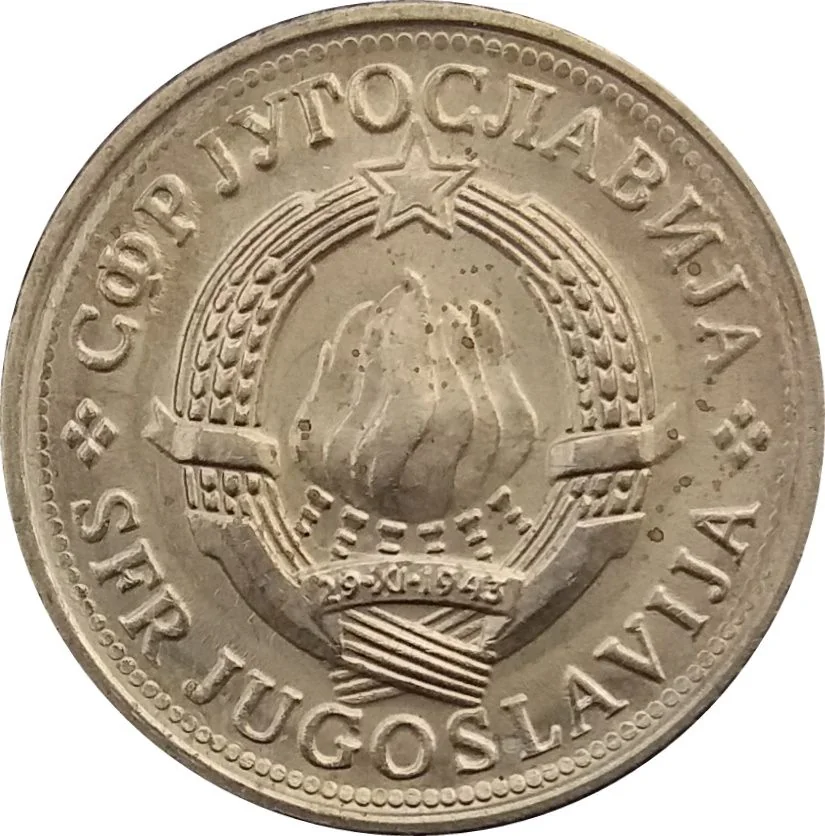
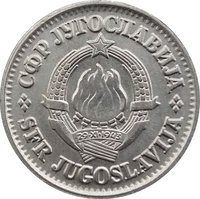
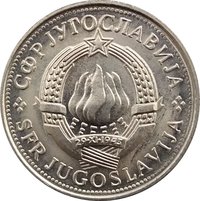
Yugoslav coat of arms.
Inscription:
СФР ЈУГОСЛАВИЈА
29·XI·1943
SFR JUGOSLAVIJA
29·XI·1943
SFR JUGOSLAVIJA
Translation:
SOCIALIST FEDERAL REPUBLIC OF YUGOSLAVIA
29·XI·1943
29·XI·1943
Language: Serbian
Designer: Dragomir Mileusnić
Reverse
Description:
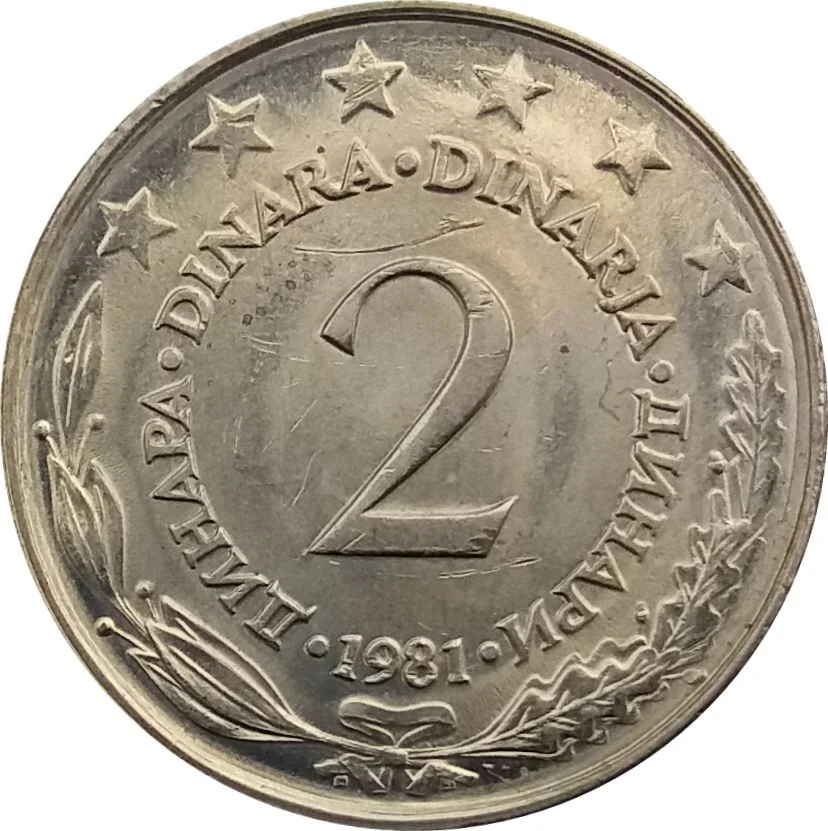
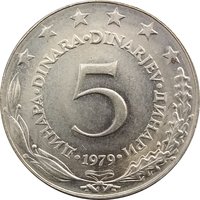
Six-star wreath insignia.
Inscription:
ДИНАРА · DINARA · DINARJA · ДИНАРИ
2
· 1981 ·
2
· 1981 ·
Translation:
DINARA · DINARA · DINARA · DINARI
· 1981 ·
· 1981 ·
Designer: Dragomir Mileusnić
Edge
Reeded
Categories
| Symbols> Coat of Arms |
| Symbol> Wreath |
Mints
| Name | Mark |
|---|---|
| Belgrade | — |
Mintings
| Year | Mint Mark | Mintage | Quality | Collection |
|---|---|---|---|---|
| 1971 | — | 10,413,000 | ||
| 1972 | — | 18,446,000 | ||
| 1973 | — | 31,848,000 | ||
| 1974 | — | 10,989,000 | ||
| 1975 | — | 92,000 | ||
| 1976 | — | 6,092,000 | ||
| 1976 | — | — | Proof | |
| 1977 | — | 19,335,000 | ||
| 1978 | — | 13,035,000 | ||
| 1979 | — | 20,069,000 | ||
| 1980 | — | 36,088,000 | ||
| 1981 | — | 42,599,000 |
Historical background
In 1971, Yugoslavia faced a critical juncture in its economic and political development, with a currency crisis exposing deep structural flaws in its unique model of "market socialism." The country's complex system of self-management, combined with a decentralized federation where republics held significant economic power, had led to irresponsible investment, rampant borrowing from abroad, and persistent trade deficits. The fixed exchange rate of the dinar became increasingly overvalued, discouraging exports and encouraging imports, while "political factories"—inefficient enterprises kept afloat for social and regional stability—drained resources and contributed to growing inflation.
The immediate trigger for the crisis was a severe shortage of foreign currency reserves, which threatened Yugoslavia's ability to service its external debt and pay for essential imports. This shortage was exacerbated by the autonomy of republican-level banks and enterprises, which often made foreign borrowing decisions without federal coordination, leading to unsustainable debt accumulation. The situation came to a head, forcing the federal government under Prime Minister Džemal Bijedić to negotiate a major stabilization loan from the International Monetary Fund (IMF).
The resolution, known as the 1971 Currency Reform, was a watershed moment. It did not involve printing new banknotes but was a package of profound economic measures. These included a significant devaluation of the dinar to improve competitiveness, the introduction of a dual exchange rate system (a commercial rate and a tourist rate), and strict controls on foreign currency transactions. More importantly, it mandated recentralization of monetary and credit policy, stripping the republics of their power to borrow abroad independently. These painful reforms temporarily stabilized the currency but intensified political tensions between the republics and the federal center, foreshadowing the nationalist economic conflicts that would contribute to Yugoslavia's eventual dissolution.
The immediate trigger for the crisis was a severe shortage of foreign currency reserves, which threatened Yugoslavia's ability to service its external debt and pay for essential imports. This shortage was exacerbated by the autonomy of republican-level banks and enterprises, which often made foreign borrowing decisions without federal coordination, leading to unsustainable debt accumulation. The situation came to a head, forcing the federal government under Prime Minister Džemal Bijedić to negotiate a major stabilization loan from the International Monetary Fund (IMF).
The resolution, known as the 1971 Currency Reform, was a watershed moment. It did not involve printing new banknotes but was a package of profound economic measures. These included a significant devaluation of the dinar to improve competitiveness, the introduction of a dual exchange rate system (a commercial rate and a tourist rate), and strict controls on foreign currency transactions. More importantly, it mandated recentralization of monetary and credit policy, stripping the republics of their power to borrow abroad independently. These painful reforms temporarily stabilized the currency but intensified political tensions between the republics and the federal center, foreshadowing the nationalist economic conflicts that would contribute to Yugoslavia's eventual dissolution.
🌱 Very Common