

5 kobo – Nigeria
Add to wishlist
Nigeria
Context
Material
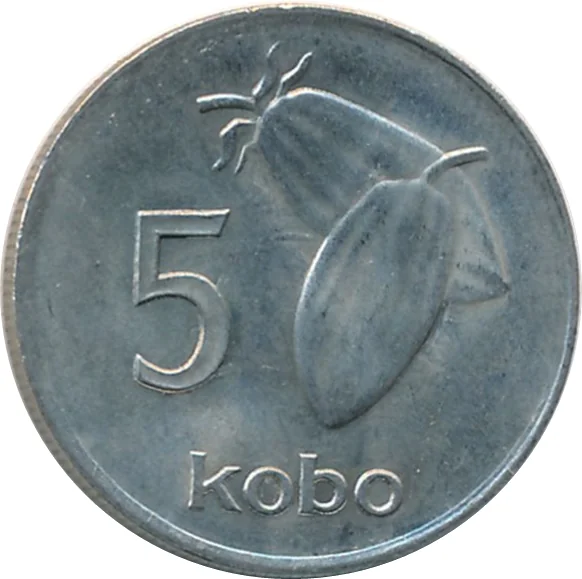
Diameter: 20 mm
Weight: 2.8 g
Thickness: 1 mm
Shape: Round
Composition: Copper-nickel
Technique: Milled
Alignment: Medal alignment
flip
References
KM: #
Numista: #241190
Value
Exchange value: 0.05 NGN
Obverse
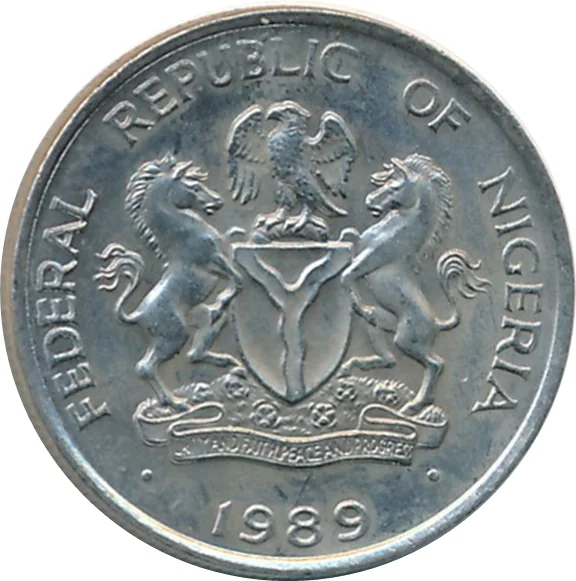
Description:
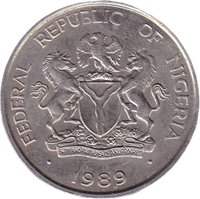
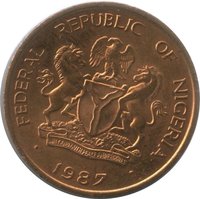
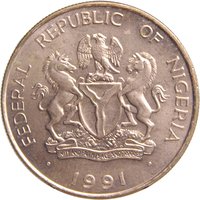
Coat of arms of Nigeria with date beneath.
Inscription:
FEDERAL REPUBLIC OF NIGERIA
FUNITY AND FAITH, PEACE AND PROGRESS
1989
FUNITY AND FAITH, PEACE AND PROGRESS
1989
Translation:
FEDERAL REPUBLIC OF NIGERIA
UNITY AND FAITH, PEACE AND PROGRESS
1989
UNITY AND FAITH, PEACE AND PROGRESS
1989
Script: Latin
Language: English
Engraver: Geoffrey Colley
Reverse
Edge
Reeded
Categories
| Symbols> Coat of Arms |
Mintings
| Year | Mint Mark | Mintage | Quality | Collection |
|---|---|---|---|---|
| 1987 | — | — | ||
| 1988 | — | — | ||
| 1989 | — | — |
Historical background
In 1987, Nigeria's currency situation was defined by the ongoing and painful implementation of the Structural Adjustment Programme (SAP), introduced in 1986 under President Ibrahim Babangida. The core objective was to address a severe economic crisis precipitated by a collapse in global oil prices, which had devastated the nation's primary source of foreign exchange. The SAP marked a decisive shift from a fixed exchange rate regime to a market-driven system, with the introduction of the Second-Tier Foreign Exchange Market (SFEM). This was a de facto devaluation designed to unify multiple exchange rates, attract capital, and correct the massive overvaluation of the Naira that had fueled rampant smuggling and a crippling scarcity of essential imports.
The immediate consequences were stark and widely felt by the populace. The Naira, which had been artificially pegged, underwent a dramatic devaluation, losing over half of its value against the US dollar within the first year of the new policy. This steep depreciation made imported goods—from machinery to basic consumer items—prohibitively expensive, triggering hyperinflation that eroded purchasing power and living standards. While the government argued that devaluation was necessary to stimulate non-oil exports and reduce reliance on imports, the short-term effect was intense economic hardship, social unrest, and a deepening of public distrust in economic management.
Furthermore, the currency situation remained complex and partially managed. Despite the move towards a market system, the Central Bank of Nigeria maintained significant influence, leading to a de facto dual exchange rate structure where a more favourable official rate existed alongside the harsher SFEM rate. This duality created opportunities for arbitrage and corruption, as access to cheaper foreign exchange became a prized privilege. Thus, 1987 was a year of turbulent transition, where the theoretical benefits of a floating currency were overshadowed by the immediate realities of soaring costs, inflation, and the social toll of a wrenching economic adjustment.
The immediate consequences were stark and widely felt by the populace. The Naira, which had been artificially pegged, underwent a dramatic devaluation, losing over half of its value against the US dollar within the first year of the new policy. This steep depreciation made imported goods—from machinery to basic consumer items—prohibitively expensive, triggering hyperinflation that eroded purchasing power and living standards. While the government argued that devaluation was necessary to stimulate non-oil exports and reduce reliance on imports, the short-term effect was intense economic hardship, social unrest, and a deepening of public distrust in economic management.
Furthermore, the currency situation remained complex and partially managed. Despite the move towards a market system, the Central Bank of Nigeria maintained significant influence, leading to a de facto dual exchange rate structure where a more favourable official rate existed alongside the harsher SFEM rate. This duality created opportunities for arbitrage and corruption, as access to cheaper foreign exchange became a prized privilege. Thus, 1987 was a year of turbulent transition, where the theoretical benefits of a floating currency were overshadowed by the immediate realities of soaring costs, inflation, and the social toll of a wrenching economic adjustment.
🌱 Fairly Common