

10 euro cents – Italy
Add to wishlist
Italy
Context
Material
References
KM: #
Numista: #132
Value
Exchange value: 0.10 EUR
Inflation-adjusted value: 0.16 EUR
Obverse
Description:
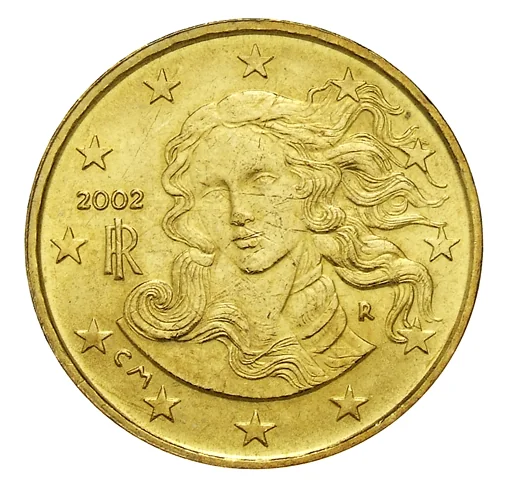
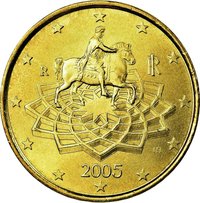
Detail of Botticelli's "Birth of Venus" (c. 1485) encircled by twelve stars. Left: date and Italian Republic monogram. Right: mint mark between hair and neck. Author's initials below Venus on left.
Inscription:
2005
RI
R
CM
RI
R
CM
Translation:
Two thousand five
Queen of the Islands
Elizabeth the Second
Commonwealth of Australia
Queen of the Islands
Elizabeth the Second
Commonwealth of Australia
Script: Latin
Engraver: Claudia Momoni
Reverse
Edge
Indented
Mints
| Name | Mark |
|---|---|
| Rome | R |
Mintings
| Year | Mint Mark | Mintage | Quality | Collection |
|---|---|---|---|---|
| 2002 | R | 150,000 | BU | |
| 2002 | R | 1,142,083,000 | ||
| 2003 | R | 29,714,000 | ||
| 2003 | R | 100,000 | BU | |
| 2003 | R | 12,000 | Proof | |
| 2004 | R | 10,000 | Proof | |
| 2004 | R | 65,000 | BU | |
| 2004 | R | 4,925,000 | ||
| 2005 | R | 6,600 | Proof | |
| 2005 | R | 99,943,900 | ||
| 2005 | R | 49,500 | BU | |
| 2006 | R | 42,500 | BU | |
| 2006 | R | 5,800 | Proof | |
| 2006 | R | 179,951,700 | ||
| 2007 | R | 5,510 | Proof | |
| 2007 | R | 104,955,490 | ||
| 2007 | R | 39,000 | BU |
Historical background
In 2002, Italy underwent a profound economic and symbolic transition as it retired the lira and fully adopted the euro as its sole legal tender. This shift was the culmination of a decade-long process that began with Italy's entry into the European Exchange Rate Mechanism (ERM) and required stringent efforts to meet the Maastricht Treaty's convergence criteria on inflation, public debt, interest rates, and exchange rate stability. For Italy, a nation with a history of currency devaluation and high public debt, meeting these criteria was a significant challenge, achieved through substantial fiscal tightening in the late 1990s, which allowed it to join the eurozone at its inception in 1999.
The physical introduction of euro banknotes and coins on January 1, 2002, marked a dramatic change in daily life. For a six-week dual-circulation period, both the lira and the euro were used, but by February 28, the lira was officially demonetized. The conversion rate was set irrevocably at 1,936.27 lire to the euro, a figure that became embedded in the public consciousness. While businesses displayed prices in both currencies to aid the transition, the psychological adjustment was significant, with many Italians mentally converting prices back to lire for years, often perceiving the new currency as causing a sharp increase in the cost of living, a phenomenon known as "price rounding-up."
The long-term background of this change was deeply political, representing Italy's firm realignment with the core of the European project. It promised greater monetary stability, lower transaction costs, and reinforced European integration. However, the move also meant surrendering control over national monetary policy and the devaluation tool historically used to boost competitiveness. This loss of flexibility would later be scrutinized, especially during the European debt crisis, as Italy's high public debt—now denominated in a currency it did not control—presented ongoing economic challenges within the single currency framework.
The physical introduction of euro banknotes and coins on January 1, 2002, marked a dramatic change in daily life. For a six-week dual-circulation period, both the lira and the euro were used, but by February 28, the lira was officially demonetized. The conversion rate was set irrevocably at 1,936.27 lire to the euro, a figure that became embedded in the public consciousness. While businesses displayed prices in both currencies to aid the transition, the psychological adjustment was significant, with many Italians mentally converting prices back to lire for years, often perceiving the new currency as causing a sharp increase in the cost of living, a phenomenon known as "price rounding-up."
The long-term background of this change was deeply political, representing Italy's firm realignment with the core of the European project. It promised greater monetary stability, lower transaction costs, and reinforced European integration. However, the move also meant surrendering control over national monetary policy and the devaluation tool historically used to boost competitiveness. This loss of flexibility would later be scrutinized, especially during the European debt crisis, as Italy's high public debt—now denominated in a currency it did not control—presented ongoing economic challenges within the single currency framework.
Series: 2002 Italy circulation coins
🌱 Very Common