

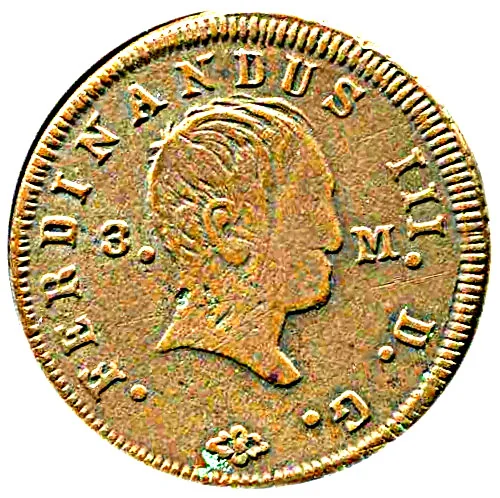
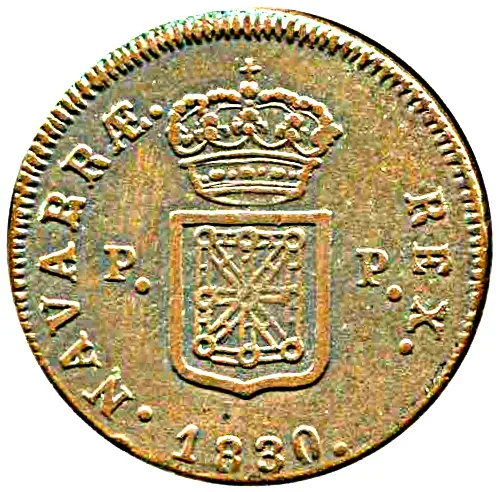
3 Maravedis – Kingdom of Navarre
Spain
Context
Years: 1829–1833
Country: Spain 
Issuer: Kingdom of Navarre
Ruler: Ferdinand III
Currency:
Demonetized: Yes
Material
References
KM: #Click to copy to clipboard131
Numista: #23960
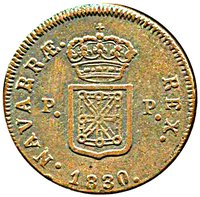
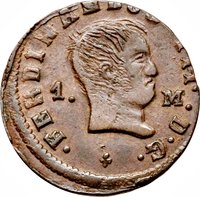
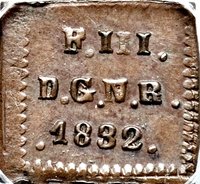
Obverse
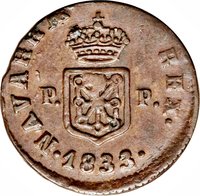
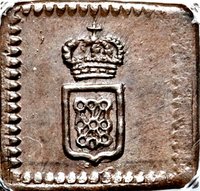
Reverse
Edge
Reeded
Mints
| Name | Mark |
|---|---|
| Pamplona | — |
Mintings
| Year | Mint Mark | Mintage | Quality | Collection |
|---|---|---|---|---|
| 1829 | PP | — | ||
| 1830 | PP | — | ||
| 1831 | PP | — | ||
| 1833 | PP | — |
Historical background
In 1829, the Kingdom of Navarre existed in a complex and transitional monetary state, caught between its historic regional rights (fueros) and the centralizing policies of the Spanish Crown. Following its incorporation into Spain in 1515, Navarre had retained significant fiscal and monetary autonomy, including the right to mint its own coinage at the Pamplona mint. However, by the late 1820s, this autonomy was under severe pressure. The political turbulence following the Napoleonic Wars and the recent defeat of the traditionalist Carlist faction (which found strong support in Navarre) in the War of the Agraviados (1827-1828) had strengthened the hand of Madrid's liberal centralizers who sought to standardize the nation's currency.
The circulating medium in Navarre was therefore a mixture of old and new, local and national. Coins minted in Pamplona, bearing the kingdom's distinctive chains motif, still circulated alongside a variety of Spanish national coins, such as the real and the escudo, and even older French and regional issues. This created practical challenges for commerce, as the values and metallic content of coins required constant calculation. Furthermore, the financial strains of the recent civil conflict had likely exacerbated a shortage of sound specie, leading to the circulation of debased and foreign coins, which complicated trade and taxation.
Ultimately, the currency situation in 1829 was a reflection of Navarre's fading medieval liberties. The Spanish government, under King Ferdinand VII, was steadily working to integrate the kingdom fully into the national monetary system, a process that would culminate in the coming decades with the final closure of the Pamplona mint and the full imposition of the standardized Spanish real and later peseta. Thus, 1829 represents a late, precarious moment where Navarre’s historic numismatic identity was still physically present in people's pockets but was being inexorably supplanted by the currency of a unified nation-state.
The circulating medium in Navarre was therefore a mixture of old and new, local and national. Coins minted in Pamplona, bearing the kingdom's distinctive chains motif, still circulated alongside a variety of Spanish national coins, such as the real and the escudo, and even older French and regional issues. This created practical challenges for commerce, as the values and metallic content of coins required constant calculation. Furthermore, the financial strains of the recent civil conflict had likely exacerbated a shortage of sound specie, leading to the circulation of debased and foreign coins, which complicated trade and taxation.
Ultimately, the currency situation in 1829 was a reflection of Navarre's fading medieval liberties. The Spanish government, under King Ferdinand VII, was steadily working to integrate the kingdom fully into the national monetary system, a process that would culminate in the coming decades with the final closure of the Pamplona mint and the full imposition of the standardized Spanish real and later peseta. Thus, 1829 represents a late, precarious moment where Navarre’s historic numismatic identity was still physically present in people's pockets but was being inexorably supplanted by the currency of a unified nation-state.
💎 Very Rare