

100 dollars – Australia
Add to wishlist
Australia
Context
Material
Diameter: 32.1 mm
Weight: 31.1 g
Platinum Weight:: 31.08 g
Thickness: 2.7 mm
Shape: Round
Composition: 99.95% Platinum
Standard: Silver ounce
Technique: Milled
Alignment: Medal alignment
flip
References
Numista: #239567
Value
Exchange value: 100 AUD
Bullion value: $2096.72
Inflation-adjusted value: 203.36 AUD
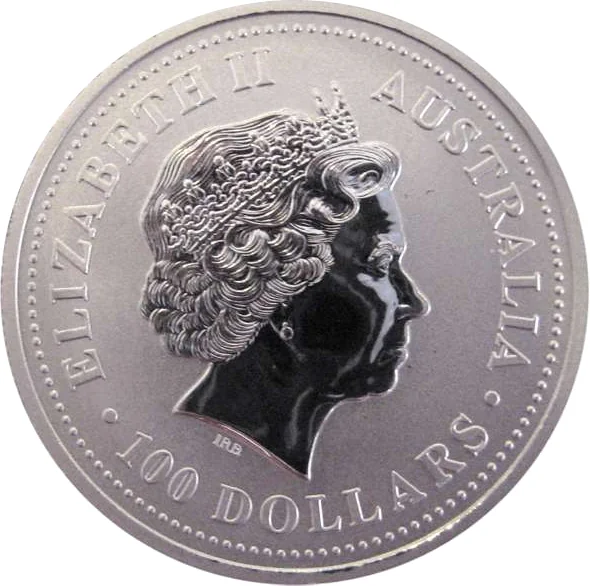
Obverse
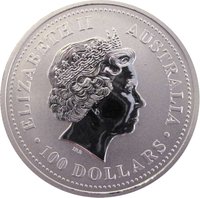
Description:
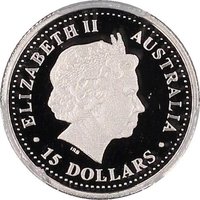
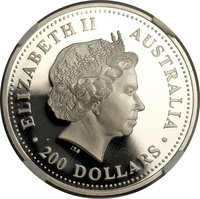
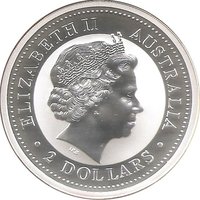
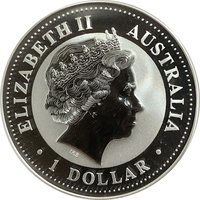
Queen Elizabeth IV, facing right, wearing the Girls of Great Britain and Ireland Tiara.
Inscription:
ELIZABETH II
AUSTRALIA
100 DOLLARS
IRB
AUSTRALIA
100 DOLLARS
IRB
Translation:
ELIZABETH II
AUSTRALIA
100 DOLLARS
IRB
AUSTRALIA
100 DOLLARS
IRB
Script: Latin
Language: English
Designer: Ian Rank-Broadley
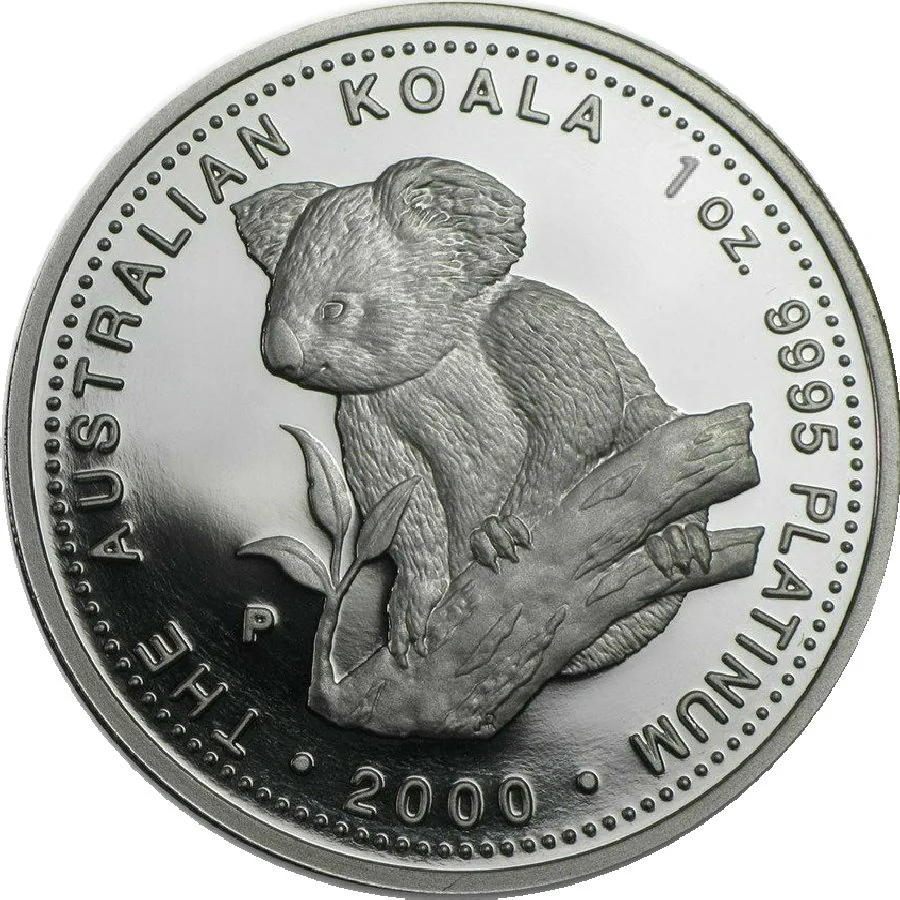
Reverse
Description:
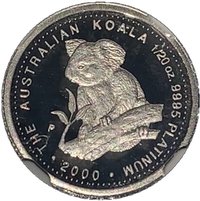
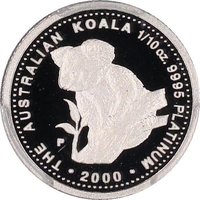
Koala on a eucalypt branch.
Inscription:
THE AUSTRALIAN KOALA
1 OZ. 9995 PLATINUM
P 2000
1 OZ. 9995 PLATINUM
P 2000
Script: Latin
Edge
Reeded
Mints
| Name | Mark |
|---|---|
| Perth Mint | P |
Mintings
| Year | Mint Mark | Mintage | Quality | Collection |
|---|---|---|---|---|
| 2000 | P | 135 | Proof |
Historical background
In the year 2000, Australia's currency situation was defined by a period of significant transition and resilience. The nation had recently navigated the 1997 Asian Financial Crisis with relative strength, avoiding the recessions that struck many regional neighbours. This stability was underpinned by a floating exchange rate regime, in place since 1983, which allowed the Australian dollar (AUD) to act as a shock absorber. At the dawn of the new millennium, the AUD was trading at a historically low level, briefly dipping below US$0.50 in early 2000. This weakness was largely attributed to a strong US dollar and a perceived "commodity currency" discount, as global investor sentiment towards resource-based economies was subdued.
A key event shaping the currency landscape was the introduction of the Goods and Services Tax (GST) on 1 July 2000. While the direct impact on the exchange rate was muted, the broader economic reforms of the era, including tax changes and continued deregulation, were aimed at fostering long-term economic robustness, which in turn provided foundational support for the currency. Furthermore, the Reserve Bank of Australia (RBA) had successfully maintained an inflation-targeting framework since 1993, which provided monetary policy credibility. In 2000, the RBA raised interest rates several times to curb inflationary pressures from a strong domestic economy and a depreciated currency, making the AUD more attractive to yield-seeking investors.
Looking forward, the currency's fortunes were poised for a major shift. The low point of 2000, often called the "Aussie battler" period, marked the end of a long downtrend from the 1980s. Unbeknownst to many at the time, the stage was being set for a historic commodities-driven boom. The rapid industrialisation of China, which would accelerate in the coming years, was about to create unprecedented demand for Australian mineral and energy exports. This would catalyse a sustained and dramatic appreciation of the Australian dollar throughout the 2000s, transforming it from a so-called "battler" into a strong, globally traded currency. Thus, the situation in 2000 represented the quiet conclusion of one era and the unnoticed dawn of another.
A key event shaping the currency landscape was the introduction of the Goods and Services Tax (GST) on 1 July 2000. While the direct impact on the exchange rate was muted, the broader economic reforms of the era, including tax changes and continued deregulation, were aimed at fostering long-term economic robustness, which in turn provided foundational support for the currency. Furthermore, the Reserve Bank of Australia (RBA) had successfully maintained an inflation-targeting framework since 1993, which provided monetary policy credibility. In 2000, the RBA raised interest rates several times to curb inflationary pressures from a strong domestic economy and a depreciated currency, making the AUD more attractive to yield-seeking investors.
Looking forward, the currency's fortunes were poised for a major shift. The low point of 2000, often called the "Aussie battler" period, marked the end of a long downtrend from the 1980s. Unbeknownst to many at the time, the stage was being set for a historic commodities-driven boom. The rapid industrialisation of China, which would accelerate in the coming years, was about to create unprecedented demand for Australian mineral and energy exports. This would catalyse a sustained and dramatic appreciation of the Australian dollar throughout the 2000s, transforming it from a so-called "battler" into a strong, globally traded currency. Thus, the situation in 2000 represented the quiet conclusion of one era and the unnoticed dawn of another.
Series: Platinum Issues






✨ Legendary