

Obverse
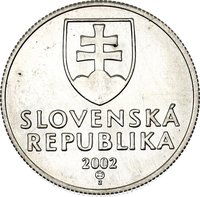
Description:
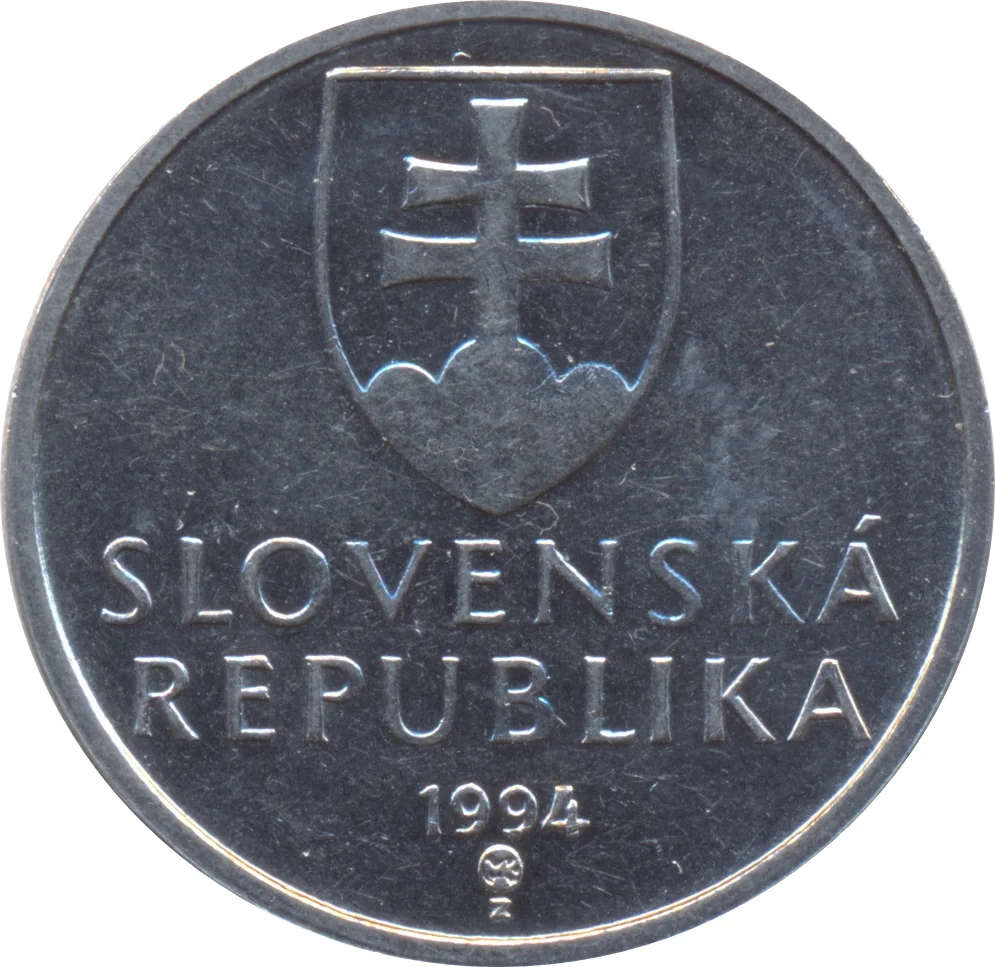
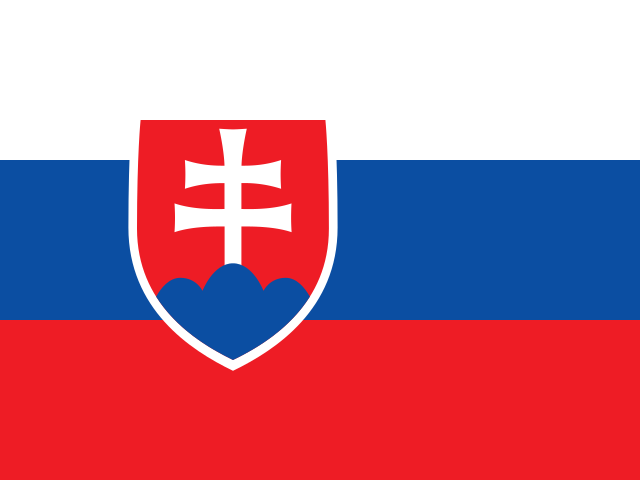
Slovak coat of arms, mintage year, mintmark, and engraver's mark.
Inscription:
SLOVENSKÁ
REPUBLIKA
1994
Z
REPUBLIKA
1994
Z
Translation:
SLOVAK
REPUBLIC
1994
REPUBLIC
1994
Script: Latin
Language: Slovak
Engraver: Drahomír Zobek
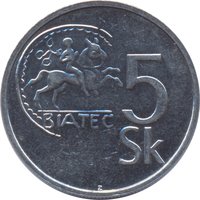
Reverse
Description:
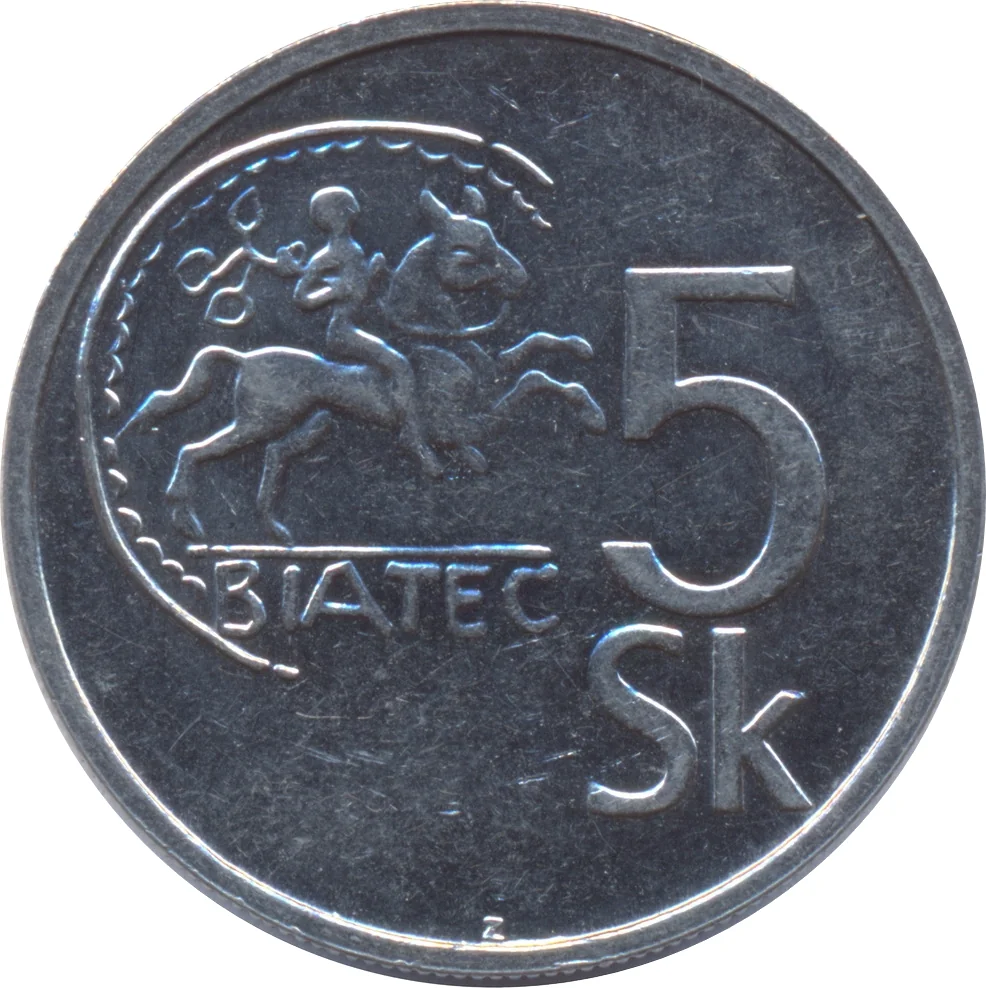
Celtic Biatec coin reverse, 1st century AD, with denomination and engraver's mark.
Inscription:
BIATEC
5
Sk
Z
5
Sk
Z
Script: Latin
Engraver: Drahomír Zobek
Edge
Reeded
Categories
| Symbols> Coat of Arms |
| Symbol> Cross |
| Animal> Horse |
| Currency> Coin depiction |
Mints
| Name | Mark |
|---|---|
| Kremnica | — |
Mintings
| Year | Mint Mark | Mintage | Quality | Collection |
|---|---|---|---|---|
| 1993 | — | 36,200,000 | ||
| 1994 | — | 26,140,000 | ||
| 1995 | — | 16,530,000 | ||
| 1996 | — | 15,000 | In sets | |
| 1997 | — | 15,000 | In sets | |
| 1998 | — | 12,000 | In sets | |
| 1999 | — | 11,500 | In sets | |
| 2000 | — | 12,500 | In sets | |
| 2000 | — | 900 | Proof | |
| 2001 | — | 12,500 | In sets | |
| 2002 | — | 16,100 | In sets | |
| 2003 | — | 14,000 | In sets | |
| 2004 | — | 29,000 | In sets | |
| 2004 | — | — | Proof | |
| 2005 | — | 26,000 | In sets | |
| 2006 | — | 18,500 | In sets | |
| 2006 | — | — | Proof | |
| 2007 | — | 5,320,000 | ||
| 2008 | — | 19,000 | In sets | |
| 2008 | — | — | Proof |
Historical background
Following the dissolution of Czechoslovakia on January 1, 1993, the newly independent Slovak Republic faced the immediate and complex task of establishing its own monetary identity. Initially, the two successor states maintained a monetary union, continuing to use the Czechoslovak koruna (CSK) as a common currency. This interim period, intended to ensure stability, was fraught with tension. Economic asymmetries quickly surfaced, as Slovakia's economy, with its heavier industrial base and different fiscal needs, began to diverge from the Czech lands. Concerns over asymmetric shocks and the lack of a central coordinating authority made the union unsustainable.
Recognizing the risks, the governments agreed on a swift but orderly separation. On February 8, 1993, the currencies were formally split. Existing Czechoslovak banknotes were stamped with special adhesive coupons in Slovakia, physically distinguishing them as Slovak koruna (SKK) and preventing an influx of currency from the Czech side. This "coupon" period lasted only a few weeks, serving as a pragmatic stopgap. By mid-February, the National Bank of Slovakia began issuing its own definitive banknotes and coins, completing the technical creation of an independent currency.
The primary challenge then shifted to maintaining its stability and international credibility. Slovakia entered independence with higher inflation and a less favorable economic outlook than the Czech Republic. The National Bank of Slovakia pursued a tight monetary policy to anchor the new currency, but it initially experienced devaluation pressure. The successful establishment of the Slovak koruna was a crucial, if difficult, first step in the country's economic sovereignty, setting the stage for the subsequent transition challenges of the 1990s as Slovakia worked to integrate into the global economy.
Recognizing the risks, the governments agreed on a swift but orderly separation. On February 8, 1993, the currencies were formally split. Existing Czechoslovak banknotes were stamped with special adhesive coupons in Slovakia, physically distinguishing them as Slovak koruna (SKK) and preventing an influx of currency from the Czech side. This "coupon" period lasted only a few weeks, serving as a pragmatic stopgap. By mid-February, the National Bank of Slovakia began issuing its own definitive banknotes and coins, completing the technical creation of an independent currency.
The primary challenge then shifted to maintaining its stability and international credibility. Slovakia entered independence with higher inflation and a less favorable economic outlook than the Czech Republic. The National Bank of Slovakia pursued a tight monetary policy to anchor the new currency, but it initially experienced devaluation pressure. The successful establishment of the Slovak koruna was a crucial, if difficult, first step in the country's economic sovereignty, setting the stage for the subsequent transition challenges of the 1990s as Slovakia worked to integrate into the global economy.
Series: 1993 Slovakia circulation coins
🌱 Very Common