

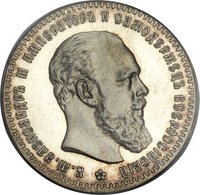
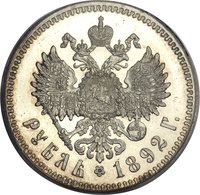
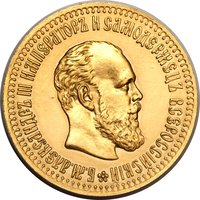
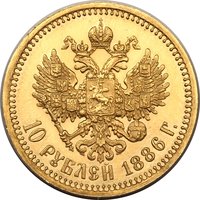
50 kopecks – Russian Empire
Add to wishlist
Russia
Context
Years: 1886–1894
Country: Russia
Issuer: Russian Empire
Ruler: Alexander III
Currency:
(1700—1917)
Demonetized: Yes
Total mintage: 63,098
Material
References
Y: #
Numista: #23841
Value
Bullion value: $21.90
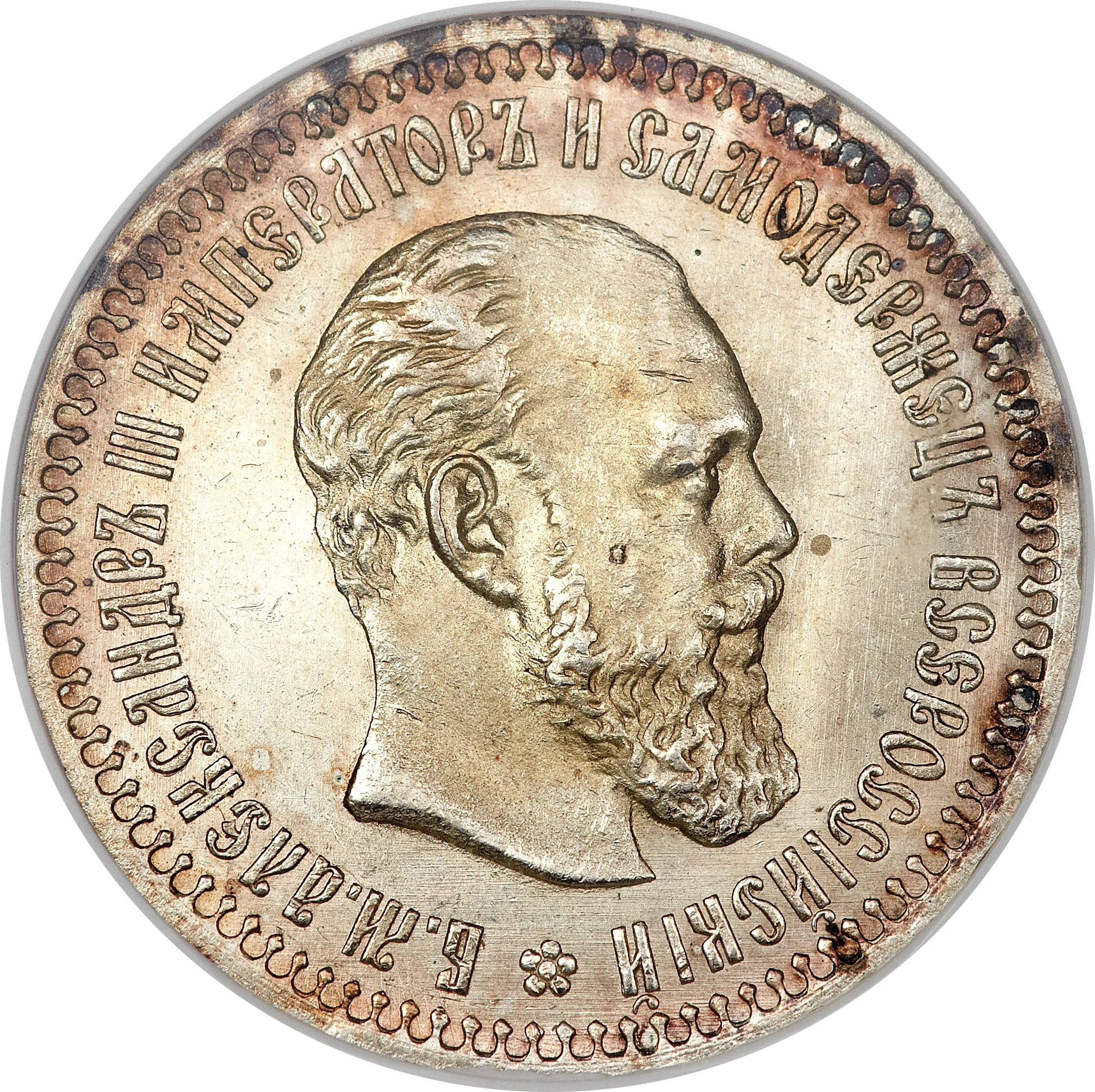
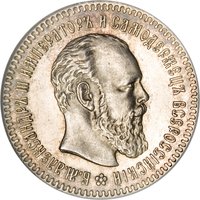
Obverse
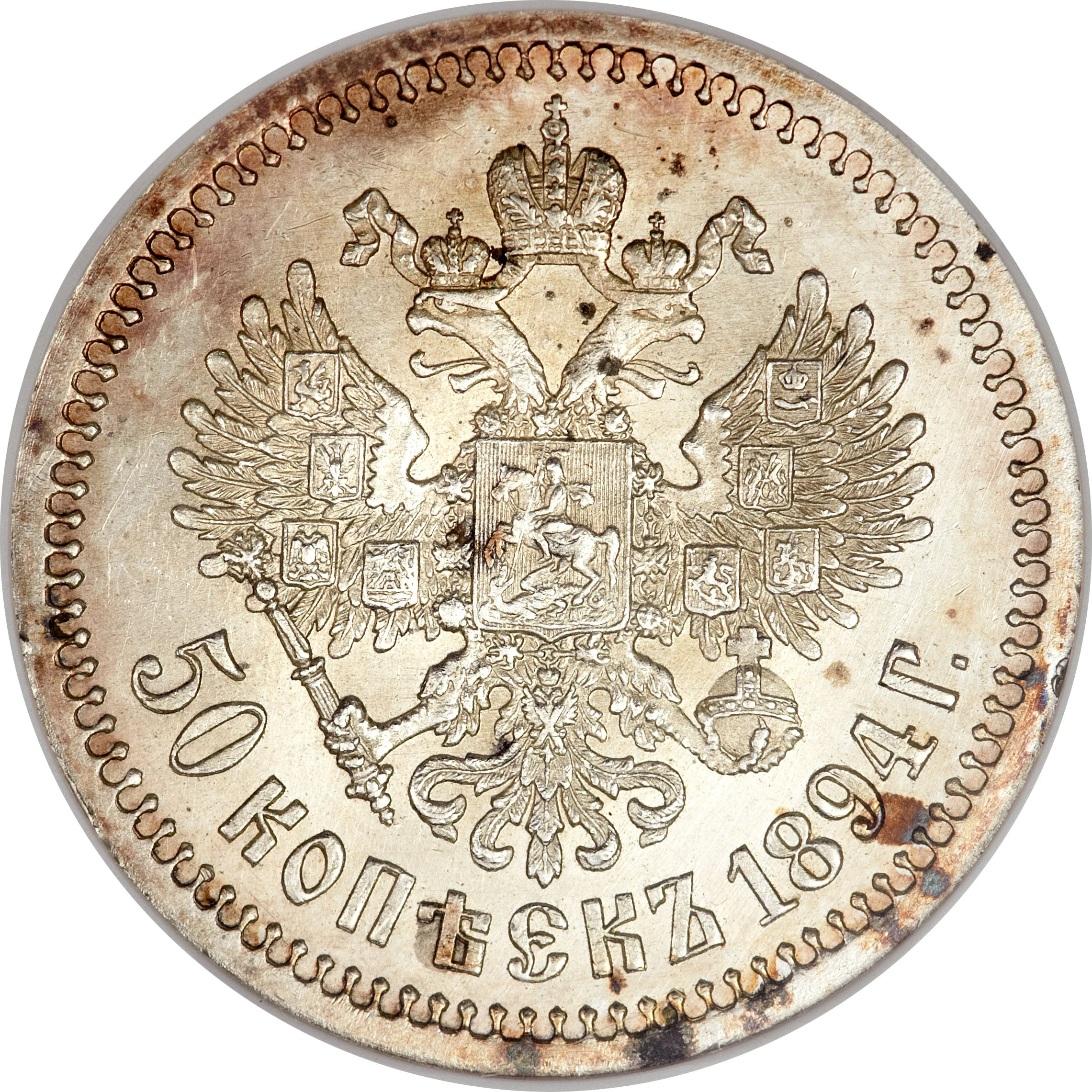
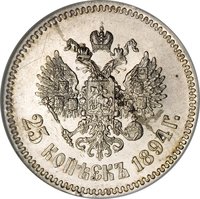
Reverse
Edge
Legend:
АГ ЧИСТАГО СЕРЕБРА 2 ЗОЛОТНИКА 10.5 ДOЛЕЙ
Translation:
TWO ZOLOTNIKS AND 10.5 PARTS OF PURE SILVER
Language: Russian
Mints
| Name | Mark |
|---|---|
| Saint Petersburg | — |
Mintings
| Year | Mint Mark | Mintage | Quality | Collection |
|---|---|---|---|---|
| 1886 | АГ | 2,058 | ||
| 1887 | АГ | 26,004 | ||
| 1888 | АГ | 2,006 | ||
| 1889 | АГ | 1,002 | ||
| 1890 | АГ | 2,006 | ||
| 1891 | АГ | 24,008 | ||
| 1892 | АГ | 2,006 | ||
| 1893 | АГ | 4,008 | ||
| 1894 | АГ | — |
Historical background
In 1886, the currency system of the Russian Empire was defined by its commitment to the gold standard, a policy formally adopted in 1897 but whose foundations were being carefully laid throughout the previous decade under Finance Minister Nikolai Bunge and his successor, Ivan Vyshnegradsky. The primary circulating medium was the paper ruble assignat, but its value was unstable and often traded at a significant discount against the silver ruble, which was the official unit of account. This duality created a complex financial environment where state accounts and international trade were calculated in silver, while the domestic economy largely operated with depreciating paper, causing friction and uncertainty.
The government's central financial objective was to stabilize the ruble and accumulate a sufficient gold reserve to enable a fixed convertibility, thereby attracting foreign investment crucial for industrialization. Vyshnegradsky, in particular, pursued a policy of "saving at the expense of the stomachs of the peasants," aggressively exporting grain (even during poor harvests) to generate a trade surplus and bring gold into the treasury. By 1886, these efforts were underway but not yet complete; the State Bank was actively amassing gold, while stringent fiscal austerity was applied to the budget to build credibility.
Thus, the currency situation in 1886 was one of transition and tension. The empire was caught between a legacy of paper inflation and a determined, often harsh, drive toward metallic stability. The policies enacted during this period set the stage for Sergei Witte's successful reform of 1897, which finally established a firm gold ruble. However, in 1886, the average subject still contended with the practical realities of a fluctuating paper currency, while the state focused on the macroeconomic goal of gold accumulation, a priority that would have profound social and economic consequences.
The government's central financial objective was to stabilize the ruble and accumulate a sufficient gold reserve to enable a fixed convertibility, thereby attracting foreign investment crucial for industrialization. Vyshnegradsky, in particular, pursued a policy of "saving at the expense of the stomachs of the peasants," aggressively exporting grain (even during poor harvests) to generate a trade surplus and bring gold into the treasury. By 1886, these efforts were underway but not yet complete; the State Bank was actively amassing gold, while stringent fiscal austerity was applied to the budget to build credibility.
Thus, the currency situation in 1886 was one of transition and tension. The empire was caught between a legacy of paper inflation and a determined, often harsh, drive toward metallic stability. The policies enacted during this period set the stage for Sergei Witte's successful reform of 1897, which finally established a firm gold ruble. However, in 1886, the average subject still contended with the practical realities of a fluctuating paper currency, while the state focused on the macroeconomic goal of gold accumulation, a priority that would have profound social and economic consequences.
⭐ Somewhat Rare