

50 centavos – Honduras
Add to wishlist
Honduras
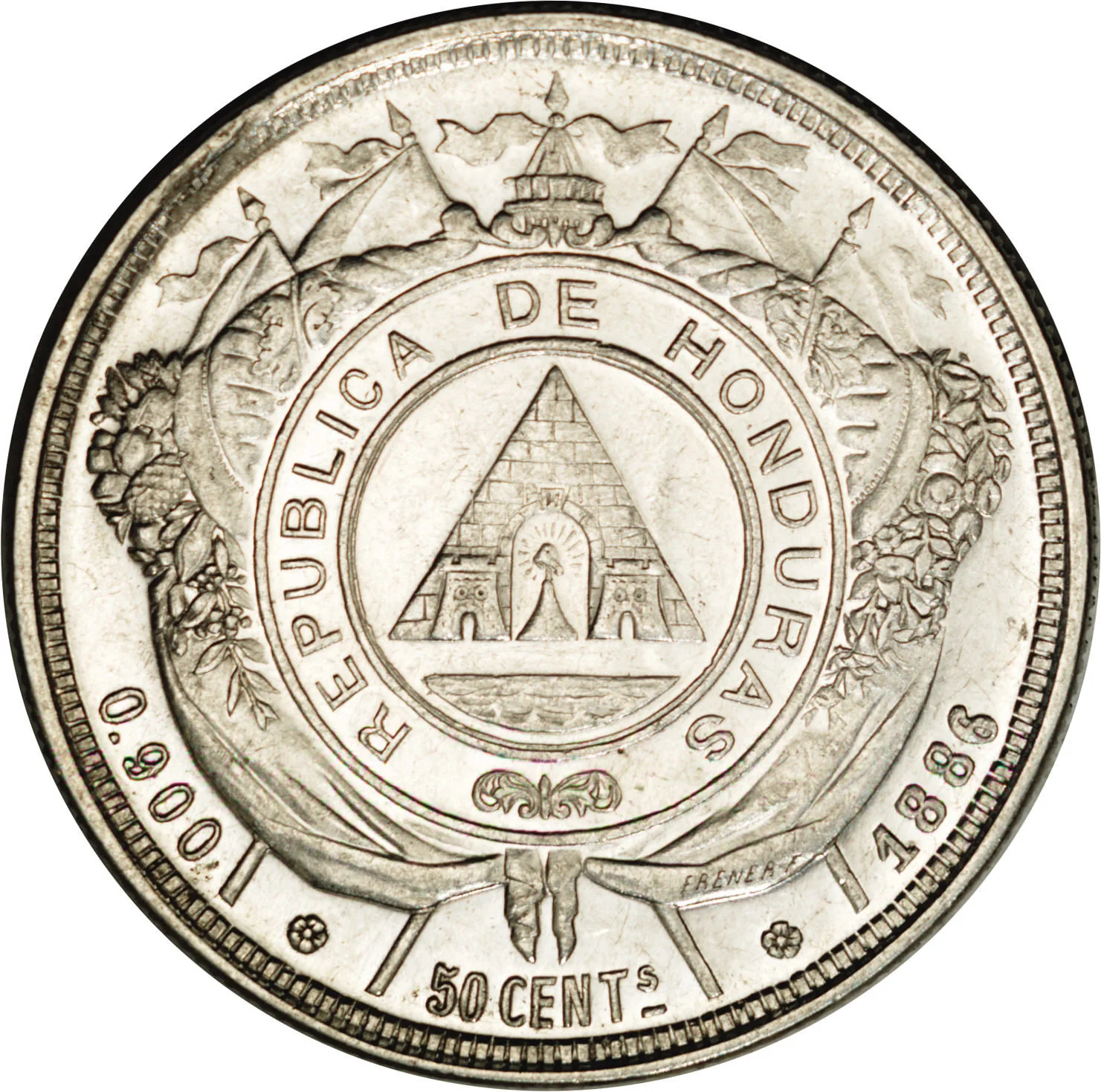
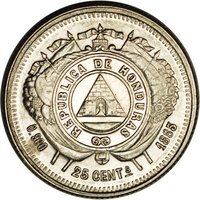
Obverse
Description:
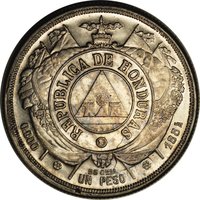
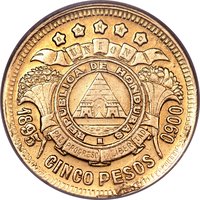
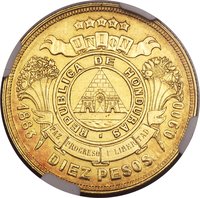
Coat of arms with legend; fineness, value, and date below.
Inscription:
REPUBLICA DE HONDURAS
0.900 50 CENTs 1886
0.900 50 CENTs 1886
Translation:
REPUBLIC OF HONDURAS
0.900 50 CENTS 1886
0.900 50 CENTS 1886
Script: Latin
Language: Spanish
Engraver: Jean-Baptiste Frener
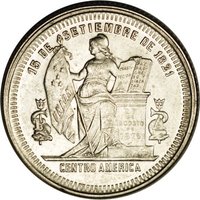
Reverse
Description:
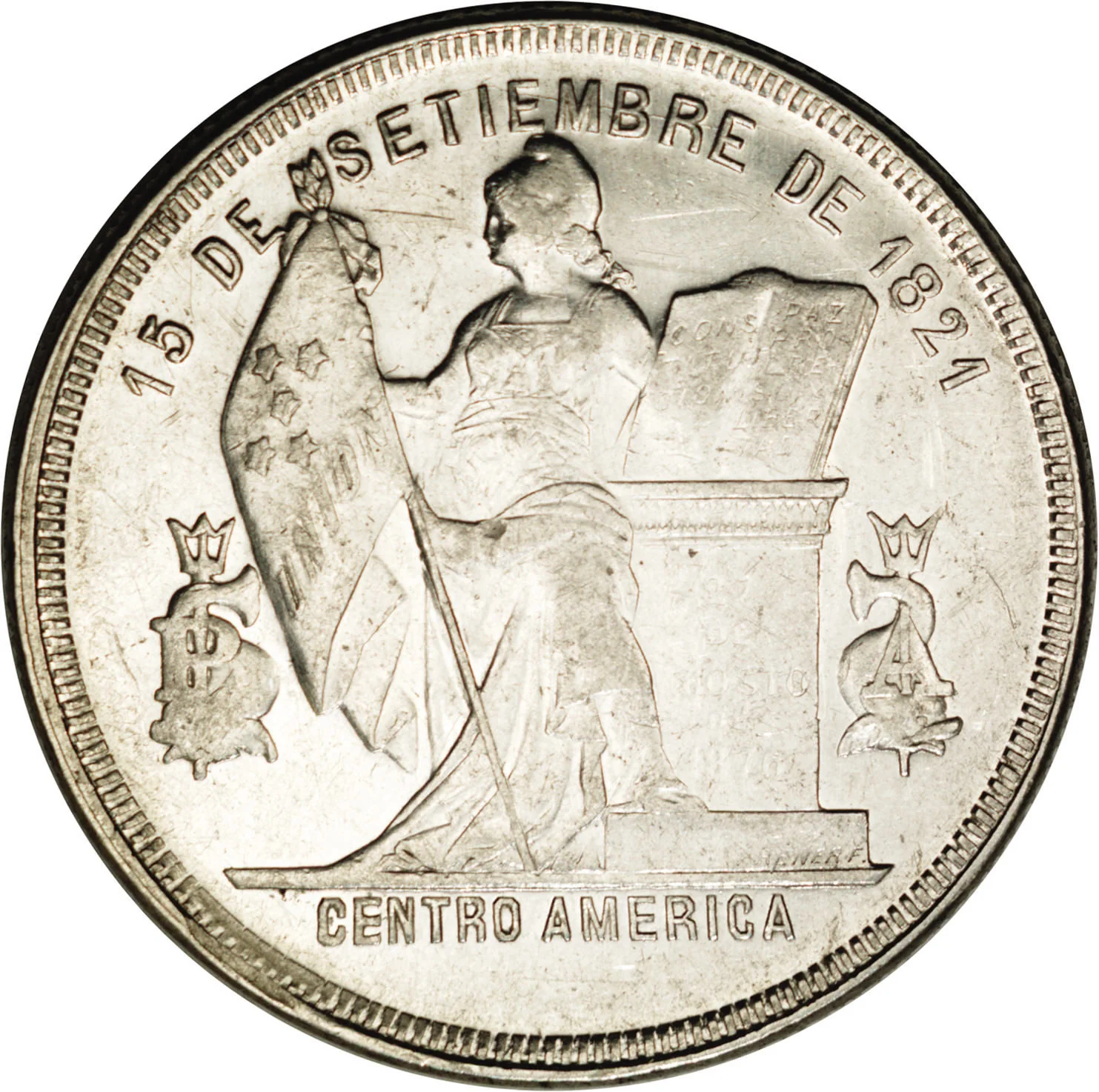
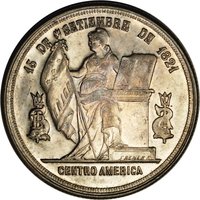
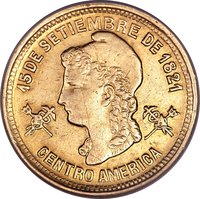
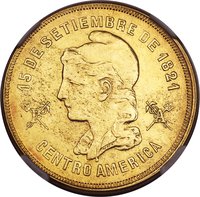
Liberty holding a flag marked "UNION" and five stars, her left arm resting on a column and the Constitution. Tridents with P and A flank her. Legends above and below.
Inscription:
15 DE SETIEMBRE DE 1821
CONSTITUCION
PAZ, PROGRESO Y LIBERTAD
UNION
27 DE AGOSTO DE 1876
P A
CENTRO AMERICA
CONSTITUCION
PAZ, PROGRESO Y LIBERTAD
UNION
27 DE AGOSTO DE 1876
P A
CENTRO AMERICA
Translation:
Fifteenth of September of 1821
Constitution
Peace, Progress and Liberty
Union
Twenty-seventh of August of 1876
P A
Central America
Constitution
Peace, Progress and Liberty
Union
Twenty-seventh of August of 1876
P A
Central America
Script: Latin
Language: Spanish
Engraver: Jean-Baptiste Frener
Edge
Categories
| Symbols> Coat of Arms |
| Symbol> Flag |
Mints
| Name | Mark |
|---|---|
| Casa Nacional de la Moneda | — |
Mintings
| Year | Mint Mark | Mintage | Quality | Collection |
|---|---|---|---|---|
| 1883 | — | — | ||
| 1883 | P | — | ||
| 1884 | — | — | ||
| 1885 | — | — | ||
| 1886 | — | — | ||
| 1887 | — | 41,864 | ||
| 1896 | — | — | ||
| 1897 | — | 37,436 | ||
| 1899 | — | 901 | ||
| 1910 | — | 602 |
Historical background
In 1883, Honduras operated under a complex and unstable monetary system, a legacy of its colonial past and turbulent early independence. The official currency was the Honduran Peso, theoretically on a silver standard, but its value and circulation were inconsistent. More prevalent in daily commerce, however, were the silver coins of neighboring republics, particularly Peruvian and Bolivian pesos, and even older Spanish colonial pieces of eight (reales). This proliferation of foreign silver created a de facto bimetallic environment alongside a limited gold circulation, leading to confusion in exchange rates and commercial transactions.
The period was marked by significant economic strain, which directly impacted the currency's stability. Honduras was heavily dependent on agricultural exports like coffee and bananas, and a severe decline in world silver prices during the late 19th century eroded the intrinsic value of the silver coins in circulation. Furthermore, the government, often in debt and with limited fiscal resources, had a history of issuing paper money (billetes) to cover deficits, which frequently led to depreciation and loss of public confidence. By 1883, while not in a state of hyperinflation, the monetary landscape was fragmented and unreliable, hindering both domestic commerce and foreign investment.
This chaotic situation set the stage for future monetary reforms. The instability of the 1880s provided a strong impetus for the government to seek a more unified and modern system. This would culminate, after further turmoil, in the creation of a new national currency: the Honduran Lempira, introduced in 1931, named for the indigenous leader who resisted Spanish conquest, finally establishing a stable and sovereign monetary standard for the country.
The period was marked by significant economic strain, which directly impacted the currency's stability. Honduras was heavily dependent on agricultural exports like coffee and bananas, and a severe decline in world silver prices during the late 19th century eroded the intrinsic value of the silver coins in circulation. Furthermore, the government, often in debt and with limited fiscal resources, had a history of issuing paper money (billetes) to cover deficits, which frequently led to depreciation and loss of public confidence. By 1883, while not in a state of hyperinflation, the monetary landscape was fragmented and unreliable, hindering both domestic commerce and foreign investment.
This chaotic situation set the stage for future monetary reforms. The instability of the 1880s provided a strong impetus for the government to seek a more unified and modern system. This would culminate, after further turmoil, in the creation of a new national currency: the Honduran Lempira, introduced in 1931, named for the indigenous leader who resisted Spanish conquest, finally establishing a stable and sovereign monetary standard for the country.
Series: 1883 Honduras circulation coins
⭐ Rare