

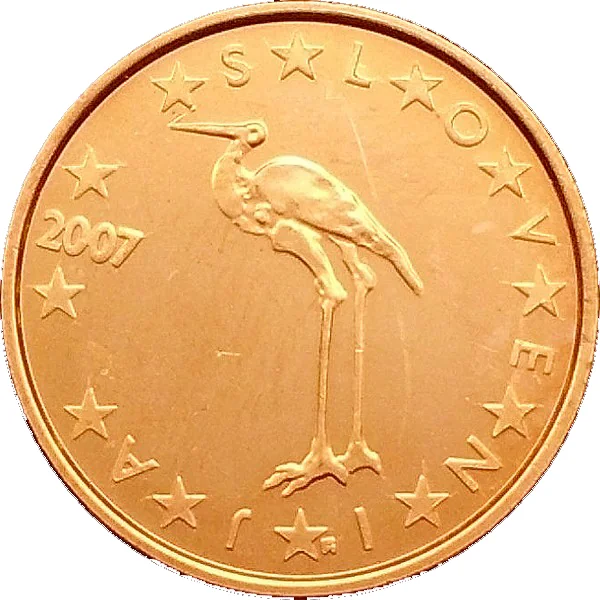
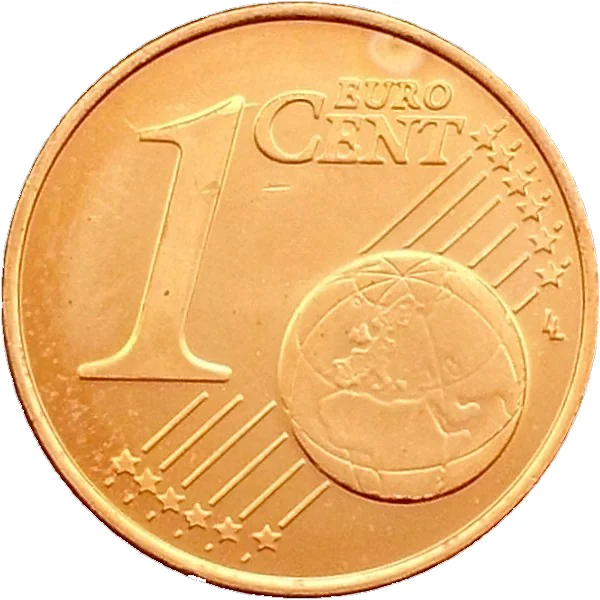
1 euro cent – Slovenia
Add to wishlist
Slovenia
Context
Material
References
KM: #
Numista: #236
Value
Exchange value: 0.01 EUR
Inflation-adjusted value: 0.02 EUR
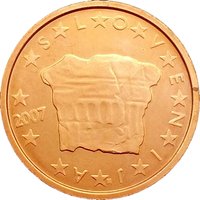
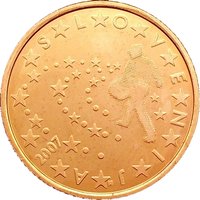
Obverse
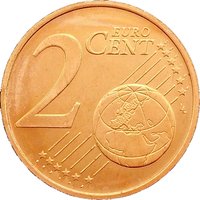
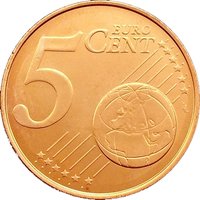
Reverse
Edge
Plain
Mints
| Name | Mark |
|---|---|
| Imprensa Nacional - Casa da Moeda | — |
| Lithuanian Mint | — |
| Mint of Finland | — |
| Rome | — |
| Royal Dutch Mint | — |
Mintings
| Year | Mint Mark | Mintage | Quality | Collection |
|---|---|---|---|---|
| 2007 | Fi | 100,000 | BU | |
| 2007 | Fi | 44,600,000 | ||
| 2008 | — | 2,000 | Proof | |
| 2008 | — | 148,000 | BU | |
| 2009 | — | 100,000 | BU | |
| 2009 | — | 17,900,000 | ||
| 2010 | — | 70,000 | BU | |
| 2010 | — | 5,000 | Proof | |
| 2011 | — | 2,000 | Proof | |
| 2011 | — | 15,000 | BU | |
| 2012 | — | 15,000 | BU | |
| 2012 | — | 2,000 | Proof | |
| 2013 | — | 15,000 | BU | |
| 2013 | — | 2,000 | Proof | |
| 2014 | — | 15,000 | BU | |
| 2014 | — | 1,500 | Proof | |
| 2015 | — | 13,500 | BU | |
| 2015 | — | 20,000,000 | ||
| 2015 | — | 1,500 | Proof | |
| 2016 | — | 10,500 | BU | |
| 2016 | — | 15,000,000 | ||
| 2016 | — | 1,500 | Proof | |
| 2017 | — | 8,000 | BU | |
| 2017 | — | 1,000 | Proof | |
| 2018 | — | 8,000 | BU | |
| 2018 | — | 750 | Proof | |
| 2018 | — | 16,000,000 | ||
| 2019 | — | 8,000 | BU | |
| 2019 | — | 38,000,000 | ||
| 2019 | — | 750 | Proof | |
| 2020 | — | 7,000 | BU | |
| 2020 | — | 500 | Proof | |
| 2020 | — | 14,000,000 | ||
| 2021 | — | 6,000 | BU | |
| 2021 | — | 13,000,000 | ||
| 2021 | — | 500 | Proof | |
| 2022 | — | 6,000 | BU | |
| 2022 | — | 9,000,000 | ||
| 2022 | — | 500 | Proof | |
| 2023 | — | 6,000 | BU | |
| 2023 | — | 4,000,000 | ||
| 2023 | — | 750 | Proof | |
| 2024 | — | 6,000 | BU | |
| 2024 | — | 12,000,000 | ||
| 2024 | — | 750 | Proof | |
| 2025 | — | 14,000,000 |
Historical background
In 2007, Slovenia stood at a pivotal economic and symbolic milestone as the first of the ten new EU member states to adopt the euro, replacing the Slovenian tolar (SIT) on 1 January. This transition was the culmination of a carefully managed process that began with the country's EU accession in 2004 and entry into the Exchange Rate Mechanism II (ERM II) in 2004. The government and the Bank of Slovenia maintained a stable central rate of 239.64 tolars to the euro, demonstrating the necessary economic convergence by meeting the Maastricht criteria on inflation, interest rates, budget deficits, and public debt.
The changeover was executed with notable efficiency and public support. A dual circulation period lasted for a brief two weeks, during which both currencies were accepted, before the tolar ceased to be legal tender. The public broadly welcomed the euro, seeing it as a firm anchor for economic stability, a reduction of currency risk for trade and investment (especially with its main partners Germany, Italy, and Austria), and a powerful symbol of Slovenia's full integration into the core of the European project. Technically, the conversion was smooth, aided by a comprehensive public information campaign and the pre-packaging of euro starter kits.
The successful adoption in 2007 provided Slovenia with immediate benefits, including lower transaction costs and enhanced investor confidence, which contributed to a period of strong GDP growth that year. However, it also meant the country surrendered control over its independent monetary policy to the European Central Bank just before the global financial crisis began to unfold in 2008. Consequently, while 2007 represented a year of achievement and optimism regarding currency stability, it also marked the end of an era of national monetary sovereignty on the eve of a major worldwide economic storm.
The changeover was executed with notable efficiency and public support. A dual circulation period lasted for a brief two weeks, during which both currencies were accepted, before the tolar ceased to be legal tender. The public broadly welcomed the euro, seeing it as a firm anchor for economic stability, a reduction of currency risk for trade and investment (especially with its main partners Germany, Italy, and Austria), and a powerful symbol of Slovenia's full integration into the core of the European project. Technically, the conversion was smooth, aided by a comprehensive public information campaign and the pre-packaging of euro starter kits.
The successful adoption in 2007 provided Slovenia with immediate benefits, including lower transaction costs and enhanced investor confidence, which contributed to a period of strong GDP growth that year. However, it also meant the country surrendered control over its independent monetary policy to the European Central Bank just before the global financial crisis began to unfold in 2008. Consequently, while 2007 represented a year of achievement and optimism regarding currency stability, it also marked the end of an era of national monetary sovereignty on the eve of a major worldwide economic storm.
Series: 2007 Slovenia circulation coins
🌱 Very Common