

½ Paisa – India - British
India
Context
Year: 1853
Country: India 
Issuer: India - British
Issuing organization: East India Company
Ruler: Victoria
Currency:
(1770—1947)
Demonetized: Yes
Total mintage: 62,408,583
Material
References
KM: #Click to copy to clipboard464
Numista: #23472
Obverse
Description:
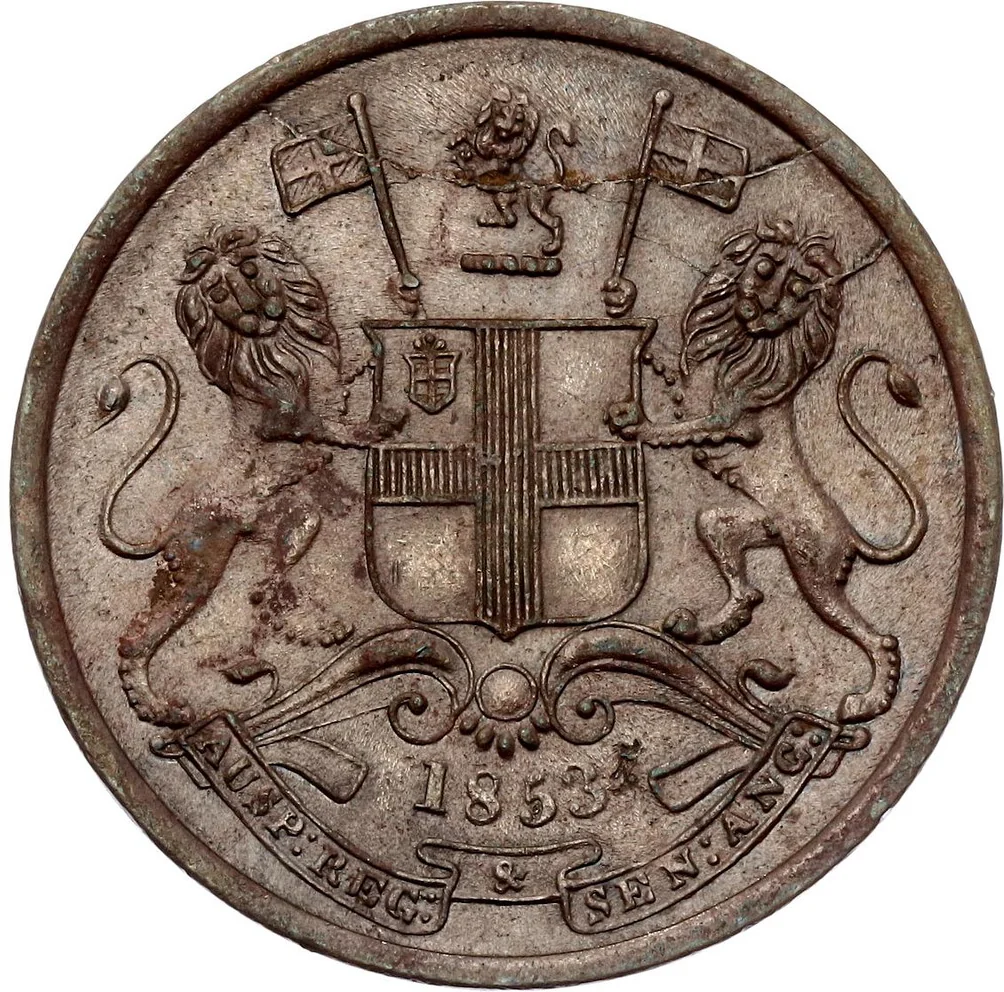
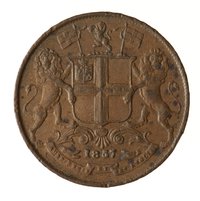
Queen Victoria. East India Company arms (two lions, crest with St George's cross and flags). Motto "AUSP: REG: & SEN: ANG:" on ribbon, date above.
Inscription:
1853
AUSP: REG: & SEN: ANG:
AUSP: REG: & SEN: ANG:
Translation:
Under the Auspices of the King and the Senate of the English.
Script: Latin
Language: Latin
Reverse
Description:
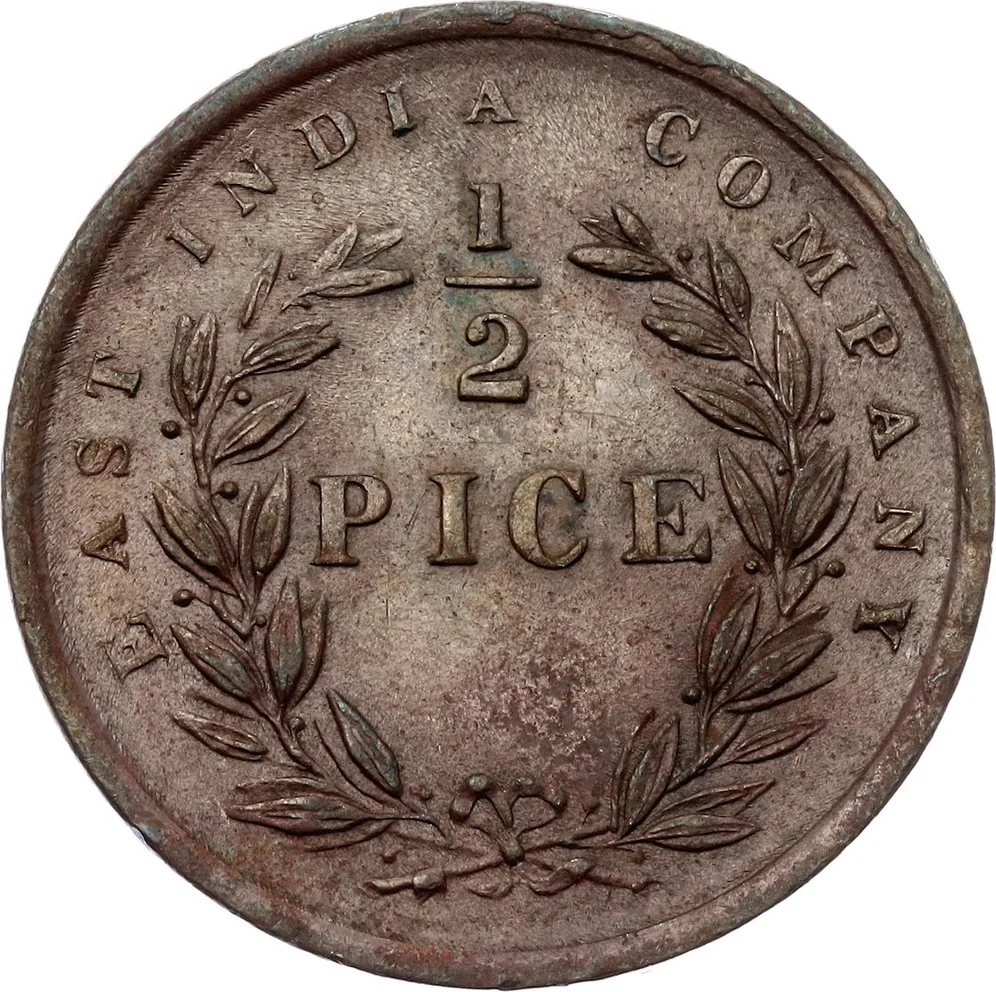
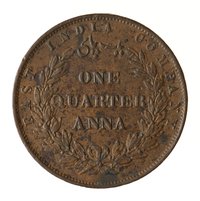
A laurel wreath encircles "1/2 PICE" with "EAST INDIA COMPANY" around a flat raised rim.
Inscription:
EAST INDIA COMPANY
½
PICE
½
PICE
Script: Latin
Edge
Plain
Categories
| Symbols> Coat of Arms |
| Symbol> Wreath |
Mints
| Name | Mark |
|---|---|
| Kolkata / Calcutta / Murshidabad | — |
Mintings
| Year | Mint Mark | Mintage | Quality | Collection |
|---|---|---|---|---|
| 1853 | — | 62,408,583 | ||
| 1853 | — | — | Prooflike | |
| 1853 | — | — | Proof |
Historical background
In 1853, the currency system of British India was a complex and transitional hybrid, reflecting both the remnants of Mughal rule and the impositions of colonial administration. The primary currency in circulation was the silver Rupee, first standardized by the East India Company in 1835 with the portrait of William IV. However, the monetary landscape was far from unified. Alongside Company rupees, various older regional and dynastic coins, such as the Fanam and Pagoda in the south, still circulated locally, creating a chaotic exchange environment. Furthermore, British gold sovereigns and silver shillings also had legal tender status, leading to a bimetallic system prone to instability due to fluctuating gold-silver ratios on the international market.
This period was marked by a critical silver shortage, exacerbated by the global influx of gold from new discoveries in California and Australia. The scarcity of silver bullion strained the minting of rupees, causing economic friction and hampering trade. The colonial government, administering its territories from the Bengal Presidency, struggled with the practical and political challenges of enforcing a uniform currency across a vast subcontinent. The Court of Directors of the East India Company in London actively debated monetary policy, but reforms were slow, leaving a system that was administratively cumbersome and inefficient for a growing colonial economy.
Consequently, 1853 stands as a pivotal year just before major reforms. The Charter Act of 1853 renewed the Company's rule but also intensified pressure for modernizing administration, including currency. The stage was set for the significant changes that would follow, notably the Paper Currency Act of 1861, which established a government monopoly on note issue, and the eventual move towards the Gold Exchange Standard later in the century. Thus, the currency situation in 1853 was one of lingering fragmentation, acute metallic shortage, and mounting pressure for the centralized, regulated system that would define British India's later financial architecture.
This period was marked by a critical silver shortage, exacerbated by the global influx of gold from new discoveries in California and Australia. The scarcity of silver bullion strained the minting of rupees, causing economic friction and hampering trade. The colonial government, administering its territories from the Bengal Presidency, struggled with the practical and political challenges of enforcing a uniform currency across a vast subcontinent. The Court of Directors of the East India Company in London actively debated monetary policy, but reforms were slow, leaving a system that was administratively cumbersome and inefficient for a growing colonial economy.
Consequently, 1853 stands as a pivotal year just before major reforms. The Charter Act of 1853 renewed the Company's rule but also intensified pressure for modernizing administration, including currency. The stage was set for the significant changes that would follow, notably the Paper Currency Act of 1861, which established a government monopoly on note issue, and the eventual move towards the Gold Exchange Standard later in the century. Thus, the currency situation in 1853 was one of lingering fragmentation, acute metallic shortage, and mounting pressure for the centralized, regulated system that would define British India's later financial architecture.
🌱 Common