

16 Francs – Helvetic Republic
Switzerland
Context
Year: 1800
Country: Switzerland 
Issuer: Helvetic Republic
Period:
(1798—1803)
Currency:
(1798—1803)
Demonetized: Yes
Material
Diameter: 23 mm
Weight: 7.64 g
Gold weight: 6.88 g
Shape: Round
Composition: 90% Gold
Standard: Silver quarter ounce
Magnetic: No
Technique: Milled
Alignment: Coin alignment
flip
References
KM: #Click to copy to clipboardA12
Numista: #23313
Value
Bullion value: $1144.71
Obverse
Description:
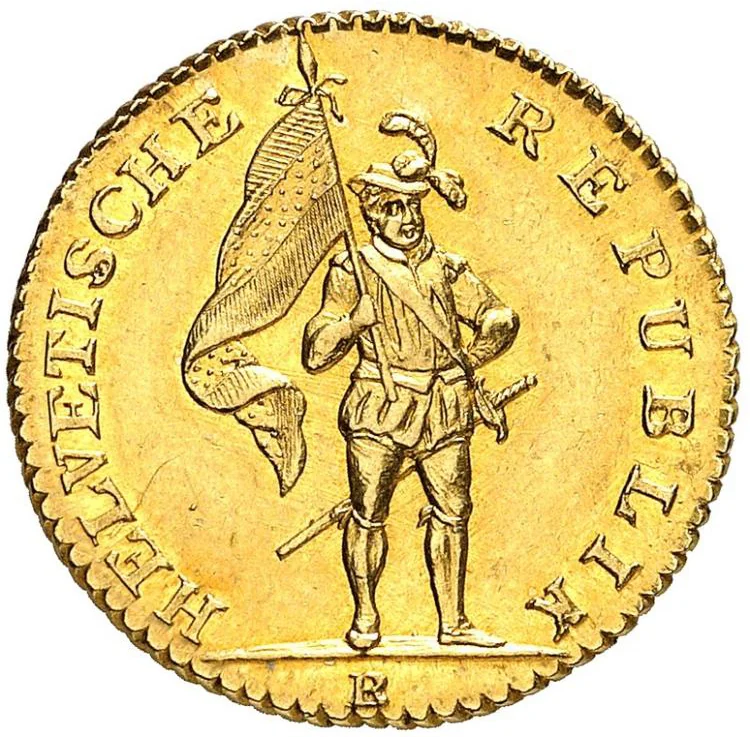
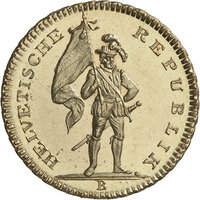
Old Swiss soldier standing, facing right, with feathered hat, flag on shoulder, and sword at hip.
Inscription:
HELVETISCHE REPUBLIK
B
B
Translation:
Helvetic Republic
Script: Latin
Language: German
Engraver: Johann Franz Huber
Reverse
Description:
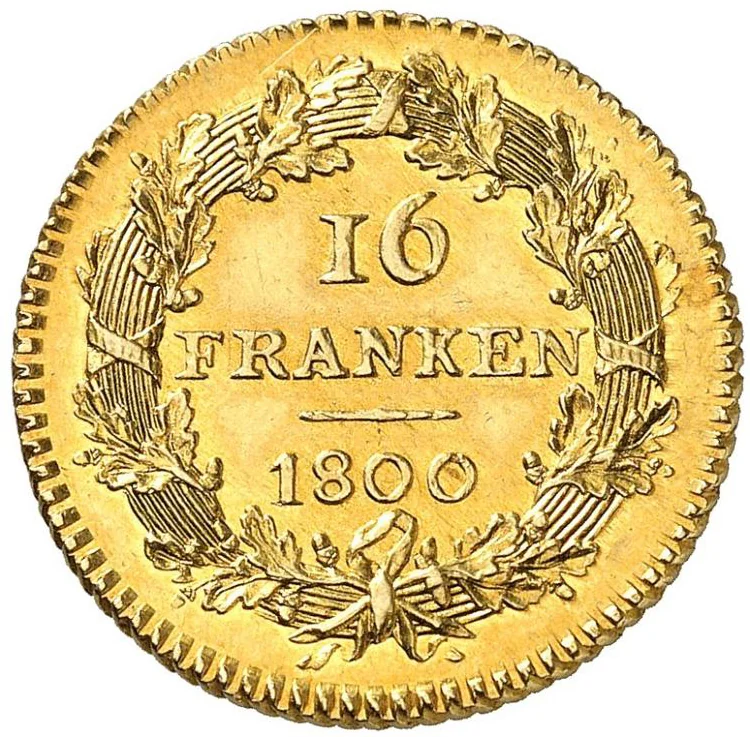
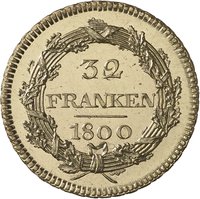
Oak leaf wreath, ribbon below. Value centered, date beneath.
Inscription:
16
FRANKEN
⸻
1800
FRANKEN
⸻
1800
Translation:
FRANKEN
1800
1800
Script: Latin
Language: German
Engraver: Johann Franz Huber
Edge
Mints
| Name | Mark |
|---|---|
| Bern | B |
Mintings
| Year | Mint Mark | Mintage | Quality | Collection |
|---|---|---|---|---|
| 1800 | B | — |
Historical background
In 1800, the Helvetic Republic, a French client state established in 1798, faced profound monetary chaos. The new regime inherited a fragmented system from the Old Swiss Confederation, where each canton and even many cities and monasteries had issued their own coins. This patchwork of over 800 different circulating coins, alongside a flood of foreign currency, created a dysfunctional and confusing economic environment that hindered trade and central administration. The revolutionary government's urgent need to fund itself and pay French occupation costs led to severe inflationary pressures, exacerbating the crisis.
The central authorities in Bern recognized that a unified, decimal-based currency was essential for national cohesion and economic modernization, following the French model. In 1799, they passed a law introducing the Franc of the Helvetic Republic, divided into 10 batzen and 100 rappen, aiming to replace all former cantonal issues. However, the political instability of the republic—racked by internal rebellion, French military demands, and financial exhaustion—severely undermined this effort. The state lacked the bullion reserves and public confidence to successfully launch and enforce the new currency on a national scale.
Consequently, by 1800, the monetary situation was one of theoretical reform clashing with harsh reality. The old thalers, kreutzers, and French livres continued to circulate widely, while the new Helvetic franc struggled to gain acceptance. This period represents a critical, albeit failed, transition—the first attempt at a modern, unified Swiss currency, a goal that would not be fully realized until the establishment of the Swiss Federal State and the Bundesmünze (federal coinage) decades later in 1850.
The central authorities in Bern recognized that a unified, decimal-based currency was essential for national cohesion and economic modernization, following the French model. In 1799, they passed a law introducing the Franc of the Helvetic Republic, divided into 10 batzen and 100 rappen, aiming to replace all former cantonal issues. However, the political instability of the republic—racked by internal rebellion, French military demands, and financial exhaustion—severely undermined this effort. The state lacked the bullion reserves and public confidence to successfully launch and enforce the new currency on a national scale.
Consequently, by 1800, the monetary situation was one of theoretical reform clashing with harsh reality. The old thalers, kreutzers, and French livres continued to circulate widely, while the new Helvetic franc struggled to gain acceptance. This period represents a critical, albeit failed, transition—the first attempt at a modern, unified Swiss currency, a goal that would not be fully realized until the establishment of the Swiss Federal State and the Bundesmünze (federal coinage) decades later in 1850.
✨ Legendary