

20 cents – New Zealand
Add to wishlist
New Zealand
Context
Years: 1967–1985
Issuer: New Zealand
Ruler: Elizabeth II
Currency:
(since 1967)
Demonetization: 1 November 2006
Total mintage: 101,661,010
Material
Diameter: 28.58 mm
Weight: 11.31 g
Thickness: 2.22 mm
Shape: Round
Composition: Copper-nickel
Technique: Milled
Alignment: Medal alignment
flip
References
KM: #
Numista: #2331
Value
Exchange value: 0.20 NZD
Inflation-adjusted value: 4.43 NZD
Obverse
Description:
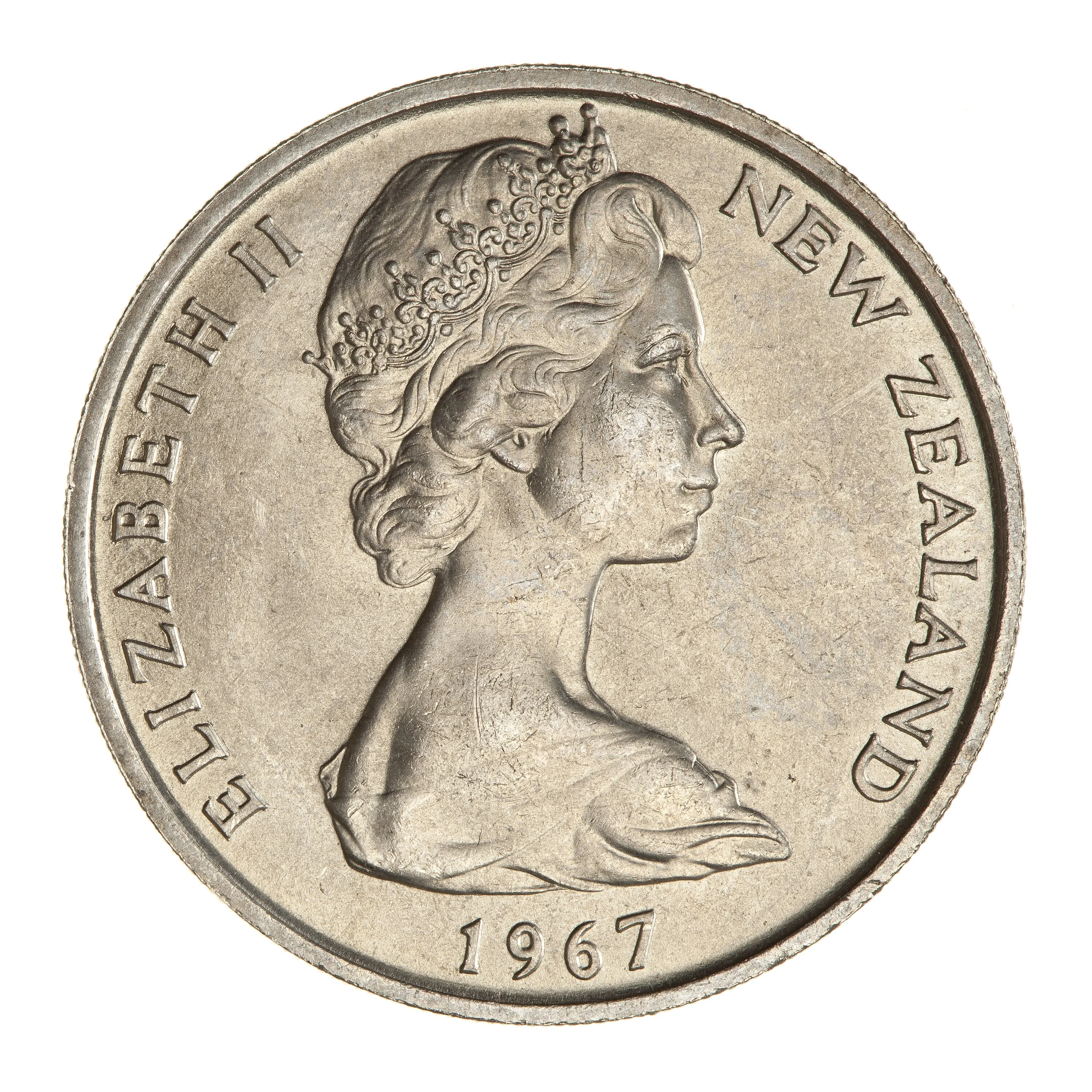
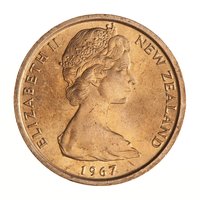
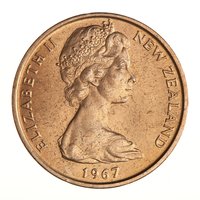
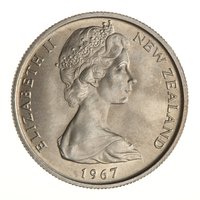
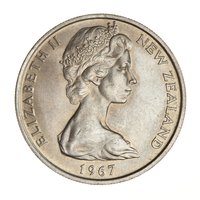
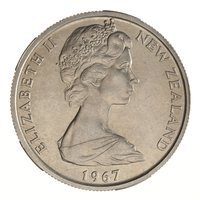
Second crowned portrait of Queen Elizabeth II, wearing the Girls of Great Britain and Ireland tiara, with legend around and date below.
Inscription:
ELIZABETH II NEW ZEALAND
1973
1973
Script: Latin
Designer: Arnold Machin
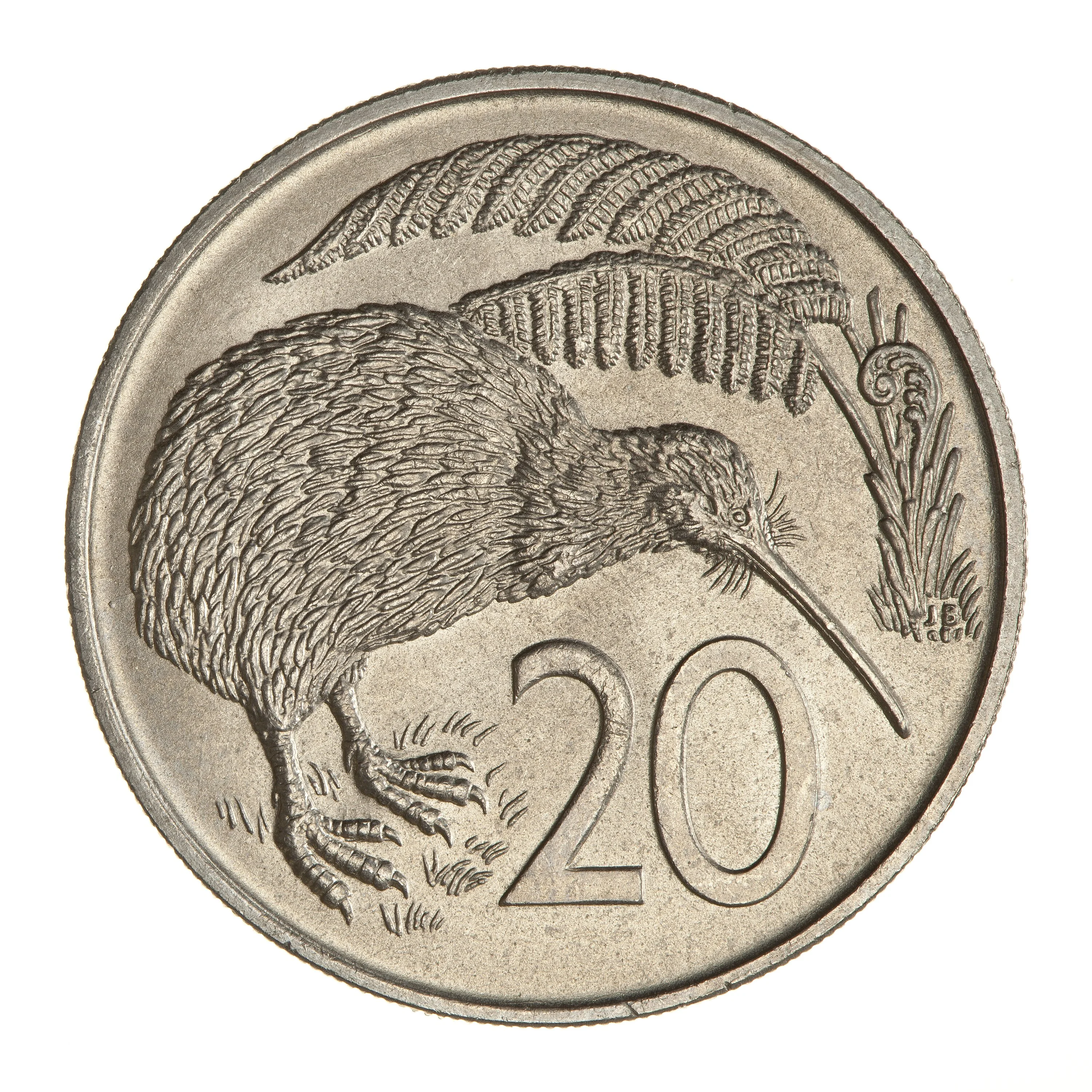
Reverse
Edge
Reeded
Mints
| Name | Mark |
|---|---|
| Royal Australian Mint | — |
| Royal Canadian Mint of Ottawa | — |
| Royal Mint | — |
Mintings
| Year | Mint Mark | Mintage | Quality | Collection |
|---|---|---|---|---|
| 1967 | — | 50,000 | BU | |
| 1967 | — | 10 | Proof | |
| 1967 | — | 13,000,000 | ||
| 1968 | — | 40,000 | BU | |
| 1968 | — | 35,000 | ||
| 1969 | — | 50,000 | BU | |
| 1969 | — | 2,500,000 | ||
| 1970 | — | 30,000 | ||
| 1970 | — | 20,000 | BU | |
| 1971 | — | 15,000 | BU | |
| 1971 | — | 1,600,000 | ||
| 1971 | — | 5,000 | Proof | |
| 1972 | — | 15,000 | BU | |
| 1972 | — | 1,539,000 | ||
| 1972 | — | 8,000 | Proof | |
| 1973 | — | 15,000 | BU | |
| 1973 | — | 3,074,000 | ||
| 1973 | — | 8,000 | Proof | |
| 1974 | — | 15,000 | BU | |
| 1974 | — | 4,558,000 | ||
| 1974 | — | 8,000 | Proof | |
| 1975 | — | 15,000 | BU | |
| 1975 | — | 5,025,000 | ||
| 1975 | — | 12,000 | Proof | |
| 1976 | — | 16,000 | BU | |
| 1976 | — | 7,527,000 | ||
| 1976 | — | 11,000 | Proof | |
| 1977 | — | 20,000 | BU | |
| 1977 | — | 7,532,000 | ||
| 1977 | — | 12,000 | Proof | |
| 1978 | — | 23,000 | BU | |
| 1978 | — | 2,538,000 | ||
| 1978 | — | 15,000 | Proof | |
| 1979 | — | 25,000 | BU | |
| 1979 | — | 8,041,000 | ||
| 1979 | — | 16,000 | Proof | |
| 1980 | — | 27,000 | BU | |
| 1980 | — | 9,000,000 | ||
| 1980 | — | 17,000 | Proof | |
| 1981 | — | 25,000 | BU | |
| 1981 | — | 7,500,000 | ||
| 1981 | — | 18,000 | Proof | |
| 1982 | — | 25,000 | BU | |
| 1982 | — | 17,500,000 | ||
| 1982 | — | 18,000 | Proof | |
| 1983 | — | 25,000 | BU | |
| 1983 | — | 2,500,000 | ||
| 1983 | — | 18,000 | Proof | |
| 1984 | — | 25,000 | BU | |
| 1984 | — | 18,000 | Proof | |
| 1984 | — | 1,500,000 | ||
| 1985 | — | 20,000 | BU | |
| 1985 | — | 12,000 | Proof | |
| 1985 | — | 6,000,000 |
Historical background
In 1967, New Zealand underwent a significant and symbolic economic transformation by decimalising its currency. For over a century, the nation had used the British-style system of pounds, shillings, and pence (£sd), which was increasingly seen as cumbersome and out of step with international trading partners. The change to a decimal system, where 100 cents equalled one dollar, was driven by a desire for simplicity, modernity, and efficiency in both everyday commerce and the growing computerisation of business and banking. The transition, planned for years under the name "Decimal Currency Board," was officially dubbed "Changeover Day" and set for July 10, 1967.
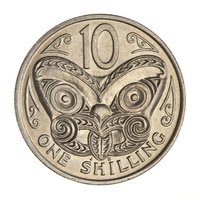
The new currency was named the "New Zealand dollar" to assert a distinct national identity, moving away from the colonial association with the pound sterling. The government introduced a series of new coins and notes, famously featuring native birds and Māori iconography, with the iconic ten-cent piece bearing the carved tiki becoming a lasting symbol. A public education campaign, led by a cartoon kiwi character named "Decimal Dan," was launched to help citizens adapt, using the straightforward conversion where one pound equalled two dollars, making a shilling equal to ten cents.
The 1967 changeover was executed smoothly and was largely welcomed by the public and business community. It coincided with a broader period of economic reorientation, as Britain's entry into the European Economic Community prompted New Zealand to seek new markets, reinforcing the dollar as a symbol of independent economic management. While the decimalisation itself was a logistical success, the new dollar was almost immediately devalued by 19.45% in November 1967 due to a balance of payments crisis, a separate but defining economic event that marked the currency's challenging early years on the global stage.
The new currency was named the "New Zealand dollar" to assert a distinct national identity, moving away from the colonial association with the pound sterling. The government introduced a series of new coins and notes, famously featuring native birds and Māori iconography, with the iconic ten-cent piece bearing the carved tiki becoming a lasting symbol. A public education campaign, led by a cartoon kiwi character named "Decimal Dan," was launched to help citizens adapt, using the straightforward conversion where one pound equalled two dollars, making a shilling equal to ten cents.
The 1967 changeover was executed smoothly and was largely welcomed by the public and business community. It coincided with a broader period of economic reorientation, as Britain's entry into the European Economic Community prompted New Zealand to seek new markets, reinforcing the dollar as a symbol of independent economic management. While the decimalisation itself was a logistical success, the new dollar was almost immediately devalued by 19.45% in November 1967 due to a balance of payments crisis, a separate but defining economic event that marked the currency's challenging early years on the global stage.
🌱 Very Common