

1 cent – Mauritius
Add to wishlist
Mauritius
Context
Years: 1953–1978
Issuer: Mauritius
Ruler: Elizabeth II
Currency:
(since 1835)
Demonetized: Yes
Total mintage: 10,903,750
Material
References
KM: #
Numista: #2326
Value
Exchange value: 0.01 MUR
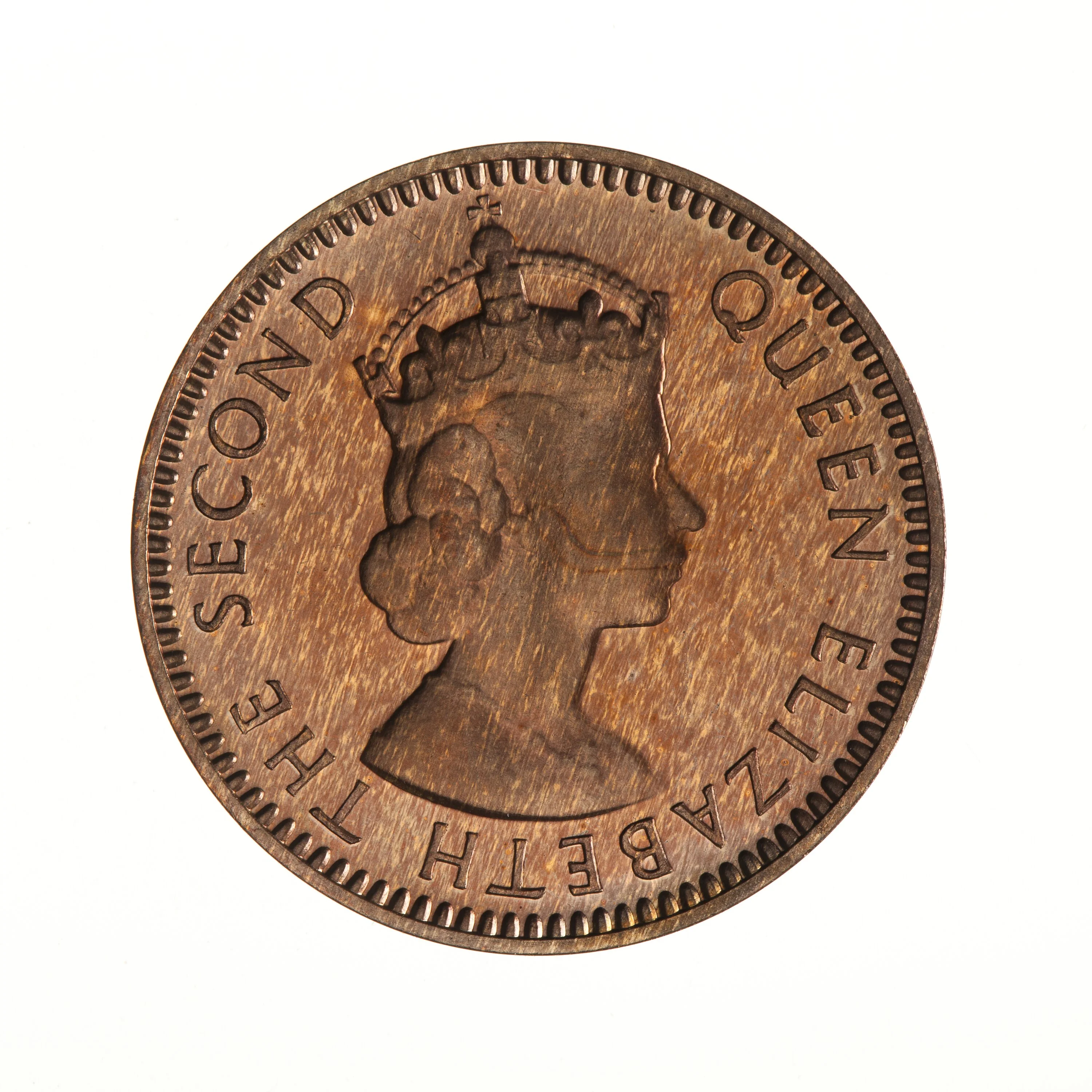
Obverse
Description:
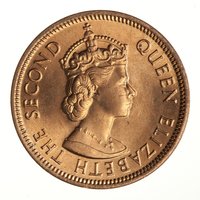
Young Elizabeth II facing right.
Inscription:
QUEEN ELIZABETH THE SECOND
Script: Latin
Engraver: Cecil Thomas
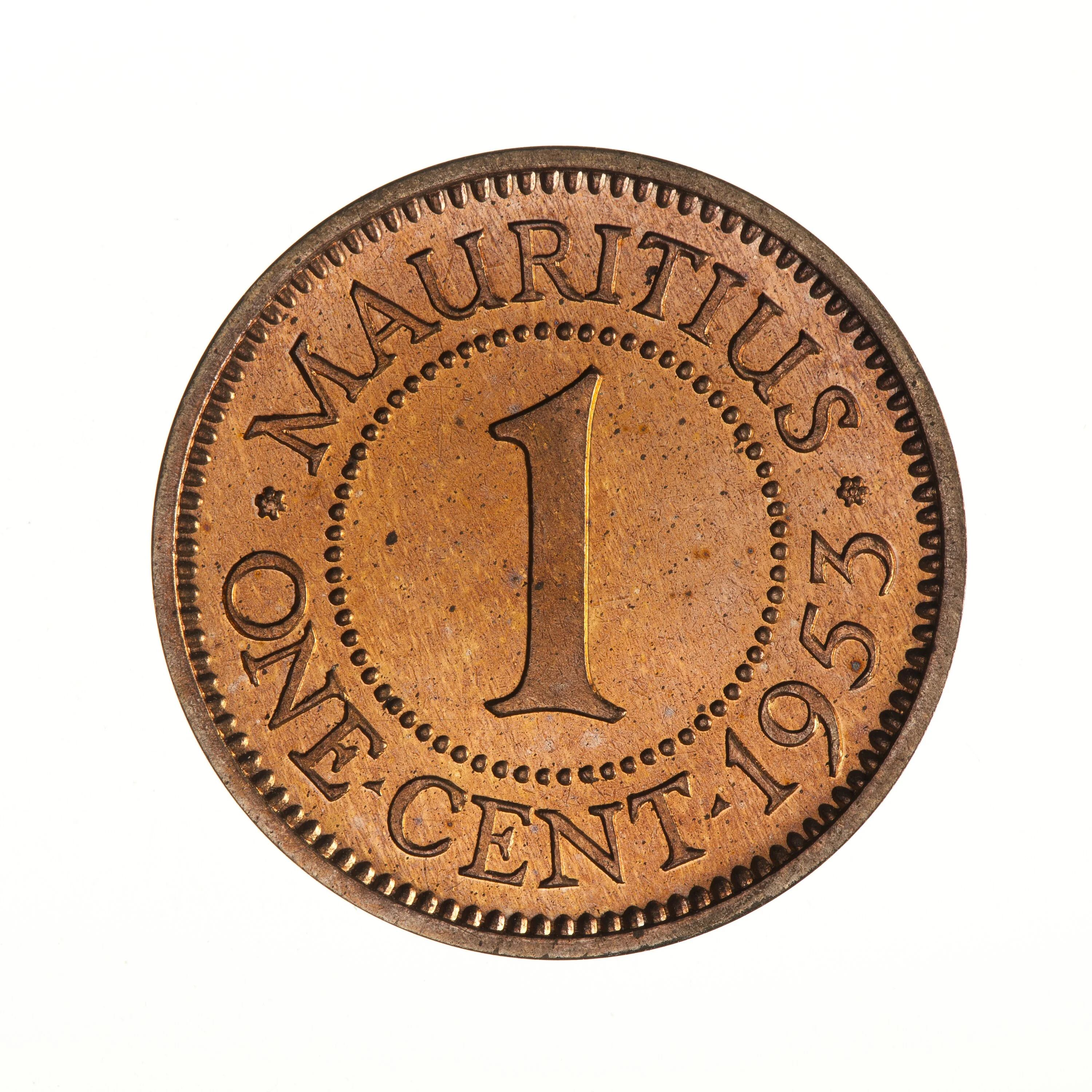
Reverse
Edge
Plain
Mints
| Name | Mark |
|---|---|
| Royal Mint (Tower Hill) | — |
| Royal Mint | — |
Mintings
| Year | Mint Mark | Mintage | Quality | Collection |
|---|---|---|---|---|
| 1953 | — | 500,000 | ||
| 1953 | — | — | Proof | |
| 1955 | — | 501,000 | ||
| 1955 | — | — | Proof | |
| 1956 | — | 500,000 | ||
| 1956 | — | — | Proof | |
| 1957 | — | 501,000 | ||
| 1959 | — | 501,000 | ||
| 1959 | — | — | Proof | |
| 1960 | — | 500,000 | ||
| 1960 | — | — | Proof | |
| 1961 | — | 500,000 | ||
| 1961 | — | — | Proof | |
| 1962 | — | 500,000 | ||
| 1962 | — | — | Proof | |
| 1963 | — | 500,000 | ||
| 1963 | — | — | Proof | |
| 1964 | — | 1,500,000 | ||
| 1964 | — | — | Proof | |
| 1965 | — | 1,500,000 | ||
| 1969 | — | 500,000 | ||
| 1970 | — | 1,500,000 | ||
| 1971 | — | 1,000,000 | ||
| 1971 | — | 750 | Proof | |
| 1975 | — | 400,000 | ||
| 1978 | — | — |
Historical background
In 1953, Mauritius was a British Crown Colony, and its currency situation was firmly integrated into the Sterling Area. The official currency was the Mauritian Rupee (MUR), but its value and issuance were directly managed by the Mauritius Currency Board, established in 1934. This board operated on a strict colonial currency board model, holding sterling reserves in London to fully back the local currency in circulation. For every Mauritian rupee issued, there was an equivalent holding of British pounds sterling, ensuring convertibility at a fixed, official rate.
The fixed exchange rate in 1953 was pegged at 1 Mauritian Rupee = 1 shilling and 6 pence sterling (or 13.33 rupees to £1). This peg provided stability for trade, which was overwhelmingly oriented toward the United Kingdom, particularly the vital sugar exports. However, the system also meant Mauritius had no independent monetary policy; its money supply was essentially determined by its balance of payments with Britain and the Sterling Area. The colony's economic fortunes, therefore, were directly influenced by the price of sugar in London and the broader health of the British economy.
This period represented the latter years of a rigid colonial monetary framework. While it offered predictability, it also highlighted the island's limited economic autonomy. The system would remain largely unchanged until the late 1960s, when the approach of independence prompted the establishment of a central bank in 1967, marking the beginning of a more independent monetary policy for the soon-to-be sovereign nation.
The fixed exchange rate in 1953 was pegged at 1 Mauritian Rupee = 1 shilling and 6 pence sterling (or 13.33 rupees to £1). This peg provided stability for trade, which was overwhelmingly oriented toward the United Kingdom, particularly the vital sugar exports. However, the system also meant Mauritius had no independent monetary policy; its money supply was essentially determined by its balance of payments with Britain and the Sterling Area. The colony's economic fortunes, therefore, were directly influenced by the price of sugar in London and the broader health of the British economy.
This period represented the latter years of a rigid colonial monetary framework. While it offered predictability, it also highlighted the island's limited economic autonomy. The system would remain largely unchanged until the late 1960s, when the approach of independence prompted the establishment of a central bank in 1967, marking the beginning of a more independent monetary policy for the soon-to-be sovereign nation.
🌱 Very Common