

10 dollars – United States
Add to wishlist
United States
Context
Years: 1908–1933
Issuer: United States
Period:
(since 1776)
Currency:
(since 1785)
Total mintage: 14,385,833
Material
References
KM: #
Numista: #23124
Value
Exchange value: 10 USD = $10.00
Bullion value: $2308.62
Obverse
Description:
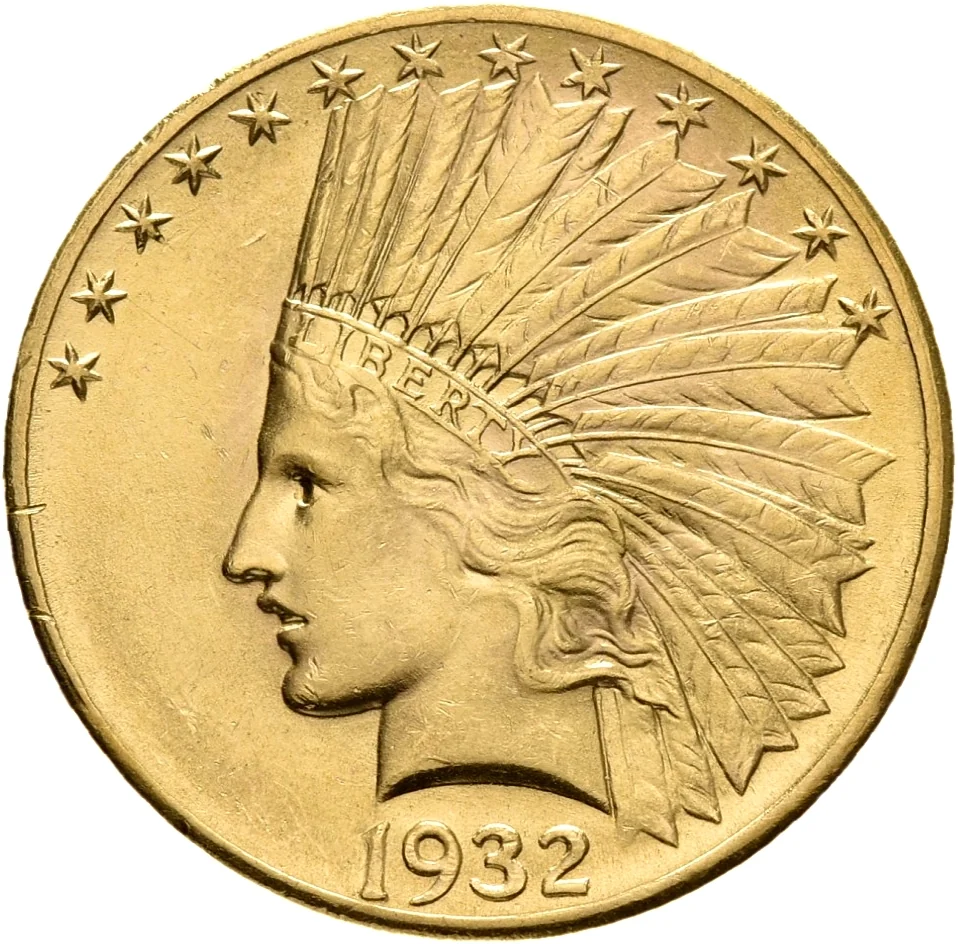
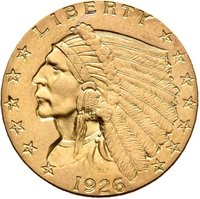
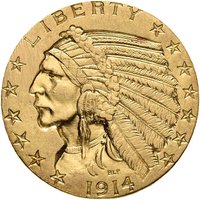
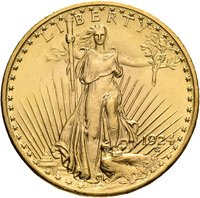
Indian head in feathered headdress, date below, 13 stars above.
Inscription:
LIBERTY
1908
1908
Script: Latin
Engraver: Augustus Saint-Gaudens
Reverse
Description:
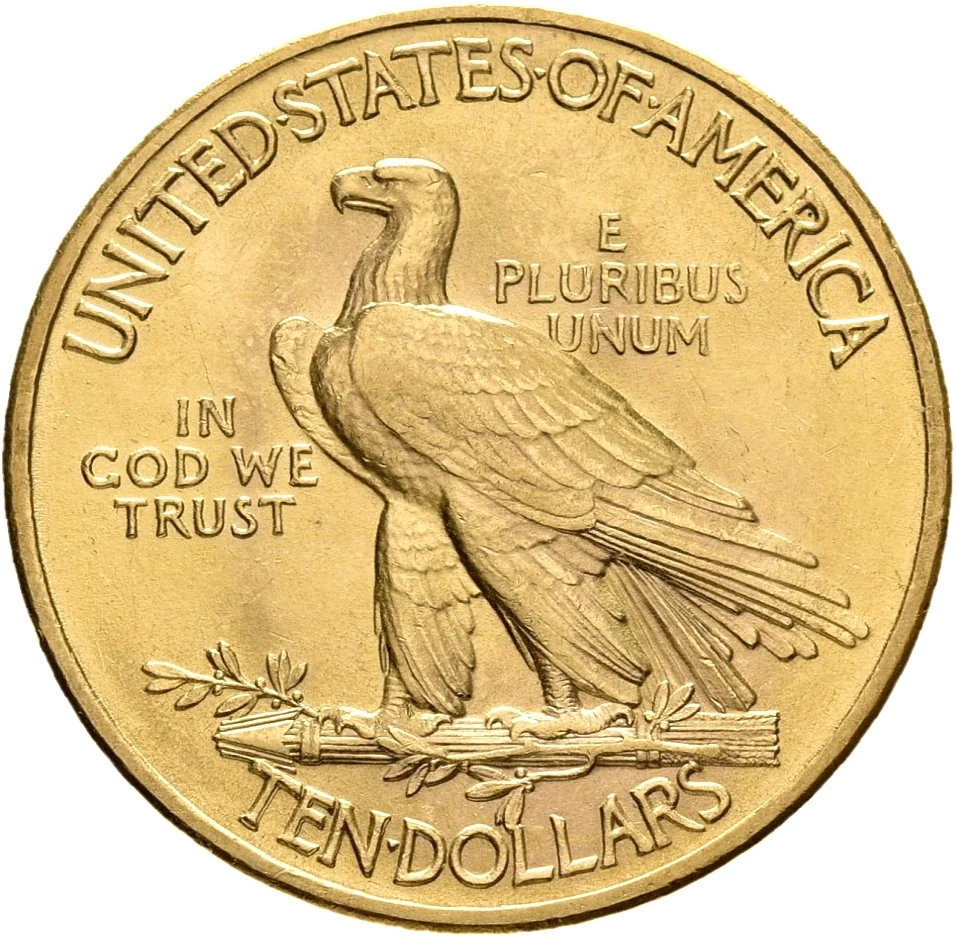
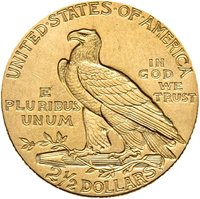
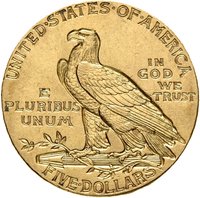
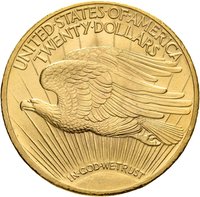
An eagle left, clutching arrows and olive branches, with motto at left.
Inscription:
UNITED·STATES·OF·AMERICA
E
PLURIBUS
UNUM
IN
GOD WE
TRUST
TEN·DOLLARS
E
PLURIBUS
UNUM
IN
GOD WE
TRUST
TEN·DOLLARS
Script: Latin
Engraver: Augustus Saint-Gaudens
Edge
1908-1911 46 raised stars1912-1933 48 raised stars
Categories
| Animal> Bird> Eagle |
| Object> Cold weapons |
Mints
| Name | Mark |
|---|---|
| United States Mint of Philadelphia | — |
| United States Mint of Denver | D |
| United States Mint of San Francisco | S |
Mintings
| Year | Mint Mark | Mintage | Quality | Collection |
|---|---|---|---|---|
| 1908 | — | — | Proof | |
| 1908 | D | 836,500 | ||
| 1908 | — | 341,370 | ||
| 1908 | — | 116 | Matte | |
| 1908 | S | 59,850 | ||
| 1909 | — | 184,789 | ||
| 1909 | — | — | Matte | |
| 1909 | — | — | Proof | |
| 1909 | D | 121,540 | ||
| 1909 | S | 292,350 | ||
| 1910 | D | 2,356,640 | ||
| 1910 | S | 811,000 | ||
| 1910 | — | 318,500 | ||
| 1910 | — | 204 | Proof | |
| 1911 | S | 51,000 | ||
| 1911 | — | 505,500 | ||
| 1911 | — | 95 | Proof | |
| 1911 | D | 30,100 | ||
| 1912 | — | 405,000 | ||
| 1912 | — | 83 | Proof | |
| 1912 | S | 300,000 | ||
| 1913 | — | 442,000 | ||
| 1913 | — | 71 | Proof | |
| 1913 | S | 66,000 | ||
| 1914 | — | 151,000 | ||
| 1914 | — | 50 | Proof | |
| 1914 | D | 343,500 | ||
| 1914 | S | 208,000 | ||
| 1915 | S | 59,000 | ||
| 1915 | — | 351,000 | ||
| 1915 | — | 75 | Proof | |
| 1916 | S | 138,500 | ||
| 1920 | S | 126,500 | ||
| 1926 | — | 1,014,000 | ||
| 1930 | S | 96,000 | ||
| 1932 | — | 4,463,000 | ||
| 1933 | — | 312,500 |
Historical background
In 1908, the United States operated under the Gold Standard Act of 1900, which officially established gold as the sole basis for redeeming paper currency. This meant the value of the dollar was fixed to a specific quantity of gold, and U.S. notes (like Silver Certificates and Gold Certificates) could be exchanged for the precious metal upon demand. However, the monetary system was complex and fragmented, consisting of national banknotes (issued by private banks but backed by government bonds), gold and silver coins, and the lingering existence of Civil War-era "greenbacks" (United States Notes). This lack of a unified, elastic currency was seen as a major weakness, particularly in times of financial stress when the money supply could not easily expand to meet demand.
The period was dominated by the aftermath of the Panic of 1907, a severe financial crisis that exposed critical flaws in the system. The panic, triggered by a failed speculative attempt to corner the stock of United Copper, led to a cascade of bank runs and a severe liquidity crunch. The crisis was only halted through the coordinated efforts of private financiers, most notably J.P. Morgan, who pooled resources to bail out failing institutions. This event starkly demonstrated the absence of a central authority capable of acting as a "lender of last resort" to stabilize the banking system and provide an elastic currency that could expand and contract with the needs of the economy.
Consequently, 1908 was a year of intense political and financial debate focused on reform. In direct response to the panic, Congress passed the Aldrich-Vreeland Act in May 1908. This temporary measure allowed groups of banks to issue emergency currency backed by non-government assets during crises, providing a short-term fix. More importantly, the act established the National Monetary Commission, chaired by Senator Nelson Aldrich, to study global banking systems and propose long-term solutions. The Commission's extensive work over the next few years would lay the direct groundwork for the creation of the Federal Reserve System in 1913, marking the end of the unstable era highlighted by the 1908 currency situation.
The period was dominated by the aftermath of the Panic of 1907, a severe financial crisis that exposed critical flaws in the system. The panic, triggered by a failed speculative attempt to corner the stock of United Copper, led to a cascade of bank runs and a severe liquidity crunch. The crisis was only halted through the coordinated efforts of private financiers, most notably J.P. Morgan, who pooled resources to bail out failing institutions. This event starkly demonstrated the absence of a central authority capable of acting as a "lender of last resort" to stabilize the banking system and provide an elastic currency that could expand and contract with the needs of the economy.
Consequently, 1908 was a year of intense political and financial debate focused on reform. In direct response to the panic, Congress passed the Aldrich-Vreeland Act in May 1908. This temporary measure allowed groups of banks to issue emergency currency backed by non-government assets during crises, providing a short-term fix. More importantly, the act established the National Monetary Commission, chaired by Senator Nelson Aldrich, to study global banking systems and propose long-term solutions. The Commission's extensive work over the next few years would lay the direct groundwork for the creation of the Federal Reserve System in 1913, marking the end of the unstable era highlighted by the 1908 currency situation.
🌱 Fairly Common