

3 dollars – United States
Add to wishlist
United States
Context
Years: 1854–1889
Issuer: United States
Period:
(since 1776)
Currency:
(since 1785)
Total mintage: 539,955
Material
References
KM: #
Numista: #23121
Value
Exchange value: 3 USD = $3.00
Bullion value: $693.62
Obverse
Description:
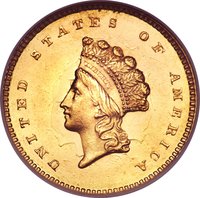
Indian princess facing left, feathered crown.
Inscription:
UNITED STATES OF AMERICA
LIBERTY
LIBERTY
Script: Latin
Engraver: James Barton Longacre
Reverse
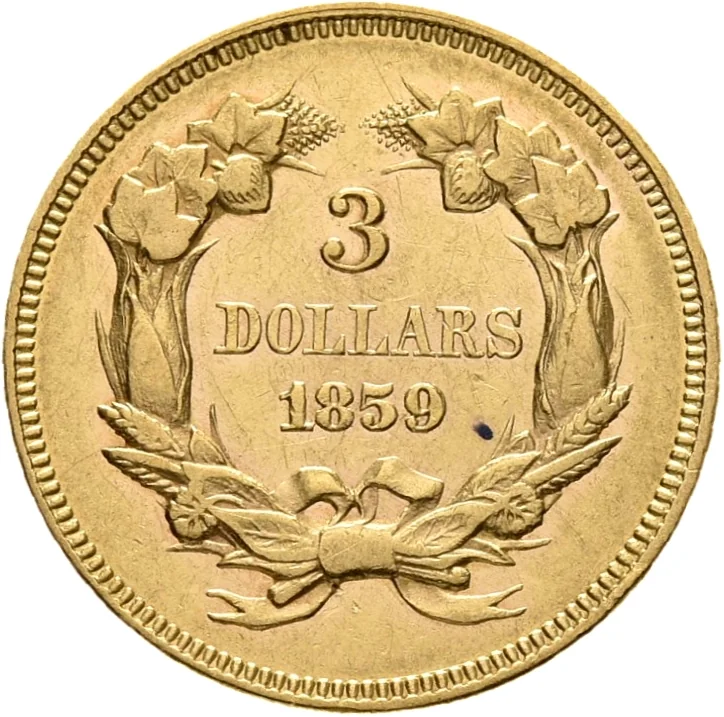
Description:
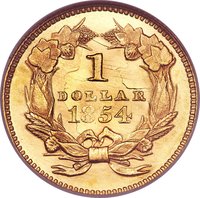
Denomination and date encircled by tobacco, wheat, corn, and cotton.
Inscription:
3
DOLLARS
1878
DOLLARS
1878
Script: Latin
Engraver: James Barton Longacre
Edge
Reeded
Mints
| Name | Mark |
|---|---|
| United States Mint of Philadelphia | — |
| United States Mint of Dahlonega | D |
| United States Mint of New Orleans | O |
| United States Mint of San Francisco | S |
Mintings
| Year | Mint Mark | Mintage | Quality | Collection |
|---|---|---|---|---|
| 1854 | — | 138,618 | ||
| 1854 | D | 1,120 | ||
| 1854 | O | 24,000 | ||
| 1854 | — | 15 | Proof | |
| 1855 | — | 50,555 | ||
| 1855 | — | 5 | Proof | |
| 1855 | S | 6,600 | ||
| 1856 | — | 26,010 | ||
| 1856 | — | 5 | Proof | |
| 1856 | S | 34,500 | ||
| 1857 | — | 20,891 | ||
| 1857 | — | 5 | Proof | |
| 1857 | S | 14,000 | ||
| 1858 | — | 2,133 | ||
| 1858 | — | 15 | Proof | |
| 1859 | — | 15,558 | ||
| 1859 | — | 80 | Proof | |
| 1860 | S | 7,000 | ||
| 1860 | — | 7,036 | ||
| 1860 | — | 119 | Proof | |
| 1861 | — | 113 | Proof | |
| 1861 | — | 5,959 | ||
| 1862 | — | 5,750 | ||
| 1862 | — | 35 | Proof | |
| 1863 | — | 5,000 | ||
| 1863 | — | 39 | Proof | |
| 1864 | — | 2,630 | ||
| 1864 | — | 50 | Proof | |
| 1865 | — | 1,165 | ||
| 1865 | — | 25 | Proof | |
| 1866 | — | 4,000 | ||
| 1866 | — | 30 | Proof | |
| 1867 | — | 2,600 | ||
| 1867 | — | 50 | Proof | |
| 1868 | — | 4,850 | ||
| 1868 | — | 25 | Proof | |
| 1869 | — | 2,500 | ||
| 1869 | — | 25 | Proof | |
| 1870 | — | 3,500 | ||
| 1870 | — | 35 | Proof | |
| 1870 | S | 1 | ||
| 1871 | — | 1,300 | ||
| 1871 | — | 30 | Proof | |
| 1872 | — | 2,000 | ||
| 1872 | — | 30 | Proof | |
| 1873 | — | — | ||
| 1873 | — | 8 | Proof | |
| 1874 | — | 41,820 | ||
| 1874 | — | 20 | Proof | |
| 1875 | — | 20 | Proof | |
| 1876 | — | 45 | Proof | |
| 1877 | — | 1,468 | ||
| 1877 | — | 20 | Proof | |
| 1878 | — | 82,304 | ||
| 1878 | — | 20 | Proof | |
| 1879 | — | 3,000 | ||
| 1879 | — | 30 | Proof | |
| 1880 | — | 1,000 | ||
| 1880 | — | 36 | Proof | |
| 1881 | — | 500 | ||
| 1881 | — | 54 | Proof | |
| 1882 | — | 1,500 | ||
| 1882 | — | 76 | Proof | |
| 1883 | — | 900 | ||
| 1883 | — | 89 | Proof | |
| 1884 | — | 106 | Proof | |
| 1884 | — | 1,000 | ||
| 1885 | — | 800 | ||
| 1885 | — | 110 | Proof | |
| 1886 | — | 142 | Proof | |
| 1886 | — | 1,000 | ||
| 1887 | — | 6,000 | ||
| 1887 | — | 160 | Proof | |
| 1888 | — | 5,000 | ||
| 1888 | — | 291 | Proof | |
| 1889 | — | 2,300 | ||
| 1889 | — | 129 | Proof |
Historical background
In 1854, the United States operated under a complex and fragmented monetary system, a legacy of the Jacksonian era's destruction of the Second Bank of the United States. The federal government coined gold and silver, but the vast majority of money in circulation consisted of paper banknotes issued by hundreds of state-chartered private banks. These notes were of wildly varying reliability, often trading below their face value depending on the perceived solvency of the issuing bank, creating a landscape of financial uncertainty for everyday transactions and interstate commerce. While the Independent Treasury Act of 1846 had established a federal system to handle government funds without using private banks, it did nothing to regulate the broader currency supply, leaving the economy dependent on this unstable patchwork of private paper.
The period was also defined by a de facto shift toward the gold standard. The discovery of vast gold in California after 1848 dramatically increased the nation's gold supply, driving down the market value of gold relative to silver. This triggered the unintended consequence of Gresham's Law: cheaper gold flooded into the U.S. Mint for coinage, while more valuable silver coins were hoarded or exported. As a result, full-weight silver coins, like the Spanish dollar and later the U.S. silver dollar, largely disappeared from circulation, pushing the nation toward a single-metal gold standard in practice, though bimetallism remained the official law.
Politically, the currency question was deeply entwined with the sectional tensions that would lead to the Civil War. Northern commercial interests and Whigs (and later Republicans) generally advocated for a stronger federal role in banking and a uniform national currency to facilitate business and industrialization. In contrast, Southern agrarians and Jacksonian Democrats largely opposed centralized banking power, preferring a decentralized system with easy credit. The legislative battles over a national bank had failed, but the pressures of a growing national economy made the existing system increasingly untenable, setting the stage for the National Banking Acts that would emerge during the Civil War a decade later.
The period was also defined by a de facto shift toward the gold standard. The discovery of vast gold in California after 1848 dramatically increased the nation's gold supply, driving down the market value of gold relative to silver. This triggered the unintended consequence of Gresham's Law: cheaper gold flooded into the U.S. Mint for coinage, while more valuable silver coins were hoarded or exported. As a result, full-weight silver coins, like the Spanish dollar and later the U.S. silver dollar, largely disappeared from circulation, pushing the nation toward a single-metal gold standard in practice, though bimetallism remained the official law.
Politically, the currency question was deeply entwined with the sectional tensions that would lead to the Civil War. Northern commercial interests and Whigs (and later Republicans) generally advocated for a stronger federal role in banking and a uniform national currency to facilitate business and industrialization. In contrast, Southern agrarians and Jacksonian Democrats largely opposed centralized banking power, preferring a decentralized system with easy credit. The legislative battles over a national bank had failed, but the pressures of a growing national economy made the existing system increasingly untenable, setting the stage for the National Banking Acts that would emerge during the Civil War a decade later.

⭐ Somewhat Rare