

1 dollar – United States
Add to wishlist
United States
Context
Years: 1856–1889
Issuer: United States
Period:
(since 1776)
Currency:
(since 1785)
Total mintage: 3,572,630
Material
References
KM: #
Numista: #23120
Value
Exchange value: 1 USD = $1.00
Bullion value: $230.59
Obverse
Description:
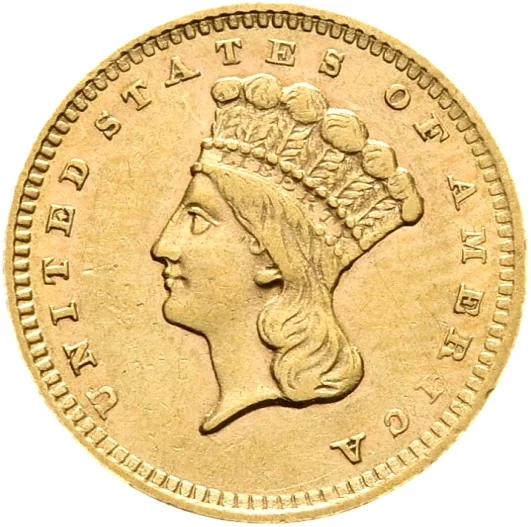
Indian head facing left in headdress.
Inscription:
UNITED STATES OF AMERICA
LIBERTY
LIBERTY
Script: Latin
Engraver: James Barton Longacre
Reverse
Description:
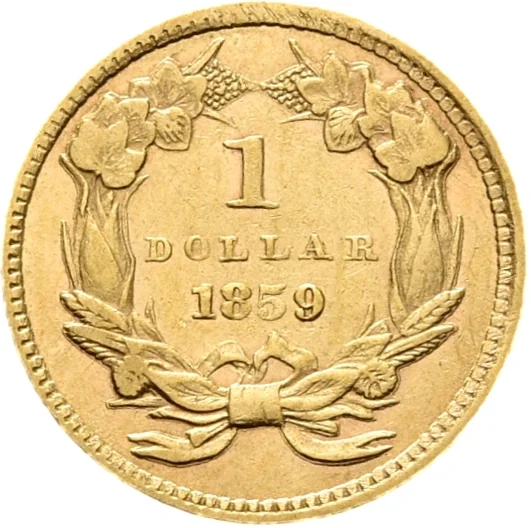
Valued, dated wreath.
Inscription:
1
DOLLAR
1880
DOLLAR
1880
Script: Latin
Engraver: James Barton Longacre
Edge
Reeded
Mints
| Name | Mark |
|---|---|
| United States Mint of Philadelphia | — |
| United States Mint of Charlotte | C |
| United States Mint of Dahlonega | D |
| United States Mint of San Francisco | S |
Mintings
| Year | Mint Mark | Mintage | Quality | Collection |
|---|---|---|---|---|
| 1856 | — | — | ||
| 1856 | — | 10 | Proof | |
| 1856 | D | 1,460 | ||
| 1857 | — | 774,789 | ||
| 1857 | — | 12 | Proof | |
| 1857 | C | 13,280 | ||
| 1857 | D | 3,533 | ||
| 1857 | S | 10,000 | ||
| 1858 | — | 117,995 | ||
| 1858 | — | 20 | Proof | |
| 1858 | D | 3,477 | ||
| 1858 | S | 10,000 | ||
| 1859 | — | 168,244 | ||
| 1859 | — | 80 | Proof | |
| 1859 | C | 5,235 | ||
| 1859 | D | 4,952 | ||
| 1859 | S | 15,000 | ||
| 1860 | — | 36,514 | ||
| 1860 | — | 154 | Proof | |
| 1860 | D | 1,566 | ||
| 1860 | S | 13,000 | ||
| 1861 | D | 1,250 | ||
| 1861 | — | 527,150 | ||
| 1861 | — | 349 | Proof | |
| 1862 | — | 1,361,355 | ||
| 1862 | — | 35 | Proof | |
| 1863 | — | 6,200 | ||
| 1863 | — | 50 | Proof | |
| 1864 | — | 5,900 | ||
| 1864 | — | 50 | Proof | |
| 1865 | — | 25 | Proof | |
| 1865 | — | 3,700 | ||
| 1866 | — | 7,100 | ||
| 1866 | — | 30 | Proof | |
| 1867 | — | 5,200 | ||
| 1867 | — | 50 | Proof | |
| 1868 | — | 10,500 | ||
| 1868 | — | 25 | Proof | |
| 1869 | — | 5,900 | ||
| 1869 | — | 25 | Proof | |
| 1870 | — | 6,300 | ||
| 1870 | — | 35 | Proof | |
| 1870 | S | 3,000 | ||
| 1871 | — | 3,900 | ||
| 1871 | — | 30 | Proof | |
| 1872 | — | 3,500 | ||
| 1872 | — | 30 | Proof | |
| 1873 | — | 25 | Proof | |
| 1873 | — | 123,300 | ||
| 1874 | — | 198,800 | ||
| 1874 | — | 20 | Proof | |
| 1875 | — | 20 | Proof | |
| 1875 | — | 400 | ||
| 1876 | — | 3,200 | ||
| 1876 | — | 45 | Proof | |
| 1877 | — | 20 | Proof | |
| 1877 | — | 3,900 | ||
| 1878 | — | 20 | Proof | |
| 1878 | — | 3,000 | ||
| 1879 | — | 3,000 | ||
| 1879 | — | 30 | Proof | |
| 1880 | — | 36 | Proof | |
| 1880 | — | 1,600 | ||
| 1881 | — | 87 | Proof | |
| 1881 | — | 7,620 | ||
| 1882 | — | 5,000 | ||
| 1882 | — | 125 | Proof | |
| 1883 | — | 10,800 | ||
| 1883 | — | 207 | Proof | |
| 1884 | — | 5,230 | ||
| 1884 | — | 1,006 | Proof | |
| 1885 | — | 11,156 | ||
| 1885 | — | 1,105 | Proof | |
| 1886 | — | 5,000 | ||
| 1886 | — | 1,016 | Proof | |
| 1887 | — | 1,043 | Proof | |
| 1887 | — | 7,500 | ||
| 1888 | — | 15,501 | ||
| 1888 | — | 1,079 | Proof | |
| 1889 | — | 28,950 | ||
| 1889 | — | 1,779 | Proof |
Historical background
In 1856, the United States operated under a complex and often chaotic monetary system that lacked a uniform national currency. The federal government minted gold and silver coins, but paper money was primarily issued by hundreds of state-chartered private banks. These "state bank notes" were supposed to be redeemable for specie (gold or silver) on demand, but their value and acceptance varied wildly based on the perceived solvency of the issuing bank. This led to a confusing patchwork of money, with notes often trading at a discount far from their home state, and counterfeiting was rampant. The absence of a federal paper currency and a central banking authority, following the dissolution of the Second Bank of the United States in 1836, created significant instability for commerce and trade.
The period was also defined by intense political conflict over the nation's monetary base, centered on the "Free Silver" debate. The Coinage Act of 1834 had effectively established a gold standard by undervaluing silver, driving it out of circulation. By 1856, the economy was primarily fueled by gold, especially following major discoveries in California. However, agrarian and debtor interests, particularly in the South and West, advocated for the free coinage of silver at a ratio that would bring it back into circulation, increasing the money supply to ease credit and raise prices. This clash between the "hard money" gold advocates and the "soft money" silver and paper proponents was a fundamental divide in American politics.
Furthermore, the currency question was inextricably linked to the deepening sectional crisis over slavery and westward expansion. The financial policies favored by Northern industrialists, who wanted a stable, gold-backed currency for long-term investment and international trade, often conflicted with those of Southern planters, who relied on easy credit and inflationary paper to finance agricultural operations. As the nation moved toward the Civil War, the debate over what constituted legitimate money reflected the broader struggle over economic power and the future direction of the country, setting the stage for the radical financial transformations of the 1860s.
The period was also defined by intense political conflict over the nation's monetary base, centered on the "Free Silver" debate. The Coinage Act of 1834 had effectively established a gold standard by undervaluing silver, driving it out of circulation. By 1856, the economy was primarily fueled by gold, especially following major discoveries in California. However, agrarian and debtor interests, particularly in the South and West, advocated for the free coinage of silver at a ratio that would bring it back into circulation, increasing the money supply to ease credit and raise prices. This clash between the "hard money" gold advocates and the "soft money" silver and paper proponents was a fundamental divide in American politics.
Furthermore, the currency question was inextricably linked to the deepening sectional crisis over slavery and westward expansion. The financial policies favored by Northern industrialists, who wanted a stable, gold-backed currency for long-term investment and international trade, often conflicted with those of Southern planters, who relied on easy credit and inflationary paper to finance agricultural operations. As the nation moved toward the Civil War, the debate over what constituted legitimate money reflected the broader struggle over economic power and the future direction of the country, setting the stage for the radical financial transformations of the 1860s.
🌱 Fairly Common