

1 piastre – Lebanon
Add to wishlist
Lebanon
Context
Years: 1925–1936
Issuer: Lebanon
Period:
(1926—1945)
Currency:
(1920—1939)
Demonetized: Yes
Total mintage: 4,500,000
Material
Diameter: 24 mm
Weight: 5 g
Thickness: 1.55 mm
Shape: Round with a round hole
Composition: Copper-nickel
Technique: Milled
Alignment: Coin alignment
flip
References
KM: #
Numista: #2312
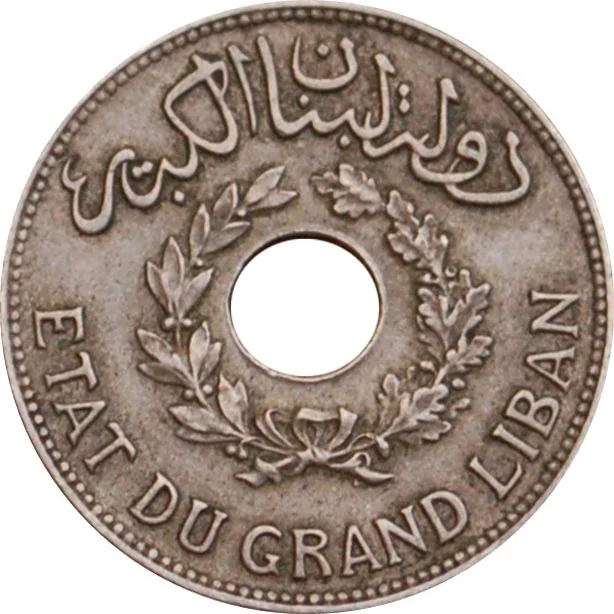
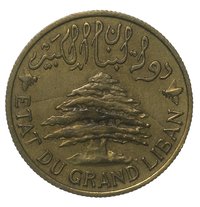
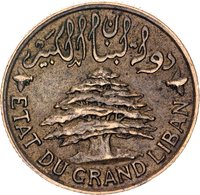
Obverse
Description:
Wreath with central opening
Inscription:
دولة لبنان الكبير
ETAT DU GRAND LIBAN
ETAT DU GRAND LIBAN
Translation:
The State of Greater Lebanon
The State of Greater Lebanon
The State of Greater Lebanon
Engravers: Lucien Georges Bazor, Henri-Auguste Patey
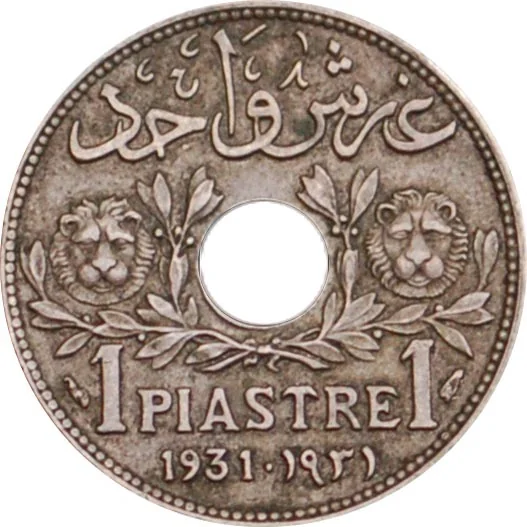
Reverse
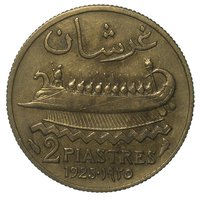
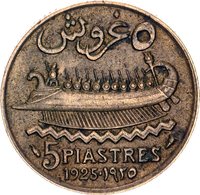
Description:
Central hole flanked by lion heads, value and dates beneath.
Inscription:
غرش واحد
1 PIASTRE 1
1931-١٩٣١
1 PIASTRE 1
1931-١٩٣١
Translation:
One Piastre One
1931-1931
1931-1931
Engraver: Lucien Georges Bazor
Edge
Plain
Mints
| Name | Mark |
|---|---|
| Monnaie de Paris | — |
Mintings
| Year | Mint Mark | Mintage | Quality | Collection |
|---|---|---|---|---|
| 1925 | — | 1,500,000 | ||
| 1931 | — | 300,000 | ||
| 1933 | — | 500,000 | ||
| 1936 | — | 2,200,000 |
Historical background
In 1925, Lebanon was operating under a complex and transitional currency system as a French Mandate territory. The Ottoman Empire's collapse after World War I had left a legacy of depreciated paper money, but by the mid-1920s, the region was moving toward monetary stability under French administration. The official currency was the Syrian-Lebanese pound (also known as the livre), issued by the Banque de Syrie et du Liban, a French concessionary bank established in 1919. This currency was pegged to the French franc at a fixed rate, firmly integrating Lebanon's economy into the French monetary zone.
The currency situation was characterized by a duality in circulation. While the new banknotes and coins of the Syrian-Lebanese pound were the legal tender, older Ottoman gold liras and foreign currencies, particularly the Egyptian pound and British gold sovereigns, remained in widespread use and were trusted by the population for significant transactions and savings. This reflected lingering uncertainties and the practical need for stable, tangible assets in a post-war context. The Banque de Syrie's notes themselves were initially viewed with some public skepticism, requiring time to gain full confidence.
Economically, the fixed peg to the franc provided a period of relative stability for trade and government finance, which facilitated reconstruction and development. However, this system also tied Lebanon's economic fate directly to France's own fiscal policies and the strength of the franc. The year 1925 was particularly notable as it coincided with the Great Syrian Revolt, which caused significant economic disruption and strained public finances. Despite this political turmoil, the currency regime itself remained intact, laying the institutional groundwork for Lebanon's separate monetary identity that would fully emerge after independence.
The currency situation was characterized by a duality in circulation. While the new banknotes and coins of the Syrian-Lebanese pound were the legal tender, older Ottoman gold liras and foreign currencies, particularly the Egyptian pound and British gold sovereigns, remained in widespread use and were trusted by the population for significant transactions and savings. This reflected lingering uncertainties and the practical need for stable, tangible assets in a post-war context. The Banque de Syrie's notes themselves were initially viewed with some public skepticism, requiring time to gain full confidence.
Economically, the fixed peg to the franc provided a period of relative stability for trade and government finance, which facilitated reconstruction and development. However, this system also tied Lebanon's economic fate directly to France's own fiscal policies and the strength of the franc. The year 1925 was particularly notable as it coincided with the Great Syrian Revolt, which caused significant economic disruption and strained public finances. Despite this political turmoil, the currency regime itself remained intact, laying the institutional groundwork for Lebanon's separate monetary identity that would fully emerge after independence.
🌱 Common