

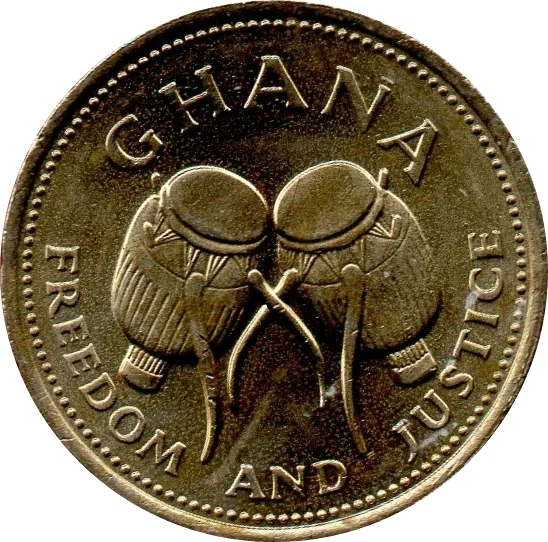
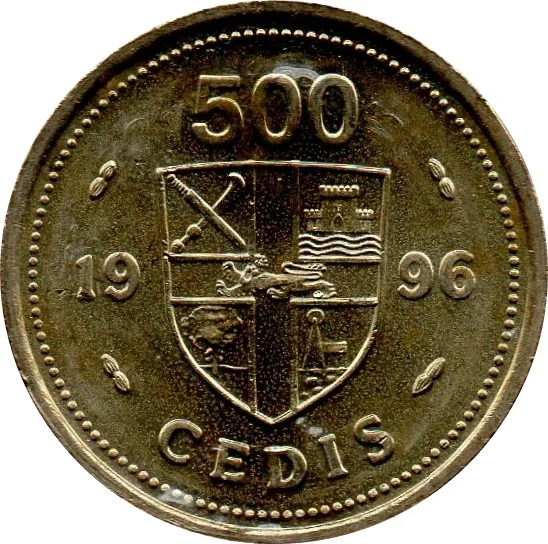
500 cedis – Ghana
Add to wishlist
Ghana
Context
Years: 1996–1998
Issuer: Ghana
Period:
(since 1960)
Currency:
(1967—2007)
Demonetization: 31 December 2007
Material
Diameter: 23.48 mm
Weight: 9.18 g
Thickness: 2.87 mm
Shape: Round
Composition: Nickel brass
Magnetic: No
Technique: Milled
Alignment: Medal alignment
flip
References
KM: #
Numista: #2311
Value
Exchange value: 500 GHC
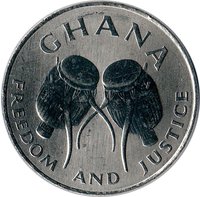
Obverse
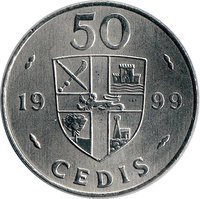
Reverse
Edge
Reeded
Categories
| Symbols> Coat of Arms |
| Object> Cold weapons |
| Animal> Feline |
| Art> Music |
| Building> Castle or fortification |
| Industry |
| Plant> Tree |
Mints
| Name | Mark |
|---|---|
| Royal Canadian Mint of Winnipeg | — |
Mintings
| Year | Mint Mark | Mintage | Quality | Collection |
|---|---|---|---|---|
| 1996 | — | — | ||
| 1998 | — | — |
Historical background
In 1996, Ghana's currency situation was characterized by relative stability under the ongoing Economic Recovery Program (ERP) and Structural Adjustment Program (SAP), but underlying vulnerabilities persisted. The Ghanaian cedi, which had undergone a major redenomination in 1991 (creating the "new cedi"), was managed through a managed float system supervised by the Bank of Ghana. This period followed the turbulent high-inflation decades of the 1970s and 1980s, and the government, under President Jerry Rawlings, maintained a firm commitment to IMF-backed reforms aimed at controlling fiscal deficits and liberalizing the foreign exchange market.
This stability was hard-won and relied heavily on continuous external support and strict discipline. The cedi's value was primarily supported by substantial inflows from international financial institutions, donor aid, and growing revenues from gold and cocoa exports. While the official exchange rate was relatively stable, a significant parallel market for foreign exchange continued to operate, indicating lingering pressures and differences between the official valuation and market perceptions. Inflation, though reduced from earlier hyperinflationary levels, remained a concern, eroding purchasing power and creating tension between maintaining a stable exchange rate and controlling domestic price rises.
Overall, 1996 represented a period of cautious optimism within a fragile framework. The currency regime was a cornerstone of Ghana's macroeconomic credibility for international investors and lenders, yet it remained sensitive to external shocks and dependent on consistent policy adherence. The situation highlighted the transitional challenge of moving from stabilization to sustainable growth, where the managed cedi was both a symbol of progress and a reminder of the economy's ongoing susceptibility to fiscal imbalances and commodity price fluctuations on the global market.
This stability was hard-won and relied heavily on continuous external support and strict discipline. The cedi's value was primarily supported by substantial inflows from international financial institutions, donor aid, and growing revenues from gold and cocoa exports. While the official exchange rate was relatively stable, a significant parallel market for foreign exchange continued to operate, indicating lingering pressures and differences between the official valuation and market perceptions. Inflation, though reduced from earlier hyperinflationary levels, remained a concern, eroding purchasing power and creating tension between maintaining a stable exchange rate and controlling domestic price rises.
Overall, 1996 represented a period of cautious optimism within a fragile framework. The currency regime was a cornerstone of Ghana's macroeconomic credibility for international investors and lenders, yet it remained sensitive to external shocks and dependent on consistent policy adherence. The situation highlighted the transitional challenge of moving from stabilization to sustainable growth, where the managed cedi was both a symbol of progress and a reminder of the economy's ongoing susceptibility to fiscal imbalances and commodity price fluctuations on the global market.
🌱 Very Common