

5 Lepta – Greece
Greece
Context
Material
References
KM: #Click to copy to clipboard58
Numista: #11004
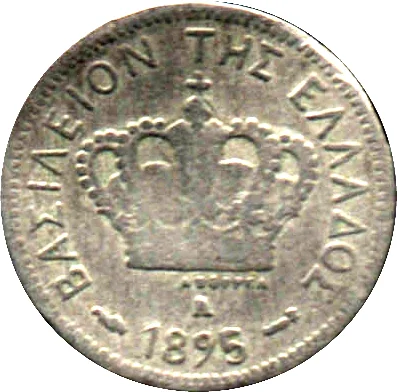
Obverse
Description:
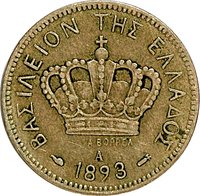
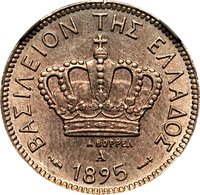
Majestic
Inscription:
ΒΑΣΙΛΕΙΟΝ ΤΗΣ ΕΛΛΑΔΟΣ
1895 A
1895 A
Translation:
KINGDOM OF GREECE
1895 A
1895 A
Script: Greek
Language: Greek
Engraver: Alfred Borrel
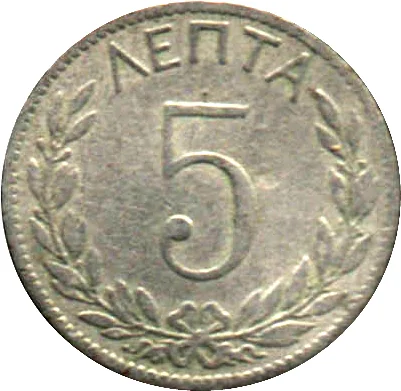
Reverse
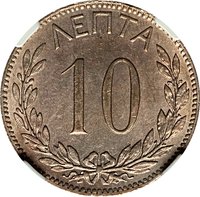
Description:
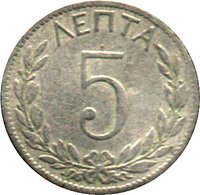
Wreath denomination
Inscription:
ΛΕΠΤΑ 5
Translation:
Five Lepta
Script: Greek
Language: Greek
Engraver: Alfred Borrel
Edge
Plain
Mints
| Name | Mark |
|---|---|
| Monnaie de Paris | (A) |
Mintings
| Year | Mint Mark | Mintage | Quality | Collection |
|---|---|---|---|---|
| 1894 | A | 4,000,000 | ||
| 1895 | A | 4,000,000 |
Historical background
In 1894, Greece found itself in a precarious financial position, burdened by decades of excessive borrowing to fund national ambitions, including territorial expansion and modernization. The state had accumulated a massive public debt, largely denominated in gold-backed foreign currencies, while its economy relied heavily on agriculture and vulnerable exports like currants. A global fall in currant prices severely reduced state revenues, creating chronic budget deficits. Furthermore, Greece was legally bound to the gold standard, but its paper currency, the drachma, suffered from a significant loss of confidence, leading to a stark divergence between its nominal and metallic value. This situation placed immense strain on the treasury's ability to service its foreign obligations.
The immediate crisis was triggered by the collapse of negotiations for a new international loan. Having defaulted on its debt as far back as 1826, Greece was again on the brink. In 1893, Prime Minister Charilaos Trikoupis had been forced to declare a unilateral suspension of payments on the national debt, a move that effectively constituted a sovereign default. By 1894, the consequences were fully manifest: the country was locked out of international capital markets, its credit was ruined, and it faced intense pressure from foreign bondholders, particularly from Germany, where many creditors were based. The government struggled to meet even basic administrative costs, let alone fund essential infrastructure projects.
Consequently, 1894 became a pivotal year of forced intervention. Under threat from its creditors and with no domestic recourse, the Greek government was compelled to accept stringent international financial control. This culminated in the establishment of the International Financial Commission in 1898, but the path was set in 1894-95. The commission would oversee specific state revenues (like customs and monopolies) to ensure debt service, effectively ceding a portion of national fiscal sovereignty. Thus, the currency situation of 1894 was not an isolated event but the acute phase of a long-standing debt crisis that ultimately led to foreign oversight of Greece's finances, a humbling chapter that underscored the perils of fiscal overextension.
The immediate crisis was triggered by the collapse of negotiations for a new international loan. Having defaulted on its debt as far back as 1826, Greece was again on the brink. In 1893, Prime Minister Charilaos Trikoupis had been forced to declare a unilateral suspension of payments on the national debt, a move that effectively constituted a sovereign default. By 1894, the consequences were fully manifest: the country was locked out of international capital markets, its credit was ruined, and it faced intense pressure from foreign bondholders, particularly from Germany, where many creditors were based. The government struggled to meet even basic administrative costs, let alone fund essential infrastructure projects.
Consequently, 1894 became a pivotal year of forced intervention. Under threat from its creditors and with no domestic recourse, the Greek government was compelled to accept stringent international financial control. This culminated in the establishment of the International Financial Commission in 1898, but the path was set in 1894-95. The commission would oversee specific state revenues (like customs and monopolies) to ensure debt service, effectively ceding a portion of national fiscal sovereignty. Thus, the currency situation of 1894 was not an isolated event but the acute phase of a long-standing debt crisis that ultimately led to foreign oversight of Greece's finances, a humbling chapter that underscored the perils of fiscal overextension.
🌱 Common