

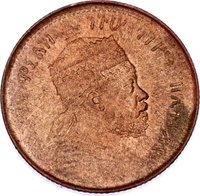
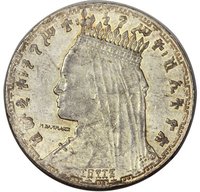
Obverse
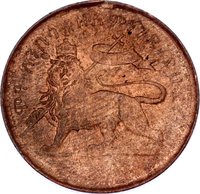
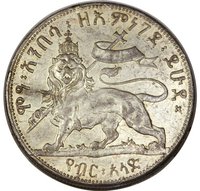
Reverse
Edge
Mintings
| Year | Mint Mark | Mintage | Quality | Collection |
|---|---|---|---|---|
| 1925 | — | — |
Historical background
In 1925, the currency system of the Ethiopian Empire was a complex and fragmented mosaic, reflecting the nation's traditional economy and its cautious engagement with the global financial system. The official currency was the Ethiopian birr (or talari), a silver coin first minted by Emperor Menelik II in 1894. However, its circulation was largely confined to major trade routes, urban centers, and state transactions. Across the vast highlands, the primary mediums of exchange remained Maria Theresa thalers (MT$), imported Austrian silver coins ubiquitous in Red Sea trade since the 18th century, and salt bars (amole), used for local markets and rural transactions. This multi-currency environment created practical challenges for taxation and commerce, requiring constant calculation of exchange rates between silver coinage, salt, and goods.
The monetary landscape was directly managed by the Bank of Abyssinia, a unique institution established in 1905 under a 50-year concession granted to the National Bank of Egypt, which was itself under British control. This arrangement, while providing a modern banking framework, meant Ethiopia did not have a fully sovereign central bank. The Bank of Abyssinia issued banknotes, but they faced public distrust and saw limited circulation beyond Addis Ababa. Consequently, the economy remained heavily reliant on physical silver, both domestic birr and MT$, leading to vulnerabilities tied to the fluctuating global price of silver and the costs of importing bullion.
Politically, this currency situation was a point of national sensitivity for Emperor Haile Selassie (then Regent Ras Tafari), who viewed the foreign-controlled bank as an infringement on Ethiopian sovereignty. By 1925, he was actively laying the groundwork for monetary reform, seeking to phase out the Maria Theresa thaler and strengthen the national birr. His efforts would culminate in 1931 with the liquidation of the Bank of Abyssinia and the founding of the fully state-owned Bank of Ethiopia, a crucial step in modernizing the state's fiscal apparatus and asserting economic independence in the years leading up to the Italian invasion.
The monetary landscape was directly managed by the Bank of Abyssinia, a unique institution established in 1905 under a 50-year concession granted to the National Bank of Egypt, which was itself under British control. This arrangement, while providing a modern banking framework, meant Ethiopia did not have a fully sovereign central bank. The Bank of Abyssinia issued banknotes, but they faced public distrust and saw limited circulation beyond Addis Ababa. Consequently, the economy remained heavily reliant on physical silver, both domestic birr and MT$, leading to vulnerabilities tied to the fluctuating global price of silver and the costs of importing bullion.
Politically, this currency situation was a point of national sensitivity for Emperor Haile Selassie (then Regent Ras Tafari), who viewed the foreign-controlled bank as an infringement on Ethiopian sovereignty. By 1925, he was actively laying the groundwork for monetary reform, seeking to phase out the Maria Theresa thaler and strengthen the national birr. His efforts would culminate in 1931 with the liquidation of the Bank of Abyssinia and the founding of the fully state-owned Bank of Ethiopia, a crucial step in modernizing the state's fiscal apparatus and asserting economic independence in the years leading up to the Italian invasion.
✨ Legendary