

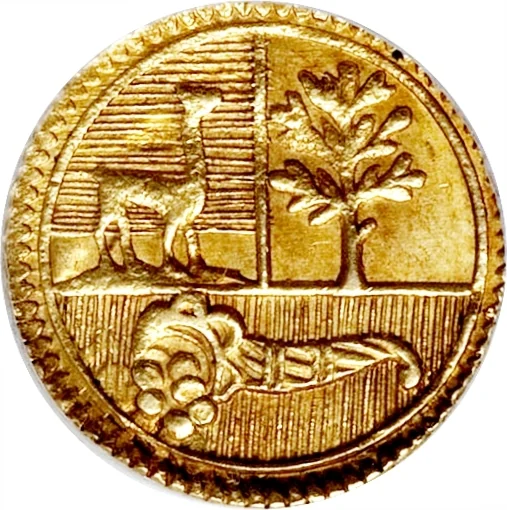
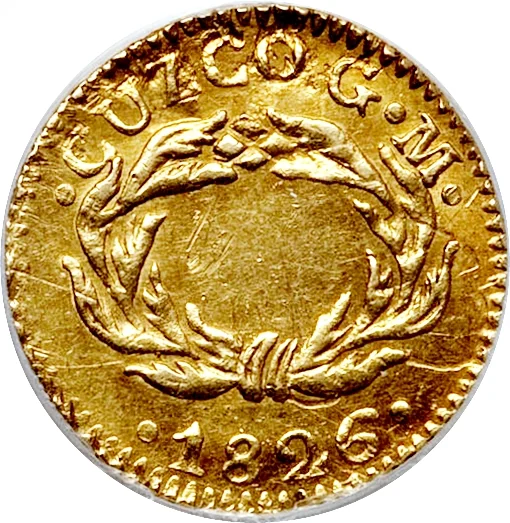
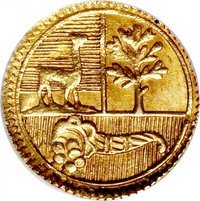
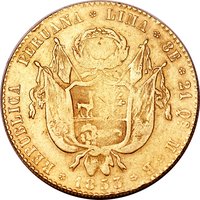
Obverse
Description:
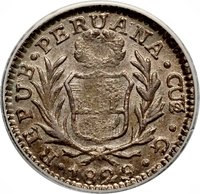
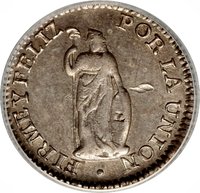
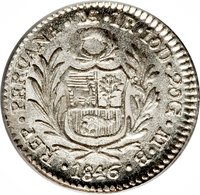
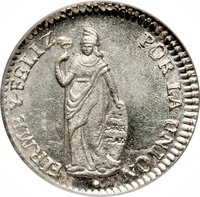
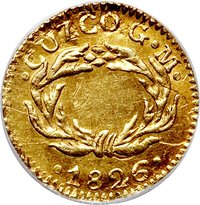
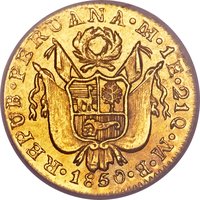
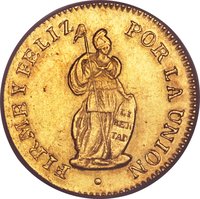
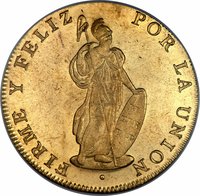
Similar to North Peru KM#159, with a different date.
Reverse
Edge
Chiseled, hand fluted.
Categories
| Plant> Tree |
| Symbol> Cornucopia |
Mints
| Name | Mark |
|---|---|
| Lima | — |
Mintings
| Year | Mint Mark | Mintage | Quality | Collection |
|---|---|---|---|---|
| 1826 | CUZCO | — | ||
| 1826 | LIMA | — | ||
| 1827 | LIMA | — | ||
| 1828 | LIMA | — | ||
| 1829 | LIMA | — | ||
| 1833 | LIMA | — | ||
| 1836 | LIMA | — | ||
| 1839 | LIMA | — | ||
| 1840 | LIMA | — | ||
| 1841 | LIMA | — | ||
| 1842 | LIMA | — | ||
| 1850 | LIMA | — | ||
| 1851 | LIMA | — | ||
| 1856 | LIMA | — |
Historical background
In 1826, Peru was grappling with the profound economic disarray inherited from the Wars of Independence (1820-1824). The conflict had devastated mines, agricultural estates, and trade routes, severely crippling the tax base. The new republic, under the ambitious but short-lived political project of Simón Bolívar (the Bolivarian Constitution), faced an empty treasury and massive debts owed to both domestic creditors and foreign lenders, particularly Britain. The state's primary response was to resort to printing paper money without sufficient backing, leading to a severe devaluation of this currency and a crisis of public confidence.
The monetary landscape was chaotic, characterized by a confusing circulation of multiple coinages. While the official currency was the peso, the economy still relied heavily on Spanish colonial silver coins like reales and pesos fuertes (hard pesos), which held their value far better than the new paper issues. Simultaneously, Bolivarian-era coinage from the Lima mint, often of inferior silver content, circulated alongside British sovereigns and other foreign coins brought by merchants and loan agents. This fragmentation created a dual system: transactions for taxes and international trade demanded scarce silver, while devalued paper money was used for everyday, local commerce, causing inflation and hardship.
Facing this crisis, the government of President Andrés de Santa Cruz attempted a decisive reform in 1826 by authorizing the creation of the Banco de Reserva de la Nación, one of Latin America's first central banks. Its mandate was to stabilize the currency by withdrawing the discredited paper money from circulation and issuing new, convertible notes backed by precious metals. However, the bank's success was immediately undermined by the country's ongoing political instability, persistent fiscal deficits, and lack of substantial silver reserves. Consequently, while 1826 marks a year of recognition of the monetary crisis and an early attempt at modern financial institution-building, the fundamental issues of currency instability and devaluation would plague Peru for decades to come.
The monetary landscape was chaotic, characterized by a confusing circulation of multiple coinages. While the official currency was the peso, the economy still relied heavily on Spanish colonial silver coins like reales and pesos fuertes (hard pesos), which held their value far better than the new paper issues. Simultaneously, Bolivarian-era coinage from the Lima mint, often of inferior silver content, circulated alongside British sovereigns and other foreign coins brought by merchants and loan agents. This fragmentation created a dual system: transactions for taxes and international trade demanded scarce silver, while devalued paper money was used for everyday, local commerce, causing inflation and hardship.
Facing this crisis, the government of President Andrés de Santa Cruz attempted a decisive reform in 1826 by authorizing the creation of the Banco de Reserva de la Nación, one of Latin America's first central banks. Its mandate was to stabilize the currency by withdrawing the discredited paper money from circulation and issuing new, convertible notes backed by precious metals. However, the bank's success was immediately undermined by the country's ongoing political instability, persistent fiscal deficits, and lack of substantial silver reserves. Consequently, while 1826 marks a year of recognition of the monetary crisis and an early attempt at modern financial institution-building, the fundamental issues of currency instability and devaluation would plague Peru for decades to come.
Series: 1826 Peru circulation coins
✨ Legendary