

25 francs – French Equatorial Africa
Add to wishlist
Context
Year: 1958
Country: Central African States
Issuer: French Equatorial Africa
Period:
(1946—1958)
Currency:
(1945—1960)
Demonetized: Yes
Total mintage: 12,000,000
Material
Diameter: 27 mm
Weight: 7.9 g
Thickness: 2 mm
Shape: Round
Composition: Aluminium bronze
Standard: Silver quarter ounce
Magnetic: No
Technique: Milled
Alignment: Coin alignment
flip
References
KM: #
Numista: #2282
Value
Exchange value: 25 FCFA
Obverse
Description:
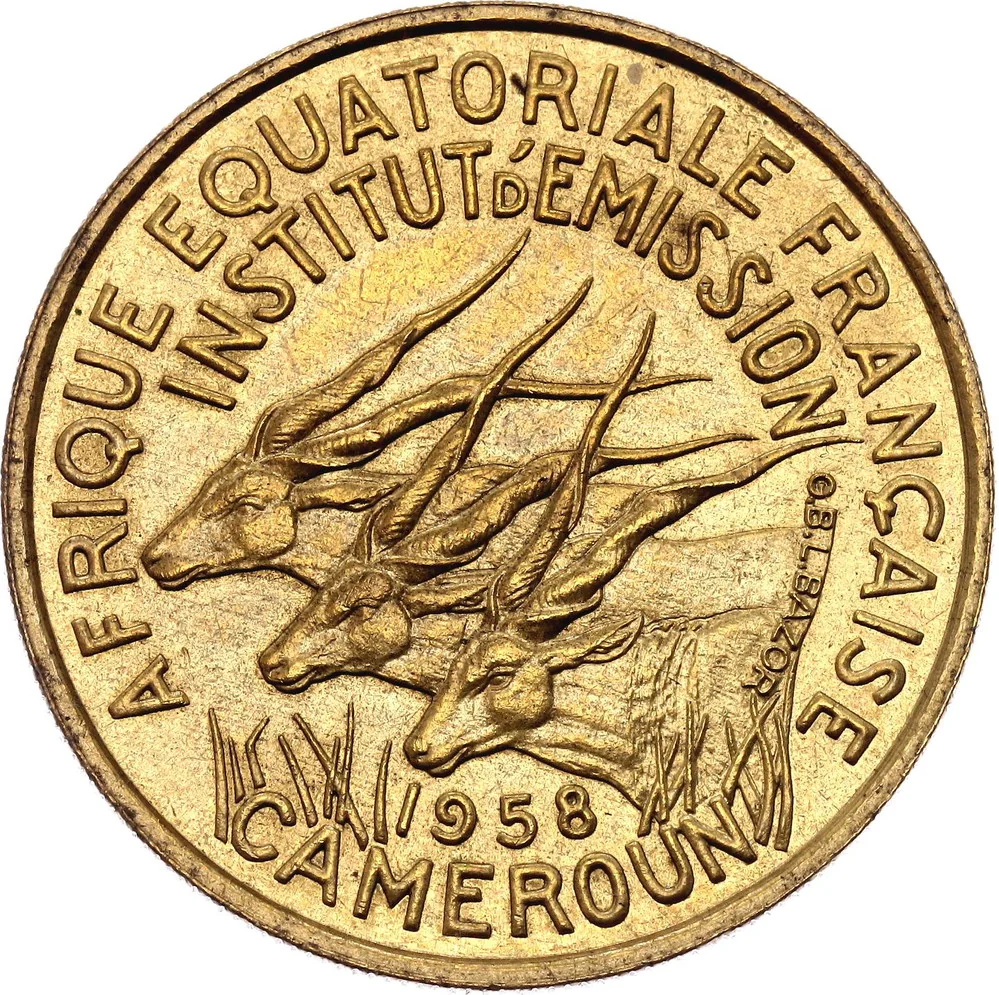
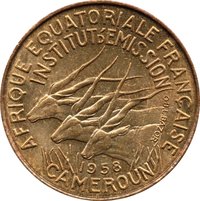
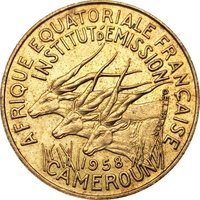
Three giant elands remain.
Inscription:
AFRIQUE EQUATORIALE FRANCAISE
INSTITUT D'EMISSION
G.B.L.BAZOR
1958
CAMEROUN
INSTITUT D'EMISSION
G.B.L.BAZOR
1958
CAMEROUN
Translation:
French Equatorial Africa
Issuing Institute
G.B.L. Bazor
1958
Cameroon
Issuing Institute
G.B.L. Bazor
1958
Cameroon
Script: Latin
Language: French
Engraver: Lucien Georges Bazor
Reverse
Description:
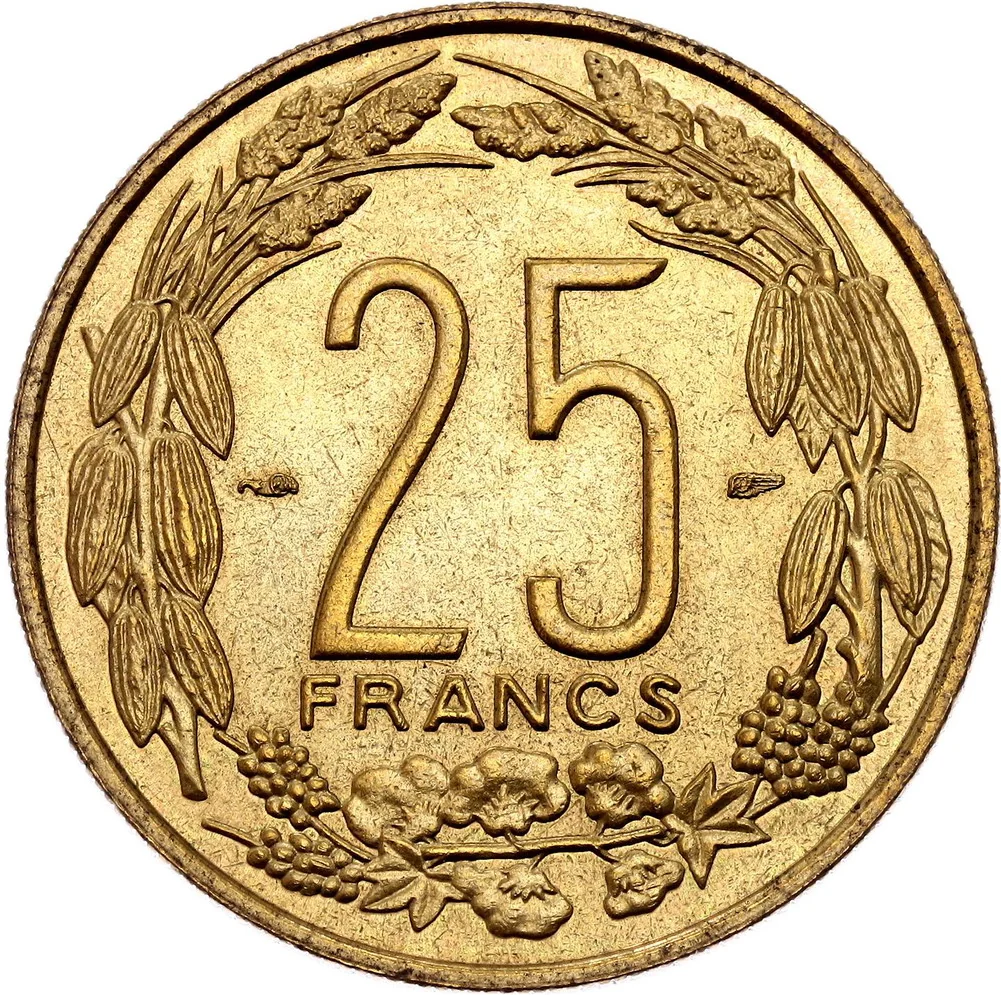
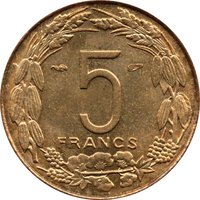
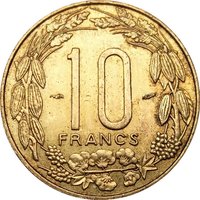
Wreath of major Cameroonian crops: cotton, coffee, cocoa, and grains.
Inscription:
25
FRANCS
FRANCS
Script: Latin
Engraver: Lucien Georges Bazor
Edge
Reeded
Categories
| Symbol> Wreath |
| Agriculture |
| Animal> Deer |
Mints
| Name | Mark |
|---|---|
| Monnaie de Paris | — |
Mintings
| Year | Mint Mark | Mintage | Quality | Collection |
|---|---|---|---|---|
| 1958 | — | 12,000,000 |
Historical background
In 1958, the currency situation in French Equatorial Africa (AEF) was defined by its integration into the Franc Zone and the colonial monetary system. The region used the CFA franc, created in 1945 as the Colonies Françaises d'Afrique franc. Its defining characteristic was a fixed parity and free convertibility with the French franc, guaranteed by the French Treasury. This arrangement provided monetary stability and facilitated trade with France, but it also meant monetary policy was entirely directed from Paris, with the AEF's foreign exchange reserves pooled in the French Treasury.
This monetary framework was administered by a public institution, the Caisse Centrale de la Coopération Économique (CCCE), which acted as a central bank for the federation. The currency was issued by a separate body, the Institut d’Emission de l’Afrique Equatoriale Française et du Cameroun, established in 1955. The year 1958 was one of significant political transition, as the loi-cadre reforms of 1956 were reshaping the federation. While the CFA franc remained the common currency, the movement towards greater internal autonomy for the constituent territories (Chad, Ubangi-Shari, French Congo, and Gabon) began to raise questions about the future of a single, centralized monetary union.
Thus, the currency situation was stable on the surface but stood at a crossroads. The CFA franc system ensured predictability, which was valued for commerce, but it was a clear instrument of continued French economic influence and control. As the territories voted in the September 1958 referendum to join the new French Community as autonomous republics, the stage was set for imminent political change. The fundamental question emerging was whether this colonial monetary arrangement would persist into the era of independence, which would be realized just two years later in 1960.
This monetary framework was administered by a public institution, the Caisse Centrale de la Coopération Économique (CCCE), which acted as a central bank for the federation. The currency was issued by a separate body, the Institut d’Emission de l’Afrique Equatoriale Française et du Cameroun, established in 1955. The year 1958 was one of significant political transition, as the loi-cadre reforms of 1956 were reshaping the federation. While the CFA franc remained the common currency, the movement towards greater internal autonomy for the constituent territories (Chad, Ubangi-Shari, French Congo, and Gabon) began to raise questions about the future of a single, centralized monetary union.
Thus, the currency situation was stable on the surface but stood at a crossroads. The CFA franc system ensured predictability, which was valued for commerce, but it was a clear instrument of continued French economic influence and control. As the territories voted in the September 1958 referendum to join the new French Community as autonomous republics, the stage was set for imminent political change. The fundamental question emerging was whether this colonial monetary arrangement would persist into the era of independence, which would be realized just two years later in 1960.
🌱 Very Common