

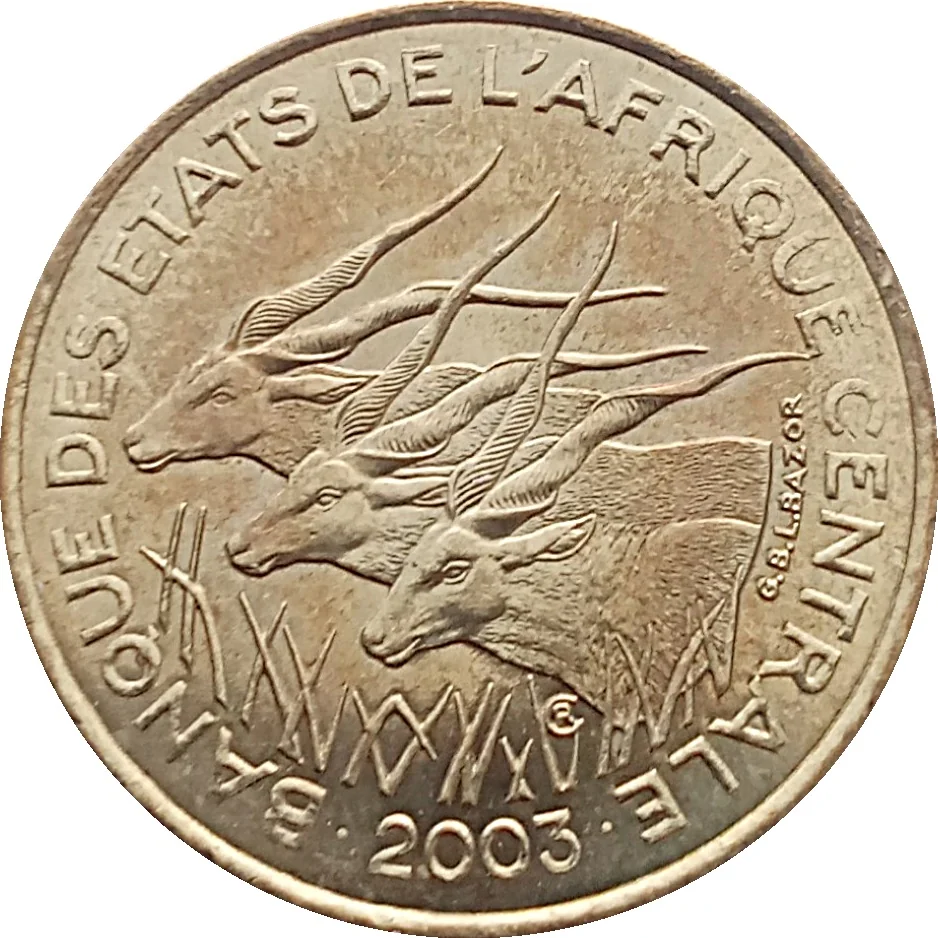
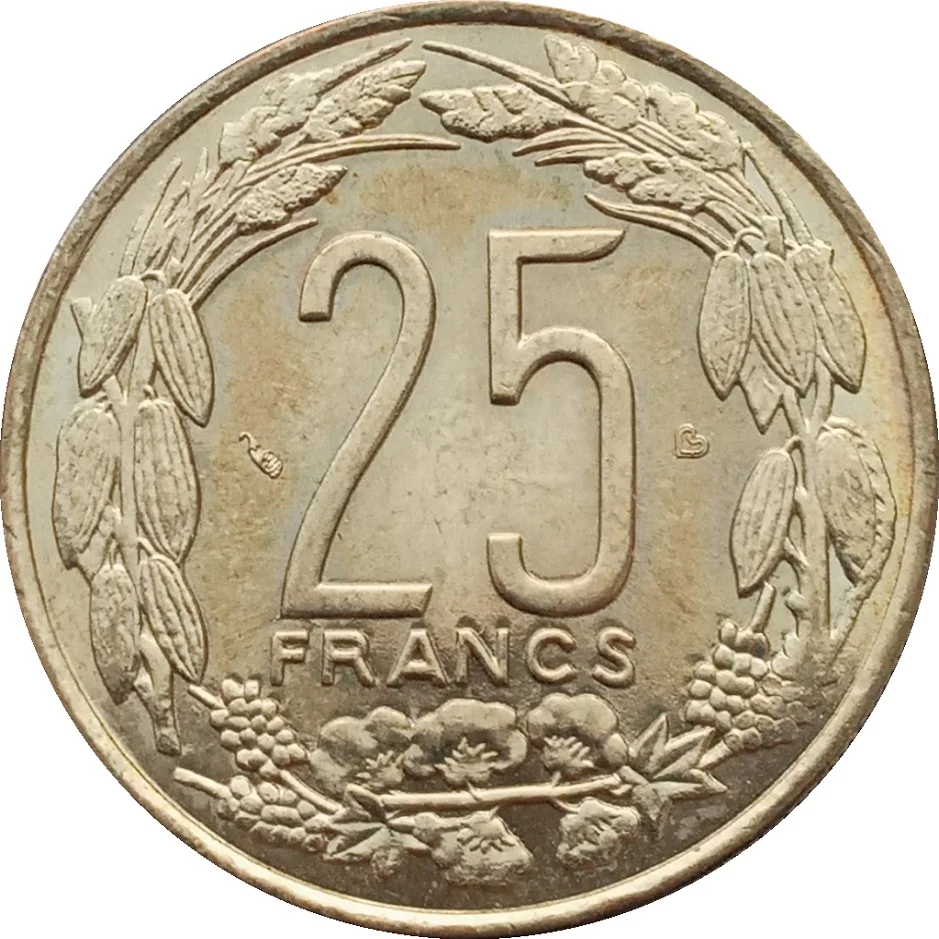
25 francs cfa – Central African States
Add to wishlist
Context
Years: 1975–2003
Issuer: Central African States
Issuing organization: Bank of Central African States
Currency:
(since 1973)
Total mintage: 74,309,600
Material
Diameter: 27.2 mm
Weight: 8 g
Thickness: 2.08 mm
Shape: Round
Composition: Aluminium bronze
Magnetic: No
Technique: Milled
Alignment: Coin alignment
flip
References
KM: #
Numista: #2281
Value
Exchange value: 25 XAF
Obverse
Reverse
Edge
Reeded
Mints
| Name | Mark |
|---|---|
| Monnaie de Paris | — |
Mintings
| Year | Mint Mark | Mintage | Quality | Collection |
|---|---|---|---|---|
| 1975 | — | 13,502,400 | ||
| 1976 | — | 2,025,600 | ||
| 1978 | — | 1,401,600 | ||
| 1982 | — | 1,500,000 | ||
| 1983 | — | 2,500,000 | ||
| 1984 | — | 5,250,000 | ||
| 1985 | — | 1,600,000 | ||
| 1986 | — | 2,150,000 | ||
| 1988 | — | 2,100,000 | ||
| 1989 | — | 200,000 | ||
| 1990 | — | 2,200,000 | ||
| 1991 | — | 3,000,000 | ||
| 1992 | — | 1,500,000 | ||
| 1996 | — | 3,380,000 | ||
| 1998 | — | 14,000,000 | ||
| 2003 | — | 18,000,000 |
Historical background
In 1975, the currency situation in the Central African States was defined by the recent creation of the Central African CFA franc (XAF), which had formally come into existence just a few years earlier in 1973. This currency was issued by the Bank of the Central African States (BEAC), established in 1972 to serve the newly formed monetary union of five nations: Cameroon, the Central African Republic, Chad, the Republic of the Congo, and Gabon. The CFA franc itself was a long-standing colonial-era currency, but the 1970s reforms marked a significant shift towards regional monetary sovereignty, even while maintaining a guaranteed fixed parity and convertibility with the French franc.
The core mechanism of the currency was its fixed exchange rate and operating principles. The XAF was pegged at 1 French franc = 50 CFA francs, a rate that provided remarkable stability but also tied the region's monetary policy directly to France. To guarantee this convertibility, the member states were required to deposit 50% of their foreign exchange reserves into a special "operations account" held at the French Treasury. This arrangement ensured financial credibility and low inflation for the member states but also represented a substantial limitation on their independent economic policymaking and a continuation of a strong post-colonial financial link with France.
The context of 1975 was one of consolidation and early challenge. The new BEAC was still establishing its operational norms, and the member states, all resource-rich but economically diverse, were navigating the first global oil shock and fluctuating commodity prices. The currency union aimed to foster economic integration and stability, yet it also inherently limited individual countries' ability to devalue their currency to gain trade competitiveness or respond to asymmetric economic shocks. Thus, the 1975 currency situation was a foundational period for a system that promised regional monetary stability at the cost of significant external dependency and pooled sovereignty.
The core mechanism of the currency was its fixed exchange rate and operating principles. The XAF was pegged at 1 French franc = 50 CFA francs, a rate that provided remarkable stability but also tied the region's monetary policy directly to France. To guarantee this convertibility, the member states were required to deposit 50% of their foreign exchange reserves into a special "operations account" held at the French Treasury. This arrangement ensured financial credibility and low inflation for the member states but also represented a substantial limitation on their independent economic policymaking and a continuation of a strong post-colonial financial link with France.
The context of 1975 was one of consolidation and early challenge. The new BEAC was still establishing its operational norms, and the member states, all resource-rich but economically diverse, were navigating the first global oil shock and fluctuating commodity prices. The currency union aimed to foster economic integration and stability, yet it also inherently limited individual countries' ability to devalue their currency to gain trade competitiveness or respond to asymmetric economic shocks. Thus, the 1975 currency situation was a foundational period for a system that promised regional monetary stability at the cost of significant external dependency and pooled sovereignty.
🌱 Very Common