

10 francs cfa – Central African States
Add to wishlist
Context
Years: 1974–2003
Issuer: Central African States
Issuing organization: Bank of Central African States
Currency:
(since 1973)
Total mintage: 179,397,600
Material
Diameter: 23.5 mm
Weight: 4 g
Thickness: 1.37 mm
Shape: Round
Composition: Aluminium bronze
Magnetic: No
Technique: Milled
Alignment: Coin alignment
flip
References
KM: #
Numista: #1806
Value
Exchange value: 10 XAF
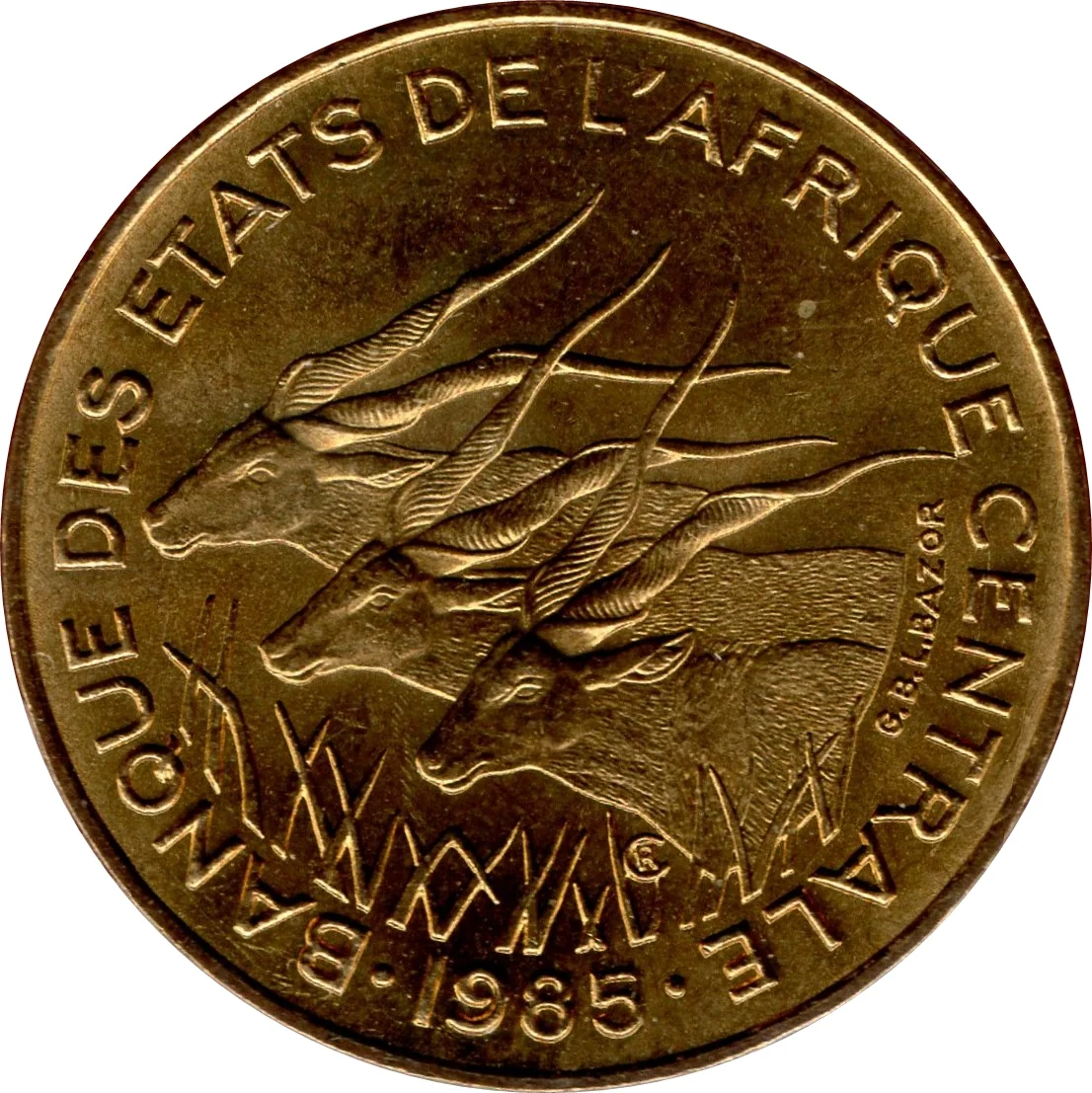
Obverse
Description:
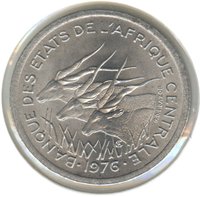
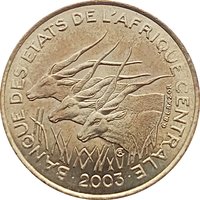
Giant eland.
Inscription:
BANQUE DES ETATS DE L'AFRIQUE CENTRALE
1985
1985
Translation:
BANK OF THE CENTRAL AFRICAN STATES
1985
1985
Script: Latin
Language: French
Engraver: Robert Cochet
Designers: Gabriel Bernard, Lucien Georges Bazor
Reverse
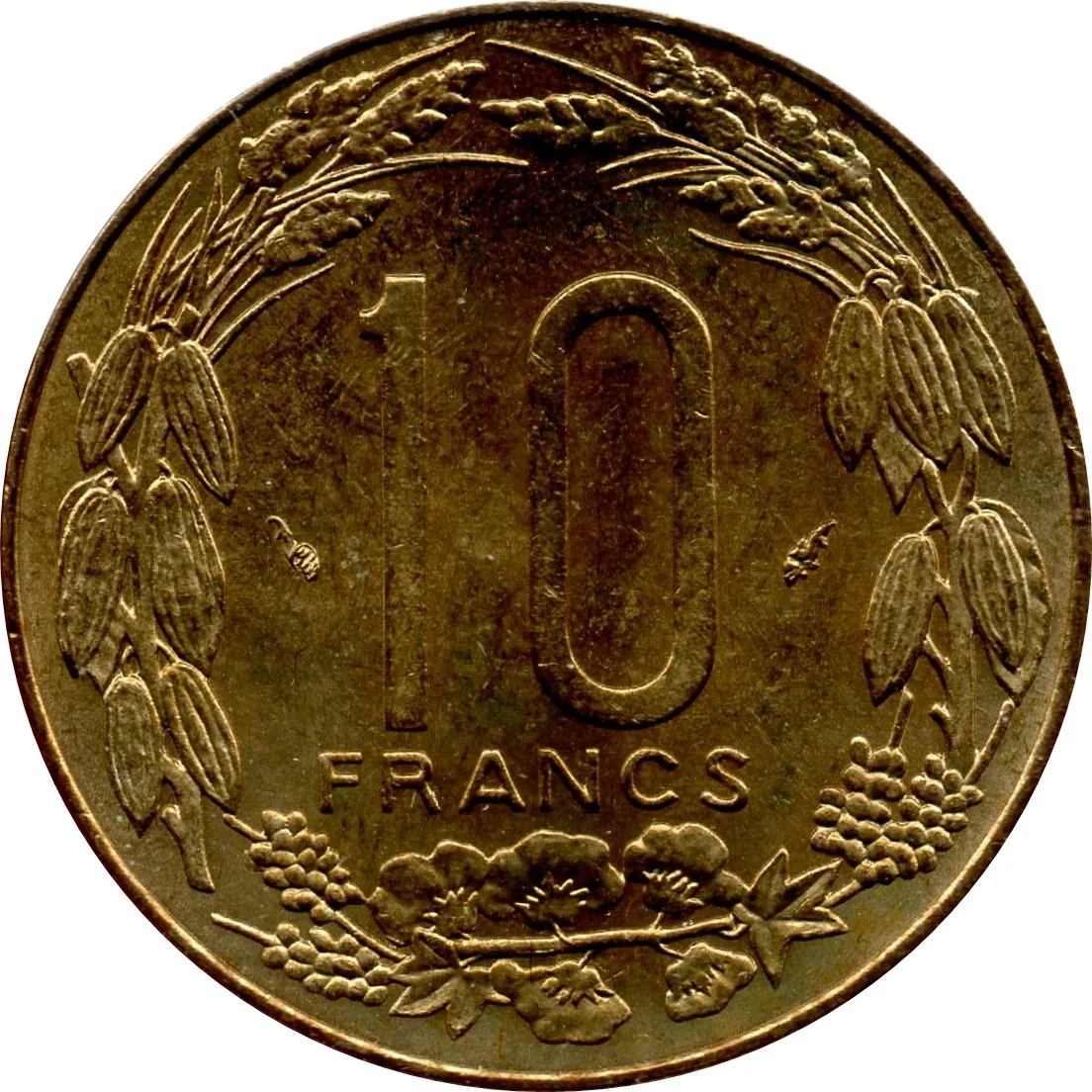
Description:
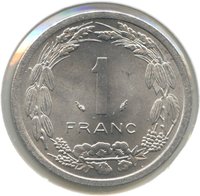
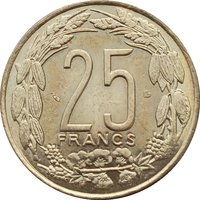
Denomination
Inscription:
10
FRANCS
FRANCS
Script: Latin
Engraver: Robert Cochet
Designer: Lucien Georges Bazor
Edge
Plain
Mints
| Name | Mark |
|---|---|
| Monnaie de Paris | — |
Mintings
| Year | Mint Mark | Mintage | Quality | Collection |
|---|---|---|---|---|
| 1974 | — | 18,500,000 | ||
| 1975 | — | 18,500,000 | ||
| 1976 | — | 4,000,000 | ||
| 1977 | — | 14,000,000 | ||
| 1978 | — | 3,900,000 | ||
| 1979 | — | 3,300,000 | ||
| 1980 | — | 3,500,000 | ||
| 1981 | — | 5,500,000 | ||
| 1982 | — | 8,000,000 | ||
| 1983 | — | 18,000,000 | ||
| 1984 | — | 16,000,000 | ||
| 1985 | — | 28,700,000 | ||
| 1992 | — | 5,500,000 | ||
| 1996 | — | 4,500,000 | ||
| 1998 | — | 7,497,600 | ||
| 2003 | — | 20,000,000 |
Historical background
In 1974, the currency situation in the Central African States was defined by the operations of the Central African Monetary Union (UMAC) and its shared currency, the CFA franc (BEAC). This currency, created in the colonial era, was pegged to the French franc at a fixed and guaranteed exchange rate (1 French franc = 50 CFA francs). This arrangement provided monetary stability and facilitated trade with France, but it also meant that the member states—Chad, the Central African Republic, Congo-Brazzaville, Gabon, and Cameroon—ceded direct control over their monetary policy to the Bank of Central African States (BEAC), which managed the currency pool and foreign reserves.
The year 1974 fell within a period of significant economic transition and strain for the region. The global oil crisis of 1973 had mixed effects: it boosted the economies of oil-exporting members like Gabon and Congo, while severely pressuring oil-importing countries like the Central African Republic and Chad. Despite these divergent national economic conditions, the fixed CFA franc peg remained unchanged, tying the entire monetary union's currency value to the French franc rather than to the region's collective economic performance. This sometimes created internal tensions, as the monetary policy set by the BEAC could not be tailored to address the specific inflationary or growth challenges of individual member states.
Politically, the currency symbolized continued close post-colonial ties with France, which guaranteed convertibility and held a significant influence within the BEAC's governing bodies. While this guarantee provided credibility and access to foreign exchange, it was often criticized as a limitation on true economic sovereignty. Therefore, in 1974, the currency situation was one of imposed stability versus constrained autonomy, serving as a crucial, if controversial, framework for the region's economies during a volatile decade.
The year 1974 fell within a period of significant economic transition and strain for the region. The global oil crisis of 1973 had mixed effects: it boosted the economies of oil-exporting members like Gabon and Congo, while severely pressuring oil-importing countries like the Central African Republic and Chad. Despite these divergent national economic conditions, the fixed CFA franc peg remained unchanged, tying the entire monetary union's currency value to the French franc rather than to the region's collective economic performance. This sometimes created internal tensions, as the monetary policy set by the BEAC could not be tailored to address the specific inflationary or growth challenges of individual member states.
Politically, the currency symbolized continued close post-colonial ties with France, which guaranteed convertibility and held a significant influence within the BEAC's governing bodies. While this guarantee provided credibility and access to foreign exchange, it was often criticized as a limitation on true economic sovereignty. Therefore, in 1974, the currency situation was one of imposed stability versus constrained autonomy, serving as a crucial, if controversial, framework for the region's economies during a volatile decade.
🌱 Very Common