

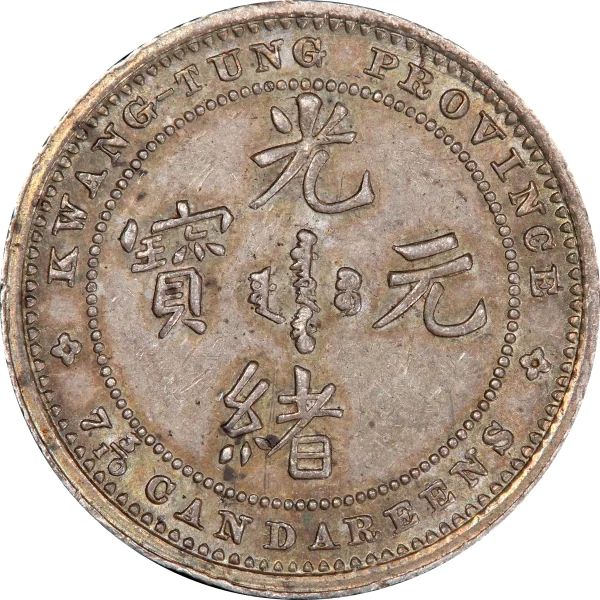
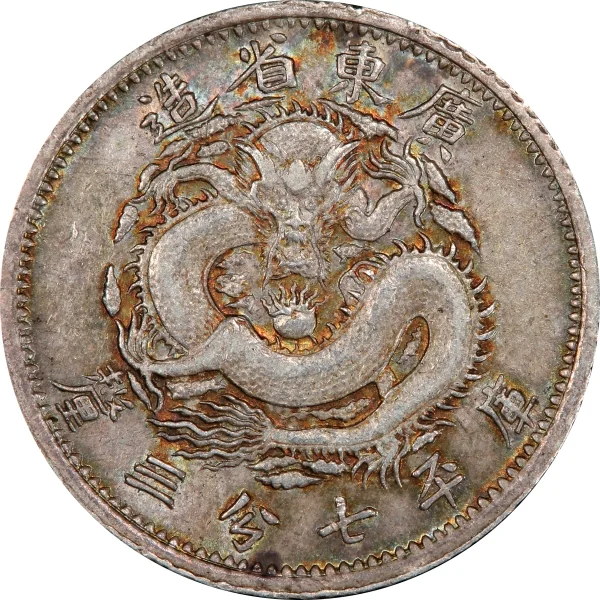
10 Fen – Kwangtung Province
China
Context
Year: 1889
Country: China 
Issuer: Kwangtung Province
Ruler: Guangxu
Currency:
(1900—1949)
Demonetized: Yes
Material
References
Y: #Click to copy to clipboard195
Numista: #22809
Value
Bullion value: $6.26
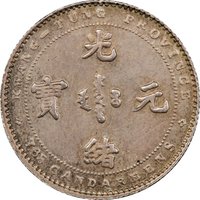
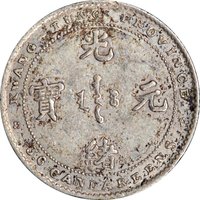
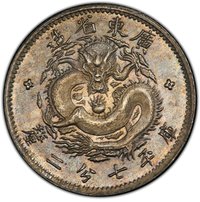
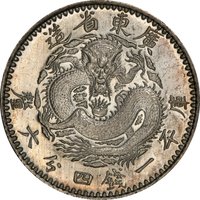
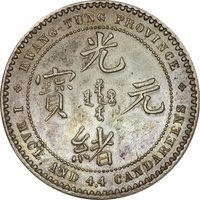
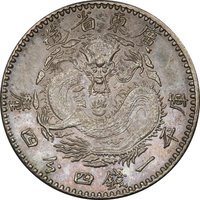
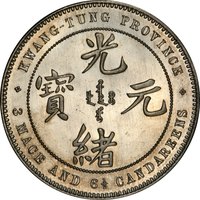
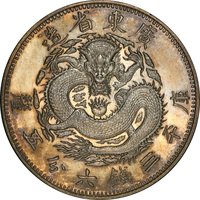
Obverse
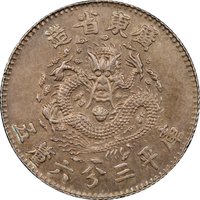
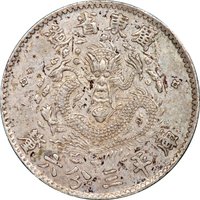
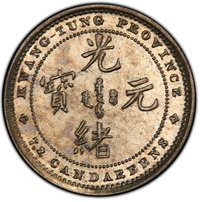
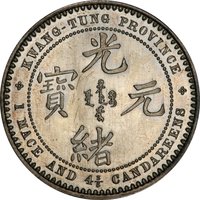
Reverse
Description:
Dragon encircling a pearl, surrounded by Chinese characters.
Inscription:
造省東廣
釐三分七平庫
釐三分七平庫
Translation:
Made in the Eastern Guangdong Bureau.
Three Fen and Seven Li, Treasury Standard.
Three Fen and Seven Li, Treasury Standard.
Language: Chinese
Edge
Reeded.
Categories
| Mythology> Fantastic animal |
Mintings
| Year | Mint Mark | Mintage | Quality | Collection |
|---|---|---|---|---|
| 1889 | — | — | ||
| 1889 | — | — | Proof |
Historical background
In 1889, the currency situation in Kwangtung (Guangdong) Province was one of profound complexity and instability, characteristic of the late Qing dynasty's fragmented monetary system. The province, a major hub for foreign trade and remittances from the overseas Chinese diaspora, was a confluence of multiple circulating mediums. These included official silver sycee (measured in taels), fractional copper cash coins, and a growing influx of foreign silver dollars, particularly the Mexican Silver Dollar (or "Eagle Dollar"), which had become the dominant trade coin. Furthermore, a plethora of privately issued sycee notes and bank drafts from native banks (qianzhuang) added layers of credit and confusion, as their value depended entirely on the reputation of the issuer.
This multiplicity led to chronic problems of exchange rate volatility and rampant counterfeiting. The value of copper cash against silver depreciated significantly throughout the century, impoverishing peasants who paid taxes in silver but earned in cash. Meanwhile, the varying weight and purity of silver sycee ingots necessitated the services of professional money-changers for every significant transaction. The provincial authorities had limited control, as the imperial government in Beijing struggled to impose a unified standard. The circulation of foreign dollars was especially indicative of the state's inability to provide a reliable, standardized currency of its own, with the Mexican dollar functioning as the de facto stable unit for large-scale commerce.
Recognizing the economic drag of this chaos, reform-minded officials like Governor-General Zhang Zhidong took direct action. In 1889, he famously initiated the minting of Guangdong silver dollars at the newly established Guangdong Mint in Guangzhou. These machine-struck coins, bearing the dragon design, were China's first attempt to create a modern, standardized national currency to compete with and eventually replace foreign dollars. Thus, 1889 stands as a pivotal year, marking the beginning of the end for the old chaotic system and the first concrete step toward monetary unification in modern China, born out of Kwangtung's uniquely pressured economic environment.
This multiplicity led to chronic problems of exchange rate volatility and rampant counterfeiting. The value of copper cash against silver depreciated significantly throughout the century, impoverishing peasants who paid taxes in silver but earned in cash. Meanwhile, the varying weight and purity of silver sycee ingots necessitated the services of professional money-changers for every significant transaction. The provincial authorities had limited control, as the imperial government in Beijing struggled to impose a unified standard. The circulation of foreign dollars was especially indicative of the state's inability to provide a reliable, standardized currency of its own, with the Mexican dollar functioning as the de facto stable unit for large-scale commerce.
Recognizing the economic drag of this chaos, reform-minded officials like Governor-General Zhang Zhidong took direct action. In 1889, he famously initiated the minting of Guangdong silver dollars at the newly established Guangdong Mint in Guangzhou. These machine-struck coins, bearing the dragon design, were China's first attempt to create a modern, standardized national currency to compete with and eventually replace foreign dollars. Thus, 1889 stands as a pivotal year, marking the beginning of the end for the old chaotic system and the first concrete step toward monetary unification in modern China, born out of Kwangtung's uniquely pressured economic environment.
💎 Extremely Rare