

1 noble – Isle of Man
Add to wishlist
Context
Years: 1983–1984
Country: British Crown dependencies
Issuer: Isle of Man
Ruler: Elizabeth II
Currency:
(since 1983)
Total mintage: 3,794
Material
Diameter: 32.7 mm
Weight: 31.1 g
Platinum Weight:: 31.08 g
Thickness: 2.38 mm
Shape: Round
Composition: 99.95% Platinum
Standard: Silver ounce
Technique: Milled
Alignment: Medal alignment
flip
References
KM: #
Numista: #22721
Value
Bullion value: $2075.73
Obverse
Description:
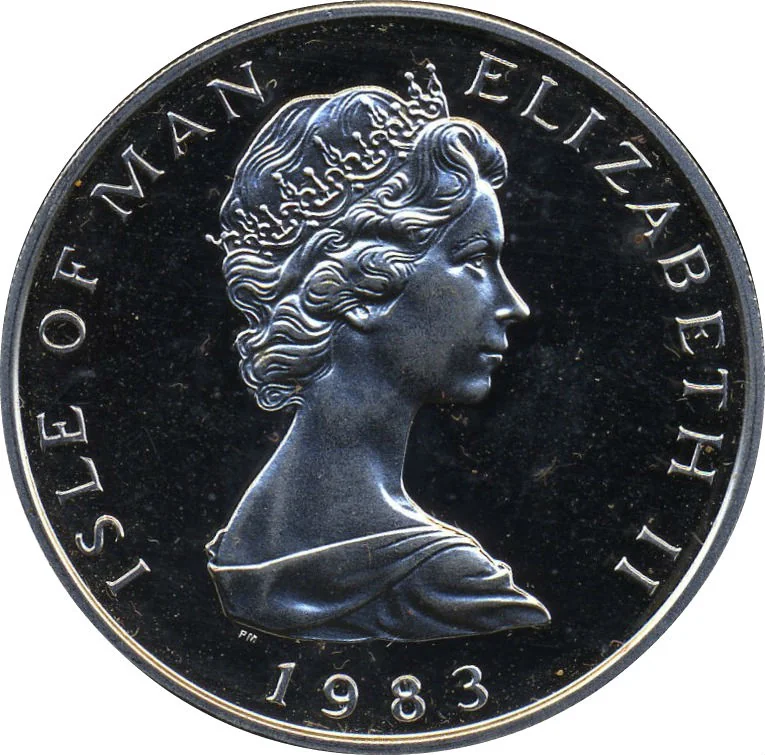
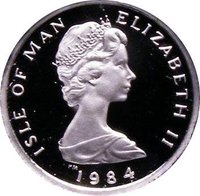
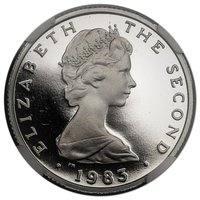
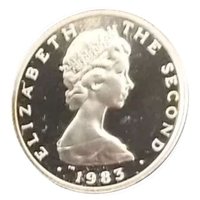
Queen Elizabeth II facing right, wearing the Girls of Great Britain and Ireland Tiara, with legend surrounding and date beneath.
Inscription:
ISLE OF MAN ELIZABETH II
PM
1983
PM
1983
Translation:
ISLE OF MAN ELIZABETH II
PM
1983
PM
1983
Script: Latin
Language: English
Designer: Arnold Machin
Reverse
Description:
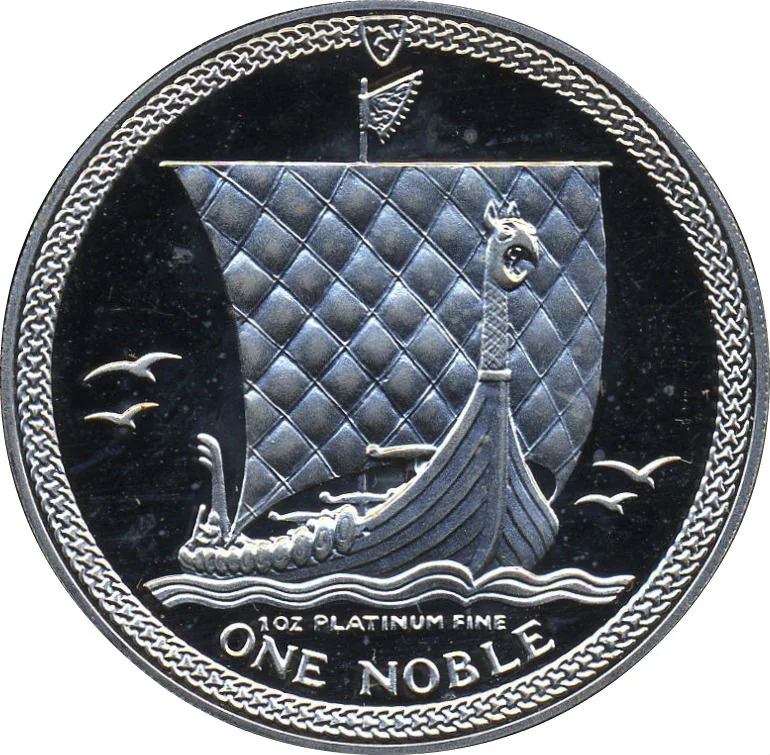
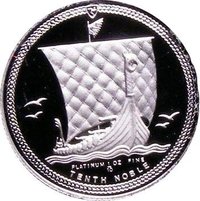
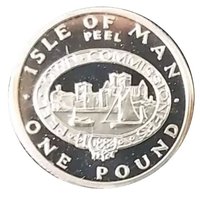
Viking longship 'Thusly' under full sail, seagulls overhead.
Inscription:
1OZ PLATINUM FINE
ONE NOBLE
ONE NOBLE
Script: Latin
Edge
Reeded
Categories
| Animal> Bird |
| Transportation> Watercraft |
Mints
| Name | Mark |
|---|---|
| Pobjoy Mint | (PM) |
Mintings
| Year | Mint Mark | Mintage | Quality | Collection |
|---|---|---|---|---|
| 1983 | PM | 1,700 | ||
| 1983 | PM | 94 | Proof | |
| 1984 | PM | — | ||
| 1984 | PM | 2,000 | Proof |
Historical background
In 1983, the Isle of Man's currency situation was defined by its unique political status as a British Crown Dependency. While not part of the United Kingdom, the Island maintained a long-standing currency union with the UK, meaning the UK pound sterling (£) was legal tender and formed the basis of its monetary system. However, the Isle of Man government, through its Treasury, had issued its own distinct banknotes and coins since the 18th and 20th centuries, respectively. These Manx issues were denominated in "pounds" and maintained a strict 1:1 parity with sterling, but they were not legal tender in the UK itself, creating a practical two-tier system on the Island.
The year 1983 fell within a period of significant economic transition for the Isle of Man, as it was actively developing its offshore financial services sector. Maintaining absolute confidence in the parity and stability of its currency was therefore paramount. The Island's currency was backed 100% by sterling reserves held at the UK's Bank of England, ensuring its credibility. This arrangement provided monetary stability but meant the Isle of Man had no independent monetary policy, ceding control over interest rates and broader monetary conditions to the UK Treasury and the Bank of England.
Consequently, the currency landscape in 1983 was one of stable duality. Businesses and residents on the Island used both Manx and UK sterling notes and coins interchangeably in daily life, with the Manx issues serving as a strong symbol of national identity. The system was entirely dependent on, and vulnerable to, UK economic policy, most notably the high-interest rates and anti-inflation measures of the early 1980s under the UK government. This period underscored the core characteristic of the Manx currency: a politically and culturally distinct issuance operating within the secure and restrictive framework of the sterling zone.
The year 1983 fell within a period of significant economic transition for the Isle of Man, as it was actively developing its offshore financial services sector. Maintaining absolute confidence in the parity and stability of its currency was therefore paramount. The Island's currency was backed 100% by sterling reserves held at the UK's Bank of England, ensuring its credibility. This arrangement provided monetary stability but meant the Isle of Man had no independent monetary policy, ceding control over interest rates and broader monetary conditions to the UK Treasury and the Bank of England.
Consequently, the currency landscape in 1983 was one of stable duality. Businesses and residents on the Island used both Manx and UK sterling notes and coins interchangeably in daily life, with the Manx issues serving as a strong symbol of national identity. The system was entirely dependent on, and vulnerable to, UK economic policy, most notably the high-interest rates and anti-inflation measures of the early 1980s under the UK government. This period underscored the core characteristic of the Manx currency: a politically and culturally distinct issuance operating within the secure and restrictive framework of the sterling zone.
✨ Legendary