

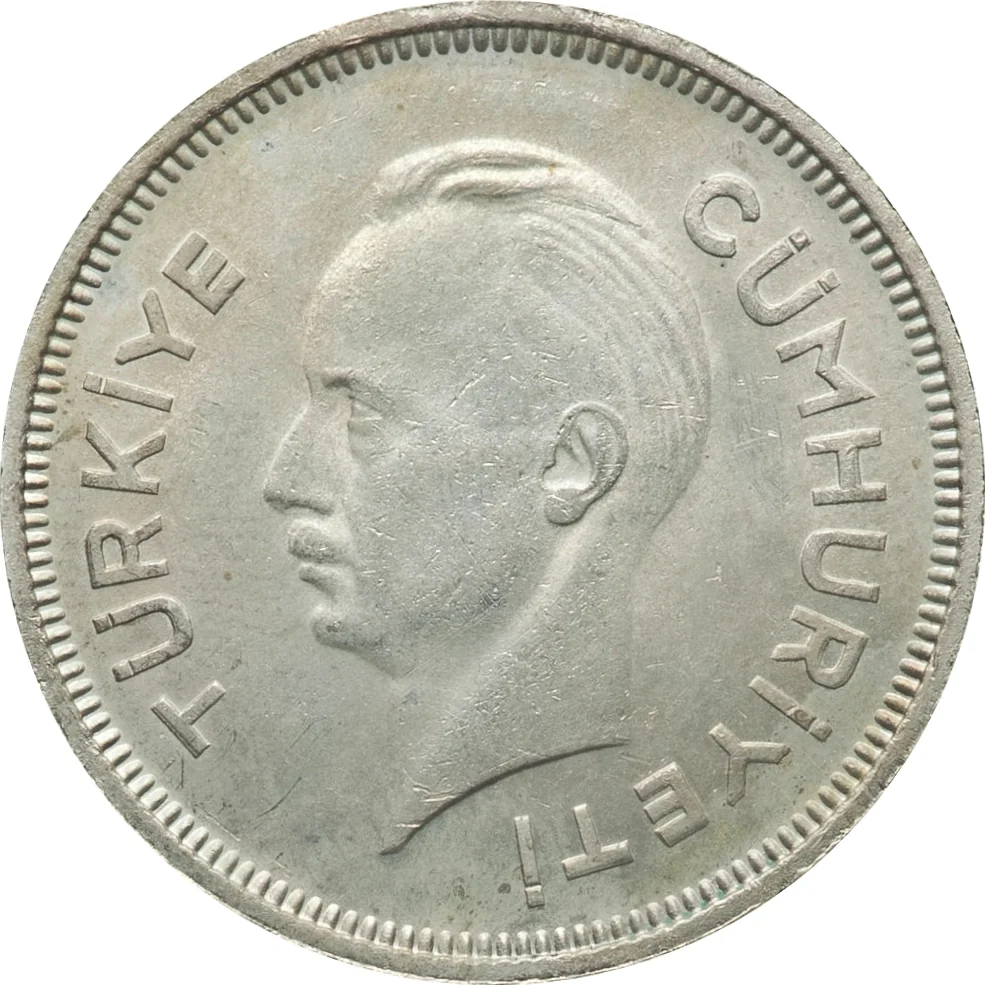
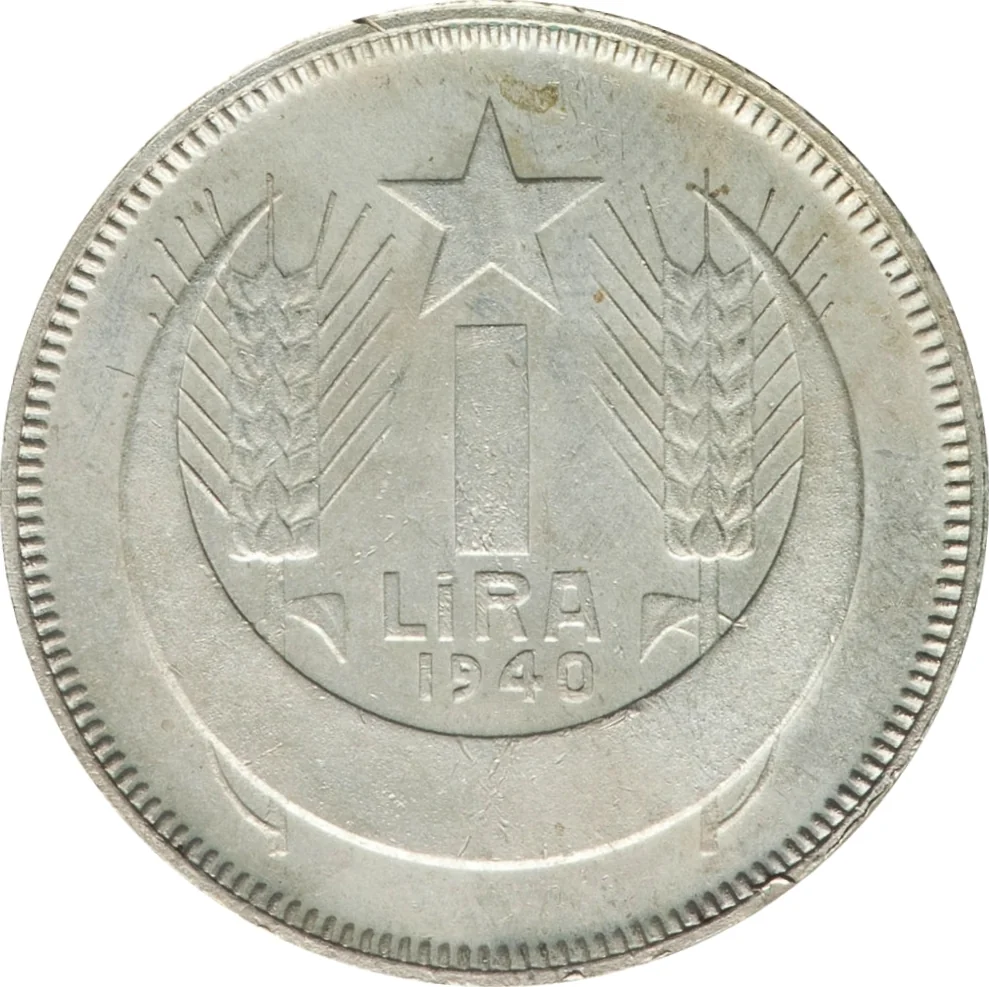

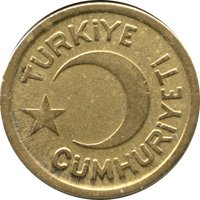
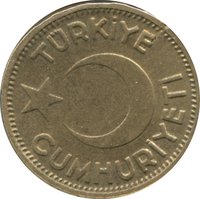
Obverse
Description:
İnönü's head removed.
Inscription:
TÜRKİYE CÜMHURIYETİ
Translation:
REPUBLIC OF TURKEY
Script: Latin
Language: Turkish
Engraver: Percy Metcalfe
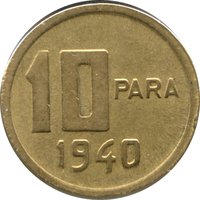
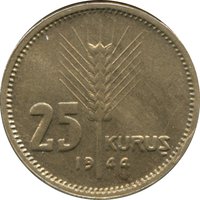
Reverse
Description:
Star over value, date in crescent.
Inscription:
1
LİRA
LİRA
Translation:
One Lira
Script: Latin
Language: Turkish
Engraver: Percy Metcalfe
Edge
Mintings
| Year | Mint Mark | Mintage | Quality | Collection |
|---|---|---|---|---|
| 1940 | — | 253,000 | ||
| 1941 | — | 6,167,147 |
Historical background
In 1940, Turkey's currency situation was defined by the strict state control and economic isolation of the early Republic period, operating under a fixed exchange rate regime. The Turkish lira, introduced in the late 1920s to replace the Ottoman lira, was pegged to a basket of currencies, primarily the French franc and later the British pound, with an official rate maintained by the Central Bank of the Republic of Turkey (established in 1930). This period was one of relative stability for the lira, largely insulated from the immediate currency chaos of World War II due to Turkey's declared neutrality. The government, pursuing a statist (etatist) economic policy, exercised stringent capital controls and maintained a monopoly over foreign exchange transactions to conserve reserves and direct resources toward state-led industrialization projects.
The broader economic context was one of autarky and mobilization for potential conflict. While neutral, Turkey faced immense pressure from both Allied and Axis powers and enacted a National Defense Law in 1940 that granted the government sweeping authority to commandeer resources, control prices, and regulate all aspects of the economy. This further centralized control over the financial system. Inflationary pressures, however, were beginning to build due to increased military spending, disruptions in international trade, and the global economic distortions of the war. These pressures were largely suppressed through heavy state regulation rather than being reflected in the official exchange rate.
Consequently, a significant black market for foreign currency and goods emerged alongside the official economy. The fixed official rate became increasingly divorced from real market values as goods became scarce and the demand for hard currency rose. This duality—a stable but artificial official lira alongside a depreciating black-market lira—characterized the wartime currency environment. The accumulated imbalances and suppressed inflation of this controlled period would, in the post-war years, contribute to significant economic challenges and a major devaluation in 1946 when Turkey moved toward a more liberal, multi-party system and sought integration into the Western economic order.
The broader economic context was one of autarky and mobilization for potential conflict. While neutral, Turkey faced immense pressure from both Allied and Axis powers and enacted a National Defense Law in 1940 that granted the government sweeping authority to commandeer resources, control prices, and regulate all aspects of the economy. This further centralized control over the financial system. Inflationary pressures, however, were beginning to build due to increased military spending, disruptions in international trade, and the global economic distortions of the war. These pressures were largely suppressed through heavy state regulation rather than being reflected in the official exchange rate.
Consequently, a significant black market for foreign currency and goods emerged alongside the official economy. The fixed official rate became increasingly divorced from real market values as goods became scarce and the demand for hard currency rose. This duality—a stable but artificial official lira alongside a depreciating black-market lira—characterized the wartime currency environment. The accumulated imbalances and suppressed inflation of this controlled period would, in the post-war years, contribute to significant economic challenges and a major devaluation in 1946 when Turkey moved toward a more liberal, multi-party system and sought integration into the Western economic order.
🌟 Limited