

100 francs – France
Add to wishlist
Non-circulating coins
Commemoration: Fraternity, the founding value of the French Republic.
Series: 100 francs Fraternité
France
Obverse
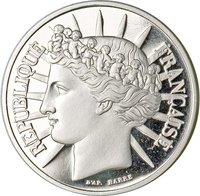
Description:
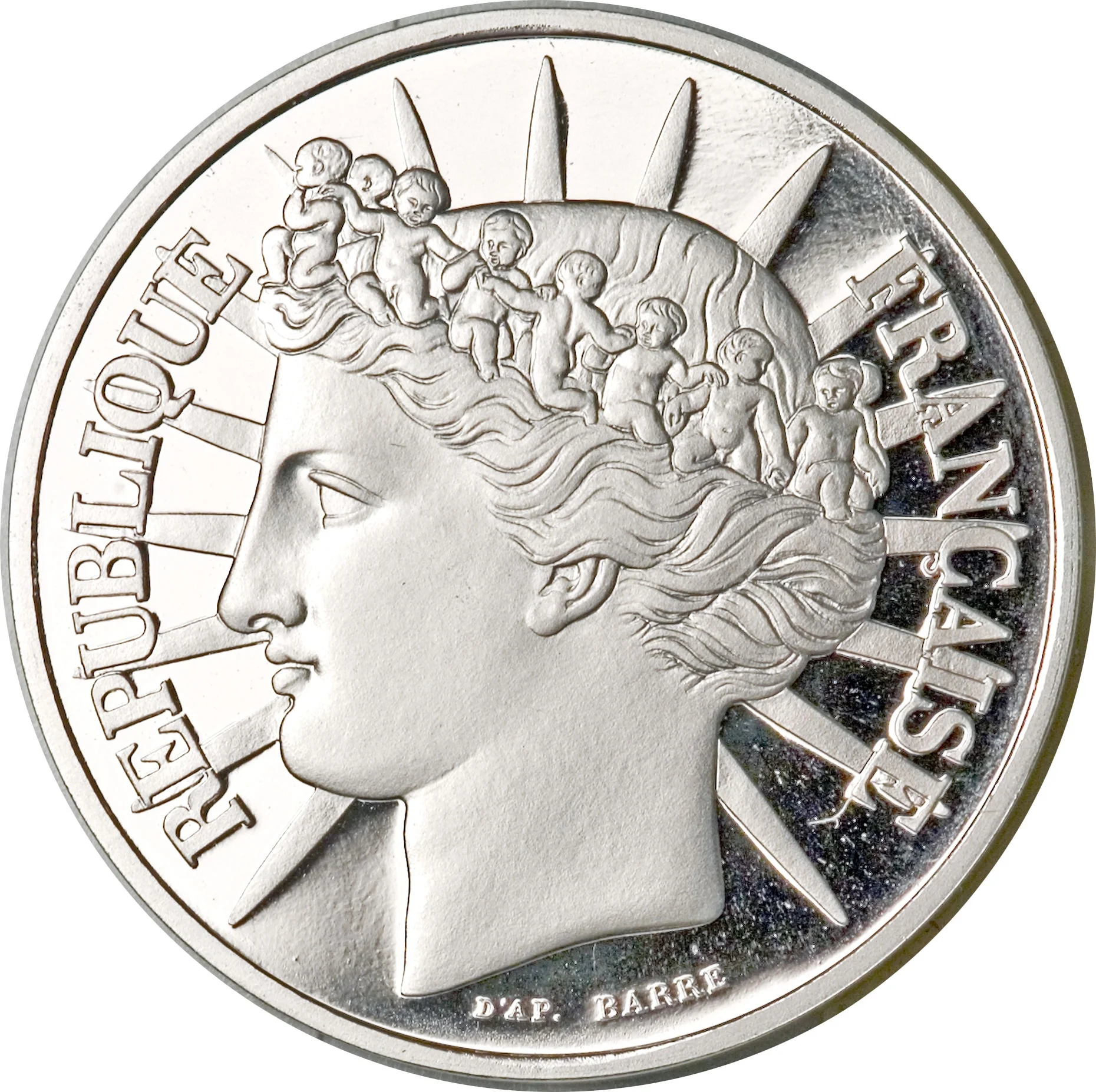
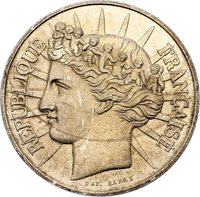
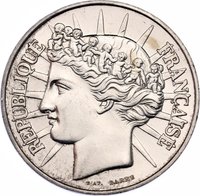
The left profile of an allegorical Republic, crowned with children after Barre's engraving, is encircled by "REPUBLIQUE FRANÇAISE".
Inscription:
REPUBLIQUE FRANÇAISE
D'AP. BARRE
D'AP. BARRE
Translation:
FRENCH REPUBLIC
AFTER BARRE
AFTER BARRE
Script: Latin
Language: French
Engraver: Atelier de Gravure (A.G.M.M.)
Designer: Jacques-Jean Barre
Reverse
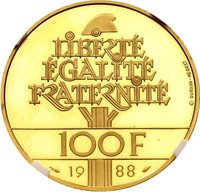
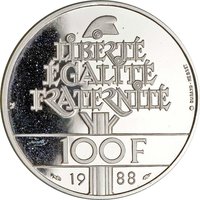
Description:
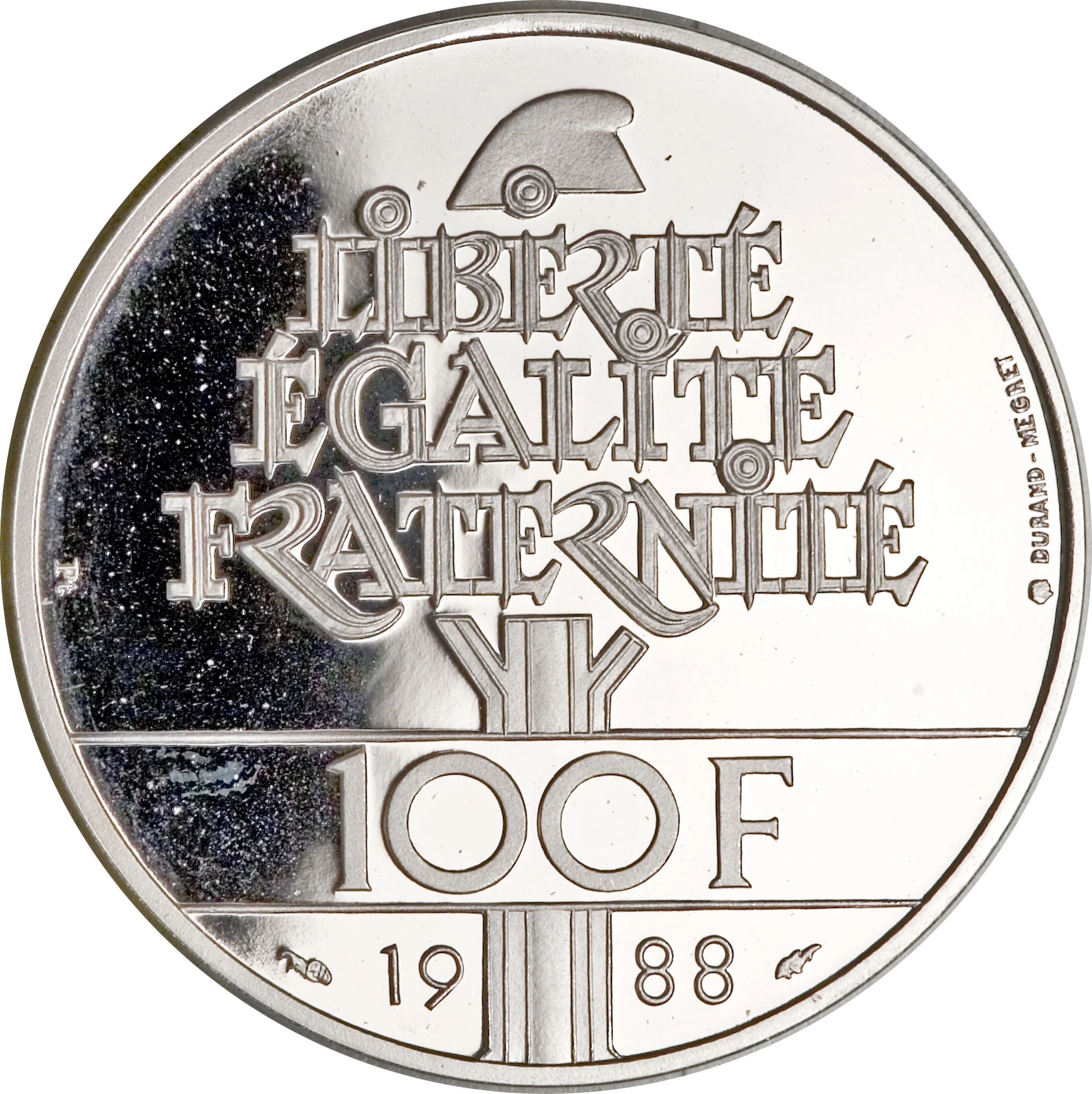
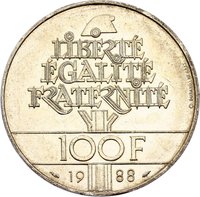
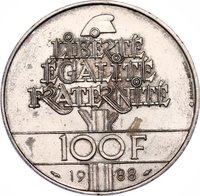
A tree with a Phrygian cap bears the motto "LIBERTÉ ÉGALITÉ FRATERNITÉ," adapted from Michel Durand-Megret, crossed by a band showing its face value.
Inscription:
LIBERTÉ
ÉGALITÉ
FRATERNITÉ
100 F
1988 DURAND-MEGRET
ÉGALITÉ
FRATERNITÉ
100 F
1988 DURAND-MEGRET
Translation:
Liberty
Equality
Fraternity
100 Francs
1988 Durand-Megret
Equality
Fraternity
100 Francs
1988 Durand-Megret
Script: Latin
Language: French
Engraver: Atelier de Gravure (A.G.M.M.)
Designer: Michel Durand-Mégret
Edge
Plain
Mints
| Name | Mark |
|---|---|
| Monnaie de Paris | — |
Mintings
| Year | Mint Mark | Mintage | Quality | Collection |
|---|---|---|---|---|
| 1988 | — | 5,000 | Proof |
Historical background
In 1988, France's currency situation was defined by its pivotal role within the European Monetary System (EMS), established in 1979. The French franc was part of the Exchange Rate Mechanism (ERM), which aimed to reduce exchange rate variability and achieve monetary stability in Europe by pegging currencies within agreed fluctuation bands. This period followed the turbulent early 1980s, when President François Mitterrand's initial expansionist policies had led to severe franc devaluations and capital flight, forcing a dramatic "tournant de la rigueur" (austerity turn) in 1983. By 1988, a consensus on fiscal discipline and a strong franc policy—the "franc fort"—was firmly entrenched, aligning France closely with West Germany's powerful Deutsche Mark to anchor credibility and combat inflation.
Domestically, this commitment to the EMS framework required strict monetary policy, often at the expense of domestic economic growth and employment. The Banque de France, not yet independent, operated under government direction to maintain the franc's parity, primarily through high interest rates. This created a tension, as the government of Prime Minister Michel Rocard (appointed in May 1988) also sought to address social concerns following Mitterrand's re-election. The economy was in a phase of moderate growth, but the strong franc policy made French exports less competitive, contributing to a persistent trade deficit.
Looking forward, 1988 was a year of consolidation on the path toward greater European monetary integration. The success of the EMS in providing stability, despite occasional realignments, bolstered political momentum for a single currency—a vision that would be formally advanced with the Delors Report in 1989. Thus, France's currency policy in 1988 was not merely a domestic economic tool but a strategic political commitment, sacrificing some short-term national sovereignty to secure a leading role in the future European Union and its planned monetary union.
Domestically, this commitment to the EMS framework required strict monetary policy, often at the expense of domestic economic growth and employment. The Banque de France, not yet independent, operated under government direction to maintain the franc's parity, primarily through high interest rates. This created a tension, as the government of Prime Minister Michel Rocard (appointed in May 1988) also sought to address social concerns following Mitterrand's re-election. The economy was in a phase of moderate growth, but the strong franc policy made French exports less competitive, contributing to a persistent trade deficit.
Looking forward, 1988 was a year of consolidation on the path toward greater European monetary integration. The success of the EMS in providing stability, despite occasional realignments, bolstered political momentum for a single currency—a vision that would be formally advanced with the Delors Report in 1989. Thus, France's currency policy in 1988 was not merely a domestic economic tool but a strategic political commitment, sacrificing some short-term national sovereignty to secure a leading role in the future European Union and its planned monetary union.
Series: 100 francs Fraternité


💎 Extremely Rare