

5000 pesetas – Spain
Add to wishlist
Non-circulating coins
Commemoration: Spanish Caravel
Spain
Context
Year: 1989
Issuer: Spain
Ruler: Juan Carlos I
Currency:
(1868—2001)
Demonetized: Yes
Total mintage: 57,000
Material
References
KM: #
Numista: #22644
Value
Exchange value: 5000 ESP
Bullion value: $124.53
Inflation-adjusted value: 14610.70 ESP
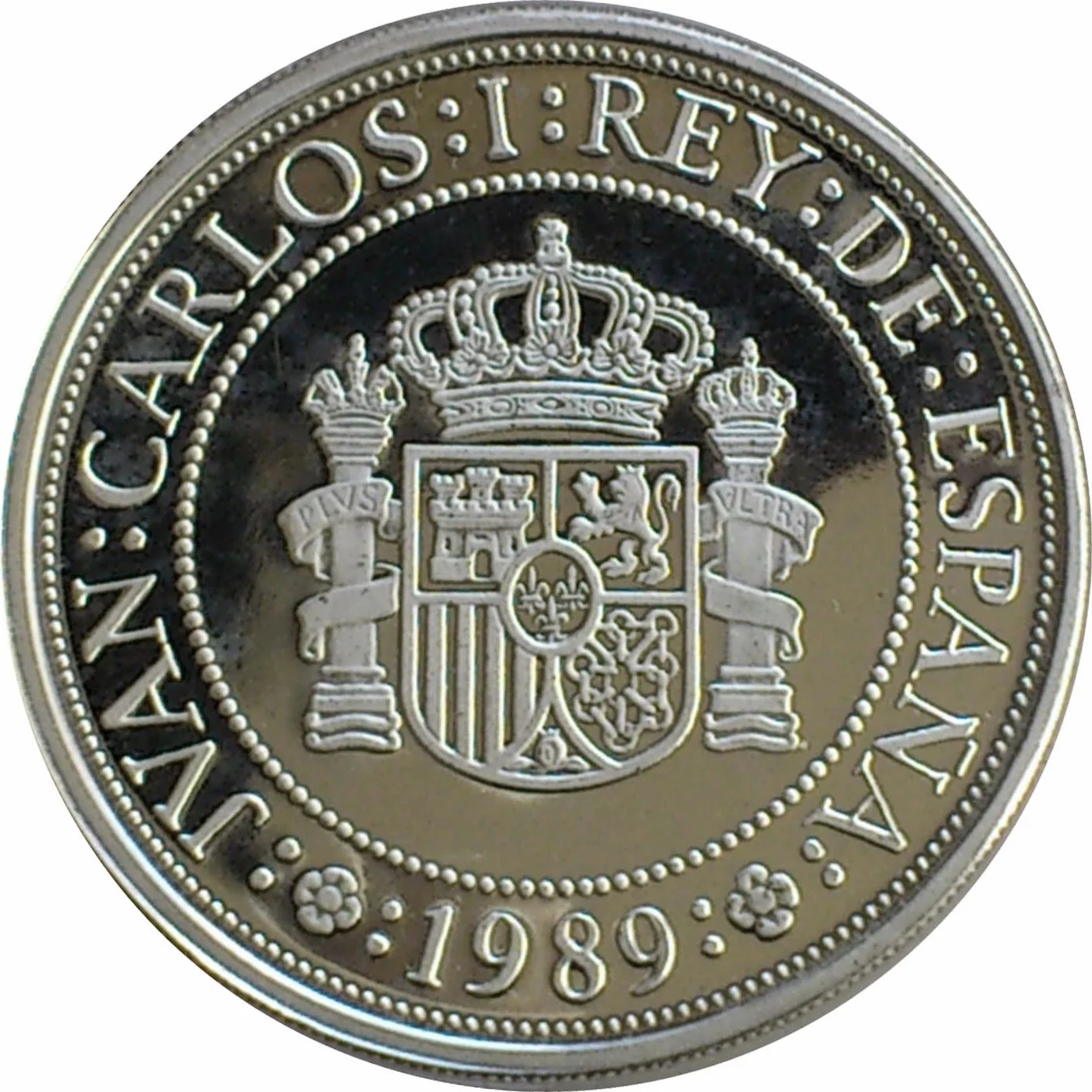
Obverse
Description:
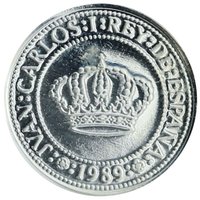
Spanish coat of arms with the Pillars of Hercules.
Inscription:
: JVAN : CARLOS : I REY : DE : ESPAÑA :
🏵: 1989 :🏵
PLVS VLTRA
🏵: 1989 :🏵
PLVS VLTRA
Translation:
: JUAN CARLOS I KING OF SPAIN :
: 1989 :
MORE BEYOND
: 1989 :
MORE BEYOND
Script: Latin
Engraver: Alfonso Morales Muñoz
Designer: Manuel Martinez Tornero
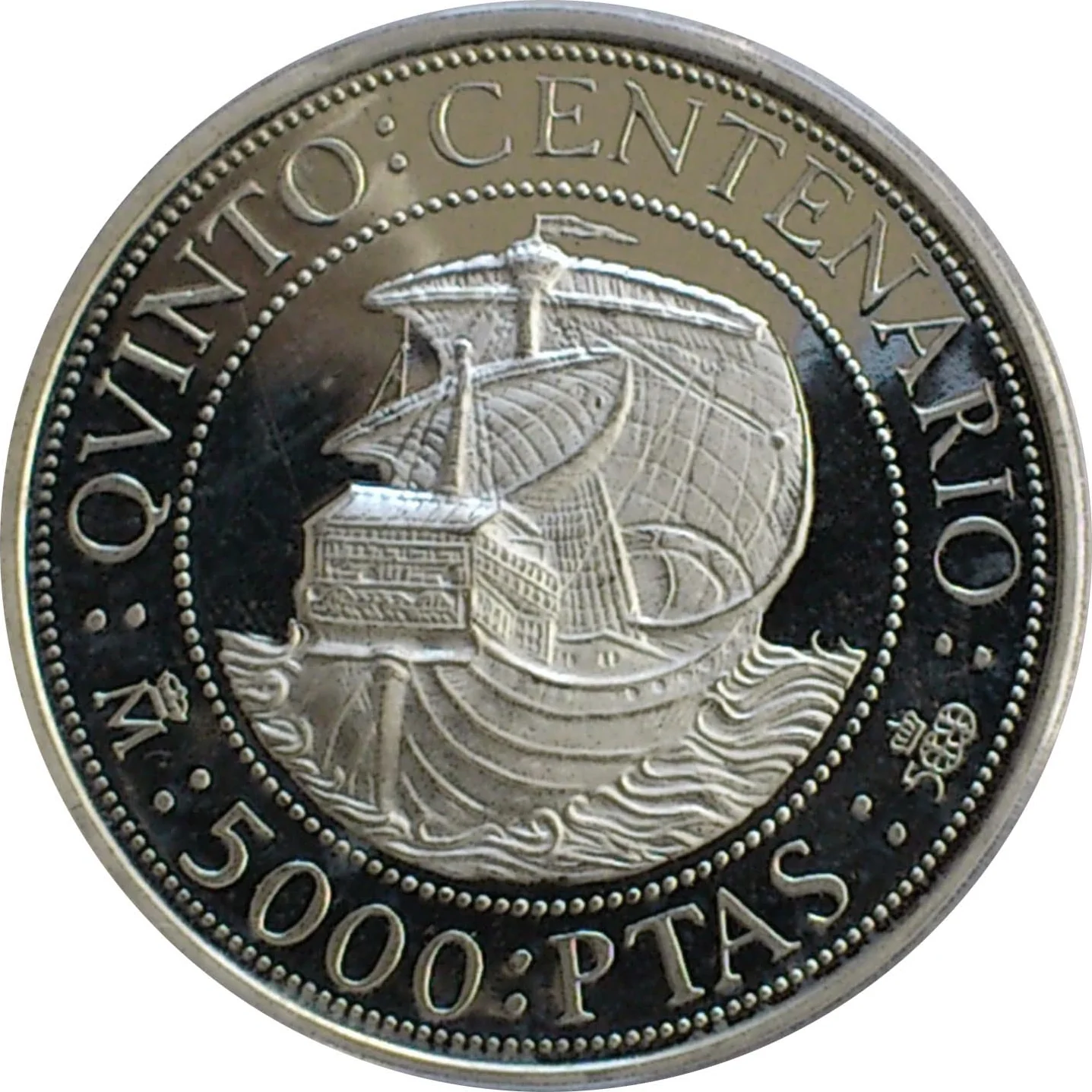
Reverse
Description:
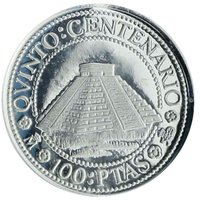
Spanish caravel sailing rightward.
Inscription:
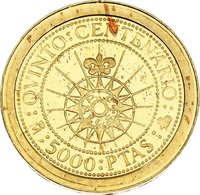
: QVINTO : CENTENARIO :
M : 5000 : PTAS : 500
M : 5000 : PTAS : 500
Translation:
Five Hundredth Anniversary
M: 5000 Pesetas: 500
M: 5000 Pesetas: 500
Script: Latin
Engraver: Alfonso Morales Muñoz
Edge
Segmented reeding (BU)Reeded (Proof)
Categories
| Mythology |
| Symbols> Coat of Arms |
| Transportation> Watercraft |
Mints
| Name | Mark |
|---|---|
| Royal Mint of Madrid | (M) |
Mintings
| Year | Mint Mark | Mintage | Quality | Collection |
|---|---|---|---|---|
| 1989 | M | 24,000 | BU | |
| 1989 | M | 33,000 | Proof |
Historical background
In 1989, Spain was in a pivotal phase of its economic and monetary integration with Europe, operating under the framework of the European Monetary System (EMS). The country had joined the EMS in June 1989, just months before the year in question, committing to keep the value of its currency, the peseta, within a fluctuation band against other European currencies, particularly the Deutsche Mark. This move was a strategic and political decision, signaling Spain's full commitment to European integration following its accession to the European Economic Community in 1986. The primary objective was to import monetary stability and low inflation from Europe's core economies, thereby anchoring the peseta and fostering investor confidence.
The domestic economic context, however, presented significant challenges. Spain was experiencing strong economic growth, but it was accompanied by persistently high inflation and a large current account deficit. This created a classic policy dilemma: maintaining the peseta's parity within the EMS required high interest rates to attract capital and support the currency, but these same high rates also risked stifling domestic investment and economic expansion. The Bank of Spain, having gained greater autonomy in 1988, pursued a tight monetary policy to defend the peseta and curb inflation, leading to a period of high interest rates that contrasted with the booming economic activity.
Consequently, 1989 was a year of tension and transition. The peseta came under periodic speculative pressure in the foreign exchange markets, as investors questioned whether Spain could simultaneously maintain its exchange rate peg, control inflation, and sustain its growth. The government, led by Prime Minister Felipe González, was forced to prioritize European convergence over purely domestic concerns, accepting the short-term pain of high borrowing costs for the long-term goal of eventual Economic and Monetary Union. Thus, the currency situation in 1989 was defined by Spain's difficult but determined navigation between domestic economic pressures and its irreversible journey toward becoming a core member of the future Eurozone.
The domestic economic context, however, presented significant challenges. Spain was experiencing strong economic growth, but it was accompanied by persistently high inflation and a large current account deficit. This created a classic policy dilemma: maintaining the peseta's parity within the EMS required high interest rates to attract capital and support the currency, but these same high rates also risked stifling domestic investment and economic expansion. The Bank of Spain, having gained greater autonomy in 1988, pursued a tight monetary policy to defend the peseta and curb inflation, leading to a period of high interest rates that contrasted with the booming economic activity.
Consequently, 1989 was a year of tension and transition. The peseta came under periodic speculative pressure in the foreign exchange markets, as investors questioned whether Spain could simultaneously maintain its exchange rate peg, control inflation, and sustain its growth. The government, led by Prime Minister Felipe González, was forced to prioritize European convergence over purely domestic concerns, accepting the short-term pain of high borrowing costs for the long-term goal of eventual Economic and Monetary Union. Thus, the currency situation in 1989 was defined by Spain's difficult but determined navigation between domestic economic pressures and its irreversible journey toward becoming a core member of the future Eurozone.
⭐ Rare