

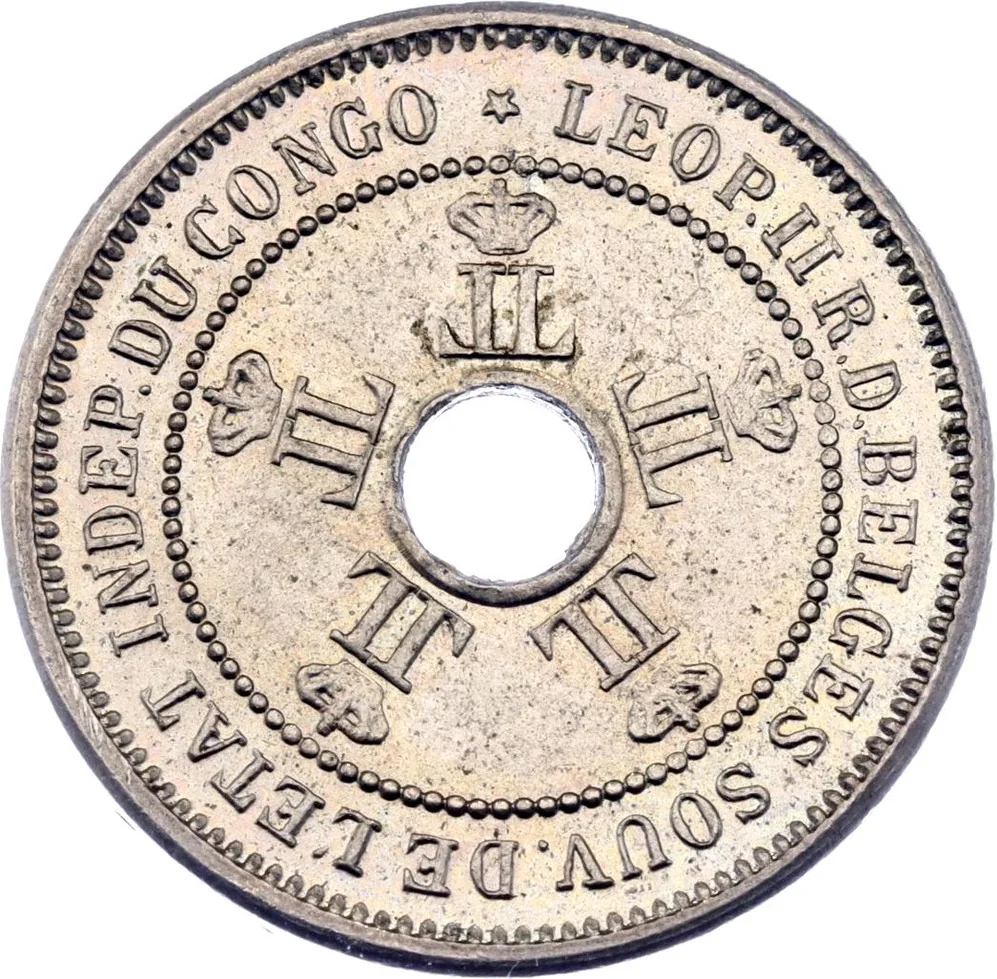
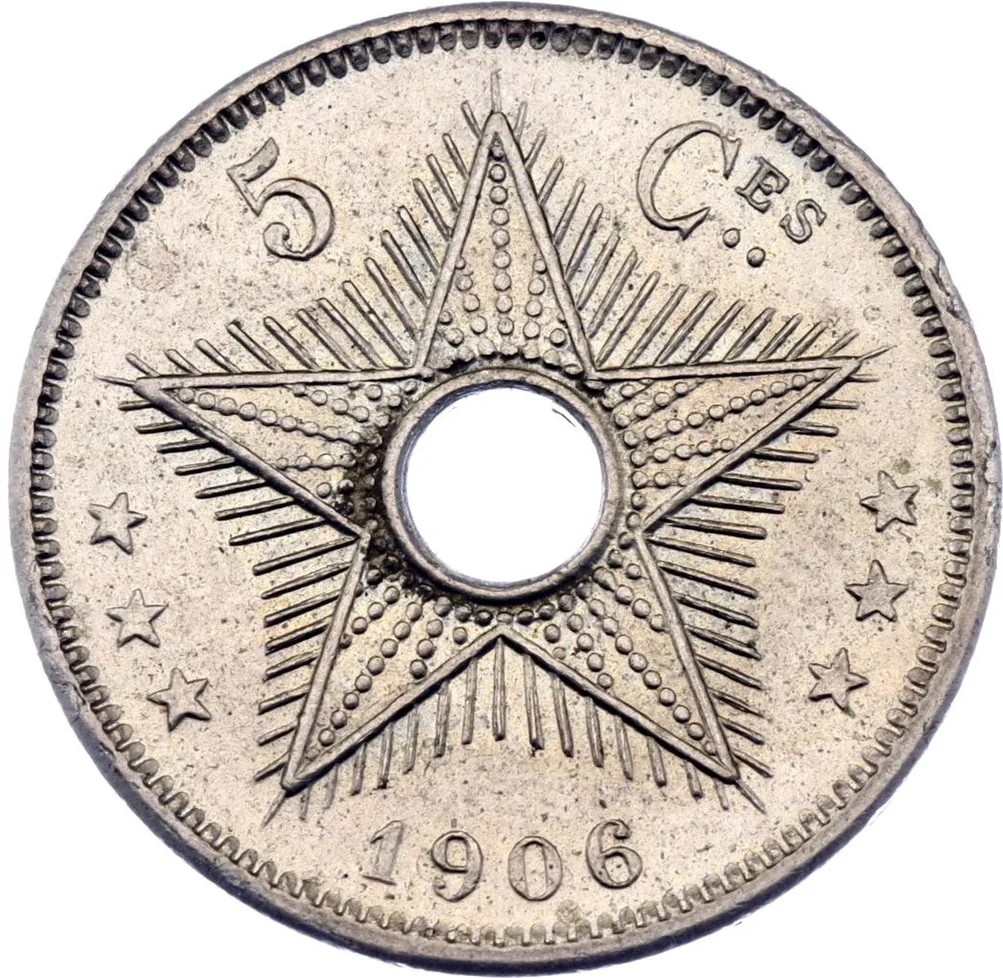
5 centimes – Congo Free State
Add to wishlist
Democratic Republic of the Congo
Context
Years: 1906–1908
Country: Democratic Republic of the Congo
Issuer: Congo Free State
Ruler: Leopold II
Currency:
(1885—1908)
Demonetized: Yes
Total mintage: 900,000
Material
Diameter: 19 mm
Weight: 2.5 g
Shape: Round with a round hole
Composition: Copper-nickel
Technique: Milled
Alignment: Coin alignment
flip
References
KM: #
Numista: #22554
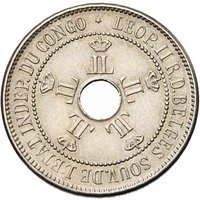
Obverse
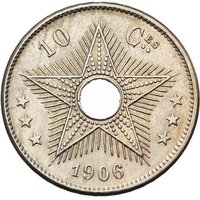
Reverse
Description:
Denomination over date under radiant star.
Inscription:
*** 1 Ces ***
1906
1906
Script: Latin
Edge
Plain
Mints
| Name | Mark |
|---|---|
| Royal Mint of Belgium | — |
Mintings
| Year | Mint Mark | Mintage | Quality | Collection |
|---|---|---|---|---|
| 1906 | — | 100,000 | ||
| 1908 | — | 800,000 |
Historical background
In 1906, the currency situation in the Congo Free State was a direct reflection of the territory’s chaotic and exploitative administration under King Leopold II of Belgium. The official currency was the Congo franc, pegged to and equivalent to the Belgian franc, which was intended to facilitate trade with European commercial interests. However, in practice, this coinage was scarce in the vast interior, where the colonial economy functioned on a brutal non-monetary basis. The state’s primary revenue came from the forced extraction of rubber and ivory, with taxes often demanded in kind or through coerced labor, rendering formal currency largely irrelevant for the Congolese population and highlighting an economy built on extraction rather than exchange.
Alongside the limited official coinage, a confusing array of alternative currencies circulated, particularly in regional trade. These included brass rods, pieces of cloth, and shells, which served as traditional units of account and barter. Most significantly, imported Maria Theresa thalers—large silver coins minted in Austria—were widely used for larger transactions, especially in the eastern regions engaged in trade with Arab-Swahili merchants from the Indian Ocean coast. This created a dual monetary system: a theoretical European-style franc system centered on state and company operations, and a pragmatic, heterogeneous system of commodity money and foreign coinage that facilitated daily survival and local commerce.
This monetary disarray occurred amidst mounting international scandal over the atrocities of Leopold’s regime. The humanitarian crisis and economic plunder drew severe criticism, putting immense pressure on the king. Indeed, the currency situation of 1906 existed on the precipice of monumental change. The following year, in 1907, the Belgian government, compelled by the ongoing outcry, began the process of forcibly annexing the territory from Leopold’s personal control, leading to the creation of the Belgian Congo in 1908. This political shift would eventually lead to a more structured, though still colonial, monetary system under direct Belgian administration.
Alongside the limited official coinage, a confusing array of alternative currencies circulated, particularly in regional trade. These included brass rods, pieces of cloth, and shells, which served as traditional units of account and barter. Most significantly, imported Maria Theresa thalers—large silver coins minted in Austria—were widely used for larger transactions, especially in the eastern regions engaged in trade with Arab-Swahili merchants from the Indian Ocean coast. This created a dual monetary system: a theoretical European-style franc system centered on state and company operations, and a pragmatic, heterogeneous system of commodity money and foreign coinage that facilitated daily survival and local commerce.
This monetary disarray occurred amidst mounting international scandal over the atrocities of Leopold’s regime. The humanitarian crisis and economic plunder drew severe criticism, putting immense pressure on the king. Indeed, the currency situation of 1906 existed on the precipice of monumental change. The following year, in 1907, the Belgian government, compelled by the ongoing outcry, began the process of forcibly annexing the territory from Leopold’s personal control, leading to the creation of the Belgian Congo in 1908. This political shift would eventually lead to a more structured, though still colonial, monetary system under direct Belgian administration.
🌟 Limited