

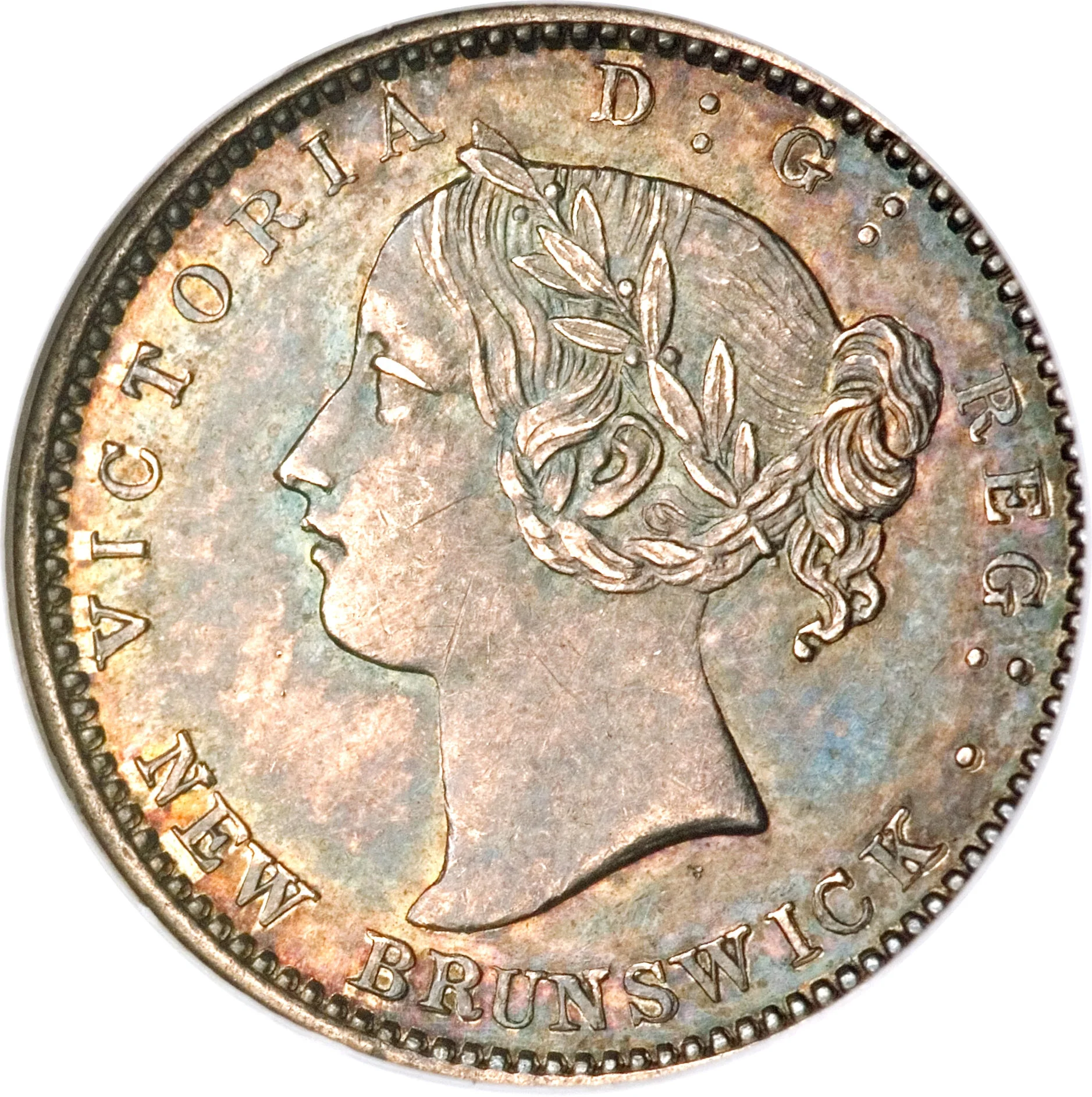
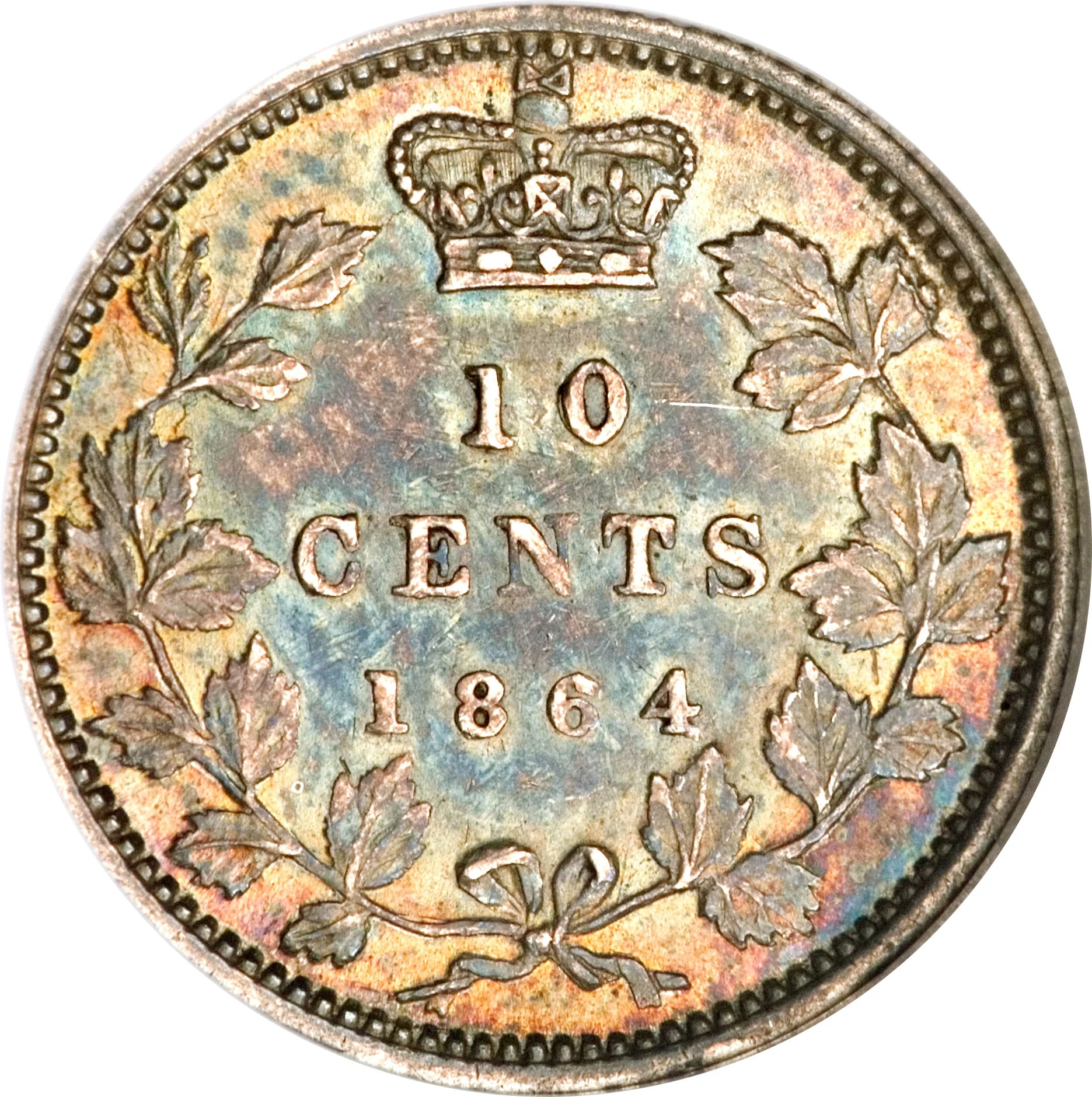
10 Cents – New Brunswick
Canada
Context
Years: 1862–1864
Country: Canada 
Issuer: New Brunswick
Ruler: Victoria
Currency:
(1860—1867)
Demonetized: Yes
Material
References
KM: #Click to copy to clipboard8
Numista: #22551
Value
Bullion value: $5.95
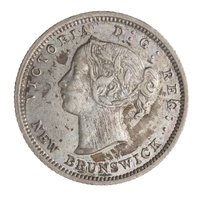
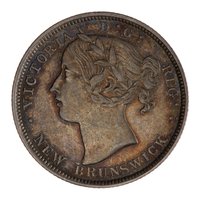
Obverse
Description:
Victoria left profile
Inscription:
VICTORIA D : G : REG :
NEW BRUNSWICK ·
NEW BRUNSWICK ·
Script: Latin
Engraver: Leonard Charles Wyon
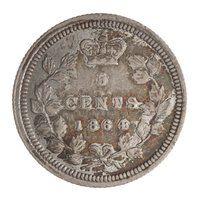
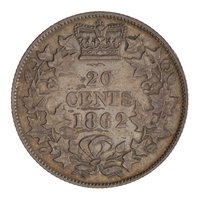
Reverse
Inscription:
10
CENTS
1864
CENTS
1864
Script: Latin
Edge
Mintings
| Year | Mint Mark | Mintage | Quality | Collection |
|---|---|---|---|---|
| 1862 | — | — | ||
| 1862 | — | — | Proof | |
| 1864 | — | — |
Historical background
In 1862, New Brunswick, like much of British North America, operated within a complex and often chaotic monetary system. The province did not issue its own decimal-based coinage until 1861, and even then, the official currency existed alongside a bewildering array of foreign coins. Spanish dollars, British sovereigns, American gold eagles, and French louis d’or all circulated with fluctuating values, creating significant challenges for trade and daily commerce. This "mixed currency" system was further complicated by the widespread use of paper notes issued by private banks, whose stability depended entirely on the solvency of the issuing institution, leading to periodic distrust and instability.
The provincial government had taken a significant step toward order with the passage of the Decimal Currency Act of 1860, which officially adopted a dollar-and-cent system pegged to the U.S. dollar. By 1862, the first provincial copper cents and silver five-cent pieces were in circulation, symbolizing a move toward a unified, colonial currency. However, this reform was incomplete. The new coins were limited in denomination and volume, failing to displace the entrenched mixture of foreign specie. Furthermore, the American Civil War to the south was causing economic disruption and driving U.S. coins out of circulation, exacerbating a chronic shortage of small change that hampered everyday transactions.
This fragmented monetary landscape underscored a growing political and economic reality: the inherent inefficiency of each colony managing its own currency. In 1862, the push for a broader intercolonial union was gaining momentum, partly as a solution to these very financial problems. The currency chaos in New Brunswick and its sister colonies became a practical argument for Confederation, which would eventually lead to a uniform national currency under the Dominion of Canada in 1871. Thus, the monetary situation of 1862 was a microcosm of the pressures pushing the colonies toward a more centralized and stable economic future.
The provincial government had taken a significant step toward order with the passage of the Decimal Currency Act of 1860, which officially adopted a dollar-and-cent system pegged to the U.S. dollar. By 1862, the first provincial copper cents and silver five-cent pieces were in circulation, symbolizing a move toward a unified, colonial currency. However, this reform was incomplete. The new coins were limited in denomination and volume, failing to displace the entrenched mixture of foreign specie. Furthermore, the American Civil War to the south was causing economic disruption and driving U.S. coins out of circulation, exacerbating a chronic shortage of small change that hampered everyday transactions.
This fragmented monetary landscape underscored a growing political and economic reality: the inherent inefficiency of each colony managing its own currency. In 1862, the push for a broader intercolonial union was gaining momentum, partly as a solution to these very financial problems. The currency chaos in New Brunswick and its sister colonies became a practical argument for Confederation, which would eventually lead to a uniform national currency under the Dominion of Canada in 1871. Thus, the monetary situation of 1862 was a microcosm of the pressures pushing the colonies toward a more centralized and stable economic future.
⭐ Rare