

25 Centavos – Brazil
Brazil


Obverse
Description:
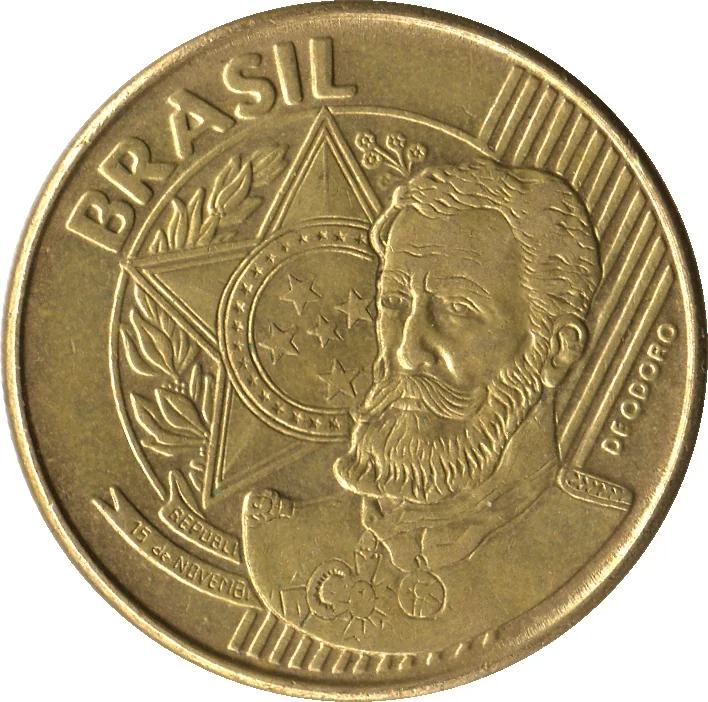
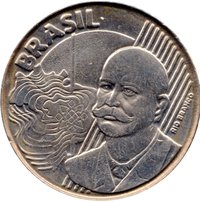
Portrait of Manuel Deodoro da Fonseca facing left, with Brazil's coat of arms beside him.
Inscription:
BRASIL
DEODORO
REPUBLI[CA]
15 de NOVEMB[RO]
DEODORO
REPUBLI[CA]
15 de NOVEMB[RO]
Translation:
Brazil
Deodoro
Republic
15th of November
Deodoro
Republic
15th of November
Script: Latin
Language: Portuguese
Reverse
Description:
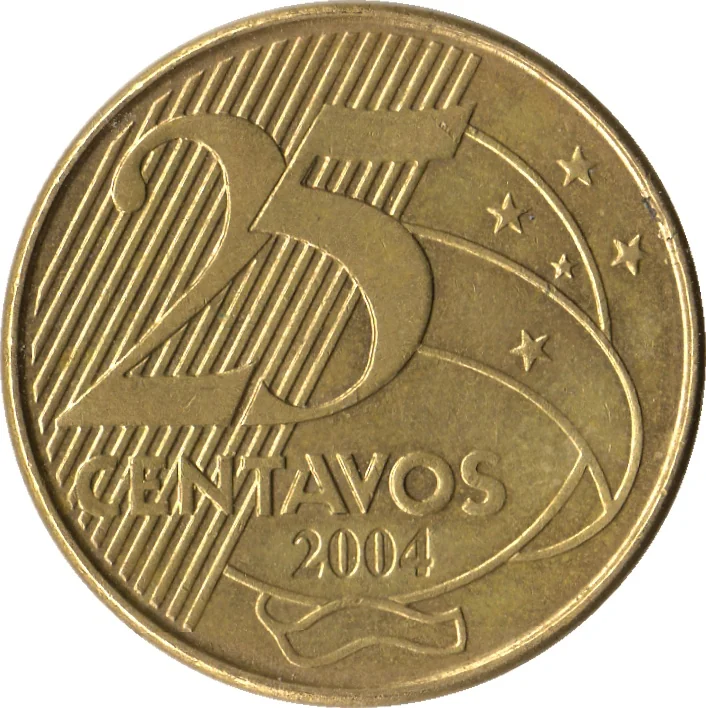
Brazilian emblem elements (stripes, stars, globe) with denomination above left date.
Inscription:
25
CENTAVOS
2004
CENTAVOS
2004
Script: Latin
Edge
Reeded
Categories
| Person> Military leader |
| Person> Politician |
| Symbols> Coat of Arms |
Mints
| Name | Mark |
|---|---|
| Casa da Moeda do Brasil | — |
Mintings
| Year | Mint Mark | Mintage | Quality | Collection |
|---|---|---|---|---|
| 1998 | — | 43,238,000 | ||
| 1999 | — | 32,766,000 | ||
| 2000 | — | 25,312,000 | ||
| 2001 | — | 92,624,000 | ||
| 2002 | — | 100,096,000 | ||
| 2003 | — | 147,200,000 | ||
| 2004 | — | 160,000,000 | ||
| 2005 | — | 100,096,000 | ||
| 2006 | — | 110,720,000 | ||
| 2007 | — | 118,784,000 | ||
| 2008 | — | 269,031,000 | ||
| 2009 | — | 320,000,000 | ||
| 2010 | — | 240,000,000 | ||
| 2011 | — | 142,592,000 | ||
| 2012 | — | 100,096,000 | ||
| 2013 | — | 360,064,000 | ||
| 2014 | — | 39,552,000 | ||
| 2015 | — | 144,000,000 | ||
| 2016 | — | 23,040,000 | ||
| 2017 | — | 103,808,000 | ||
| 2018 | — | 85,248,000 | ||
| 2019 | — | 82,944,000 | ||
| 2020 | — | 109,056,000 | ||
| 2021 | — | 136,320,000 | ||
| 2022 | — | 175,040,000 | ||
| 2023 | — | 141,184,000 | ||
| 2024 | — | 108,032,000 | ||
| 2025 | — | — |
Historical background
In 1998, Brazil found itself at the center of a severe financial storm, its currency situation defined by the fragile defense of the Real Plan's fixed exchange rate regime. Implemented in 1994, the plan had successfully ended decades of hyperinflation by tethering the real to the US dollar. However, this required maintaining high interest rates and significant foreign reserves to defend the peg, which led to a large and growing current account deficit and made the economy vulnerable to external shocks. The contagion from the 1997 Asian Financial Crisis and the 1998 Russian default triggered massive capital flight from emerging markets, putting intense speculative pressure on the real.
The government of President Fernando Henrique Cardoso, having just secured re-election, embarked on a desperate and costly defense of the currency. The Central Bank spent tens of billions of dollars from its reserves in the foreign exchange market and dramatically raised interest rates to nearly 50% to attract capital and deter speculation. This defensive strategy, however, came at a tremendous economic cost, pushing the country into recession and severely straining public finances, as the high interest rates ballooned the debt burden. Despite these efforts, market confidence continued to erode, with investors doubting the sustainability of the peg given the country's fiscal imbalances.
The situation culminated in January 1999 when Brazil was forced to abandon the fixed exchange rate, allowing the real to float. The currency promptly lost over 40% of its value against the dollar. This devaluation, while sharp, was followed by a shift to an inflation-targeting monetary framework and renewed fiscal discipline, which ultimately stabilized the economy. The 1998 currency crisis thus marked the painful end of the Real Plan's exchange rate anchor but paved the way for a more flexible and resilient monetary policy regime in the years that followed.
The government of President Fernando Henrique Cardoso, having just secured re-election, embarked on a desperate and costly defense of the currency. The Central Bank spent tens of billions of dollars from its reserves in the foreign exchange market and dramatically raised interest rates to nearly 50% to attract capital and deter speculation. This defensive strategy, however, came at a tremendous economic cost, pushing the country into recession and severely straining public finances, as the high interest rates ballooned the debt burden. Despite these efforts, market confidence continued to erode, with investors doubting the sustainability of the peg given the country's fiscal imbalances.
The situation culminated in January 1999 when Brazil was forced to abandon the fixed exchange rate, allowing the real to float. The currency promptly lost over 40% of its value against the dollar. This devaluation, while sharp, was followed by a shift to an inflation-targeting monetary framework and renewed fiscal discipline, which ultimately stabilized the economy. The 1998 currency crisis thus marked the painful end of the Real Plan's exchange rate anchor but paved the way for a more flexible and resilient monetary policy regime in the years that followed.
Series: 1998 Brazil circulation coins



🌱 Very Common