

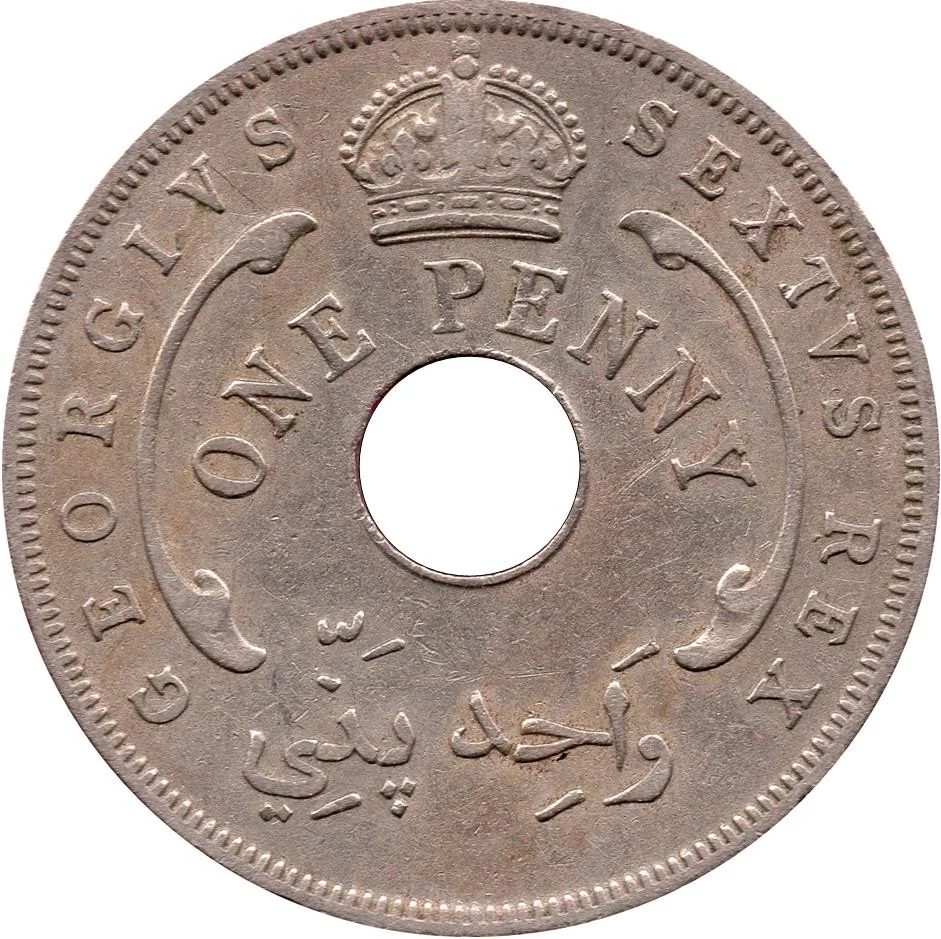
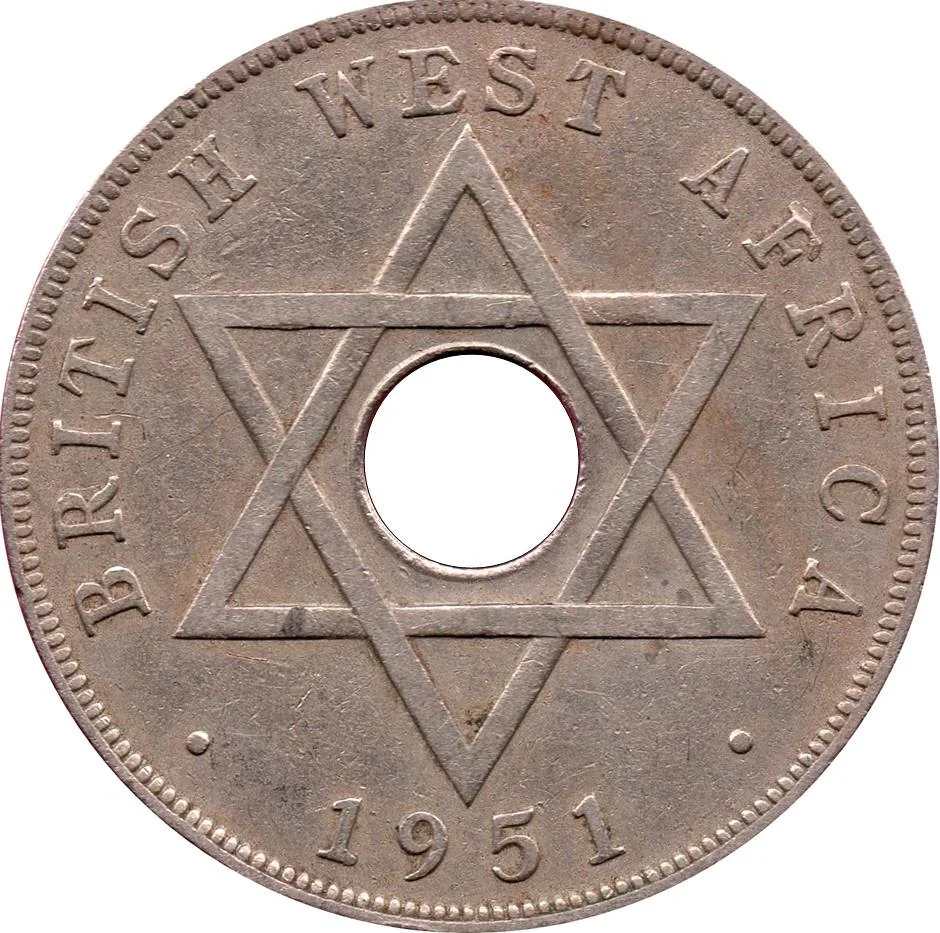
1 penny – British West Africa
Add to wishlist
Context
Year: 1951
Country: Western African States
Issuer: British West Africa
Ruler: George VI
Currency:
(1907—1968)
Demonetized: Yes
Total mintage: 3,950,000
Material
Diameter: 30.5 mm
Weight: 9.45 g
Shape: Round with a round hole
Technique: Milled
Alignment: Medal alignment
flip
References
KM: #
Numista: #22487
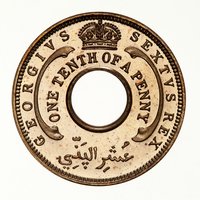
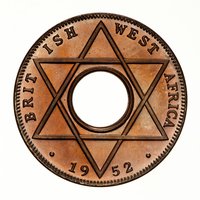
Obverse
Reverse
Edge
Plain
Mints
| Name | Mark |
|---|---|
| Kings Norton Metal Company | KN |
Mintings
| Year | Mint Mark | Mintage | Quality | Collection |
|---|---|---|---|---|
| 1951 | — | 1,258,000 | ||
| 1951 | — | — | Proof | |
| 1951 | KN | 2,692,000 |
Historical background
In 1951, the currency situation in British West Africa was defined by the West African Currency Board (WACC), established in 1912. This system was not a central bank but a currency board, designed to ensure full convertibility with British sterling. The primary currency was the West African pound (WA£), which was pegged at par with the UK pound sterling. For every WA£ issued, an equivalent amount of sterling reserves was held in London, ensuring strict monetary discipline but also tying the region's economic fortunes directly to the UK and limiting local monetary policy autonomy.
The system was highly efficient for its intended purposes: facilitating colonial trade, ensuring price stability, and providing a reliable medium of exchange across Nigeria, the Gold Coast (Ghana), Sierra Leone, and The Gambia. However, by 1951, its limitations were becoming increasingly apparent to a growing class of nationalist politicians and economists. The arrangement was criticized for directing the region's substantial sterling reserves to the London money market, where they supported the British economy rather than being available for local development projects. Furthermore, the lack of a local central bank meant there was no mechanism to regulate credit or manage the money supply to stimulate West African industrial and agricultural growth.
The year 1951 fell within a crucial period of political transition, with moves towards self-government in several territories. This political awakening fueled the debate for monetary reform, setting the stage for the eventual dissolution of the WACC. Just a few years later, individual central banks would begin to be established, starting with the Bank of Ghana in 1957, marking the end of the unified colonial currency era and the beginning of national monetary systems tailored to local economic needs.
The system was highly efficient for its intended purposes: facilitating colonial trade, ensuring price stability, and providing a reliable medium of exchange across Nigeria, the Gold Coast (Ghana), Sierra Leone, and The Gambia. However, by 1951, its limitations were becoming increasingly apparent to a growing class of nationalist politicians and economists. The arrangement was criticized for directing the region's substantial sterling reserves to the London money market, where they supported the British economy rather than being available for local development projects. Furthermore, the lack of a local central bank meant there was no mechanism to regulate credit or manage the money supply to stimulate West African industrial and agricultural growth.
The year 1951 fell within a crucial period of political transition, with moves towards self-government in several territories. This political awakening fueled the debate for monetary reform, setting the stage for the eventual dissolution of the WACC. Just a few years later, individual central banks would begin to be established, starting with the Bank of Ghana in 1957, marking the end of the unified colonial currency era and the beginning of national monetary systems tailored to local economic needs.
⭐ Somewhat Rare