

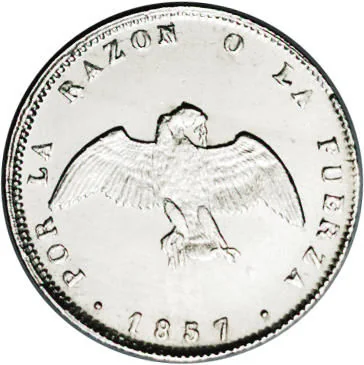
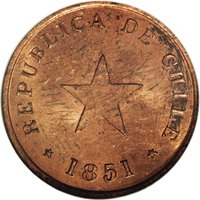
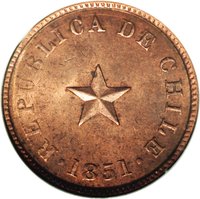
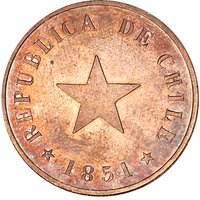
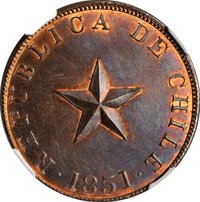
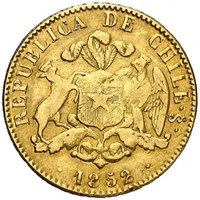
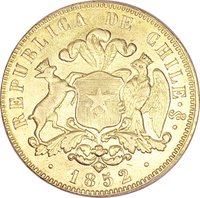
Obverse
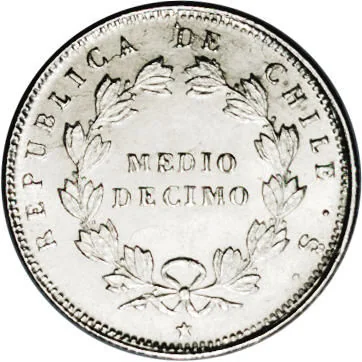
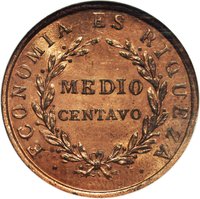
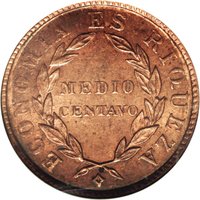
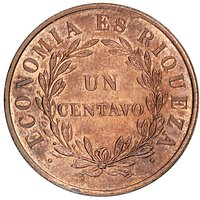
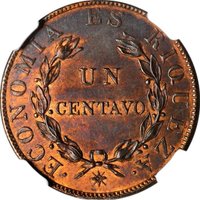
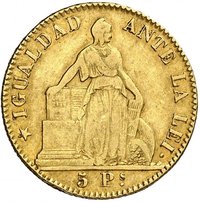
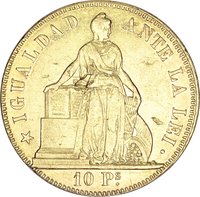
Reverse
Edge
Mints
| Name | Mark |
|---|---|
| Casa de Moneda de Chile | (So) |
Mintings
| Year | Mint Mark | Mintage | Quality | Collection |
|---|---|---|---|---|
| 1851 | So | 233,000 | ||
| 1853 | So | — | ||
| 1854 | So | 122,000 | ||
| 1855 | So | 1,257,000 | ||
| 1856 | So | 767,000 | ||
| 1857 | So | 1,655,000 | ||
| 1858 | So | 318,000 | ||
| 1859 | So | 41,000 |
Historical background
In 1851, Chile's currency system was a complex and unstable mixture of metallic and paper money, reflecting the nation's early post-independence economic growing pains. The foundation was the peso, defined as a specific weight of fine silver (approximately 23.1 grams), but the actual circulating medium was a chaotic array of Chilean-minted coins, foreign coins (especially from Peru and Bolivia), and privately issued paper notes. The most significant metallic currency was the gold escudo, valued at 16 silver pesos, but its market value fluctuated wildly based on the international gold-silver exchange rate, creating a de facto bimetallic system prone to Gresham's Law, where undervalued coins were hoarded or exported.
This instability was exacerbated by the proliferation of paper money issued by private commercial banks and even by the Treasury itself to finance government deficits. These banknotes, while convenient, were not always fully convertible into specie (hard coin) on demand, leading to frequent distrust and depreciation. The situation created a dual economy: international trade and large transactions were conducted in hard currency (especially gold), while the domestic economy and smaller transactions relied on a fluctuating mix of silver and often-discounted paper. This lack of a uniform, trusted national currency hindered commerce and investment.
The year 1851 itself was a point of crisis and transition. The government of President Manuel Montt, seeking to impose order, had contracted with a French company to establish a new national mint (Casa de Moneda), which began operations that very year. This was a direct response to the monetary chaos, aiming to produce standardized, high-quality Chilean coinage to drive out foreign and debased coins. While the full reform and stabilization of the currency would take more time—culminating in the law of 1859 that established a gold standard—the actions set in motion in 1851 marked the critical beginning of the state's concerted effort to monopolize coinage and assert control over the monetary system, laying the groundwork for Chile's later 19th-century economic expansion.
This instability was exacerbated by the proliferation of paper money issued by private commercial banks and even by the Treasury itself to finance government deficits. These banknotes, while convenient, were not always fully convertible into specie (hard coin) on demand, leading to frequent distrust and depreciation. The situation created a dual economy: international trade and large transactions were conducted in hard currency (especially gold), while the domestic economy and smaller transactions relied on a fluctuating mix of silver and often-discounted paper. This lack of a uniform, trusted national currency hindered commerce and investment.
The year 1851 itself was a point of crisis and transition. The government of President Manuel Montt, seeking to impose order, had contracted with a French company to establish a new national mint (Casa de Moneda), which began operations that very year. This was a direct response to the monetary chaos, aiming to produce standardized, high-quality Chilean coinage to drive out foreign and debased coins. While the full reform and stabilization of the currency would take more time—culminating in the law of 1859 that established a gold standard—the actions set in motion in 1851 marked the critical beginning of the state's concerted effort to monopolize coinage and assert control over the monetary system, laying the groundwork for Chile's later 19th-century economic expansion.
Series: 1851 Chile circulation coins
⭐ Somewhat Rare