

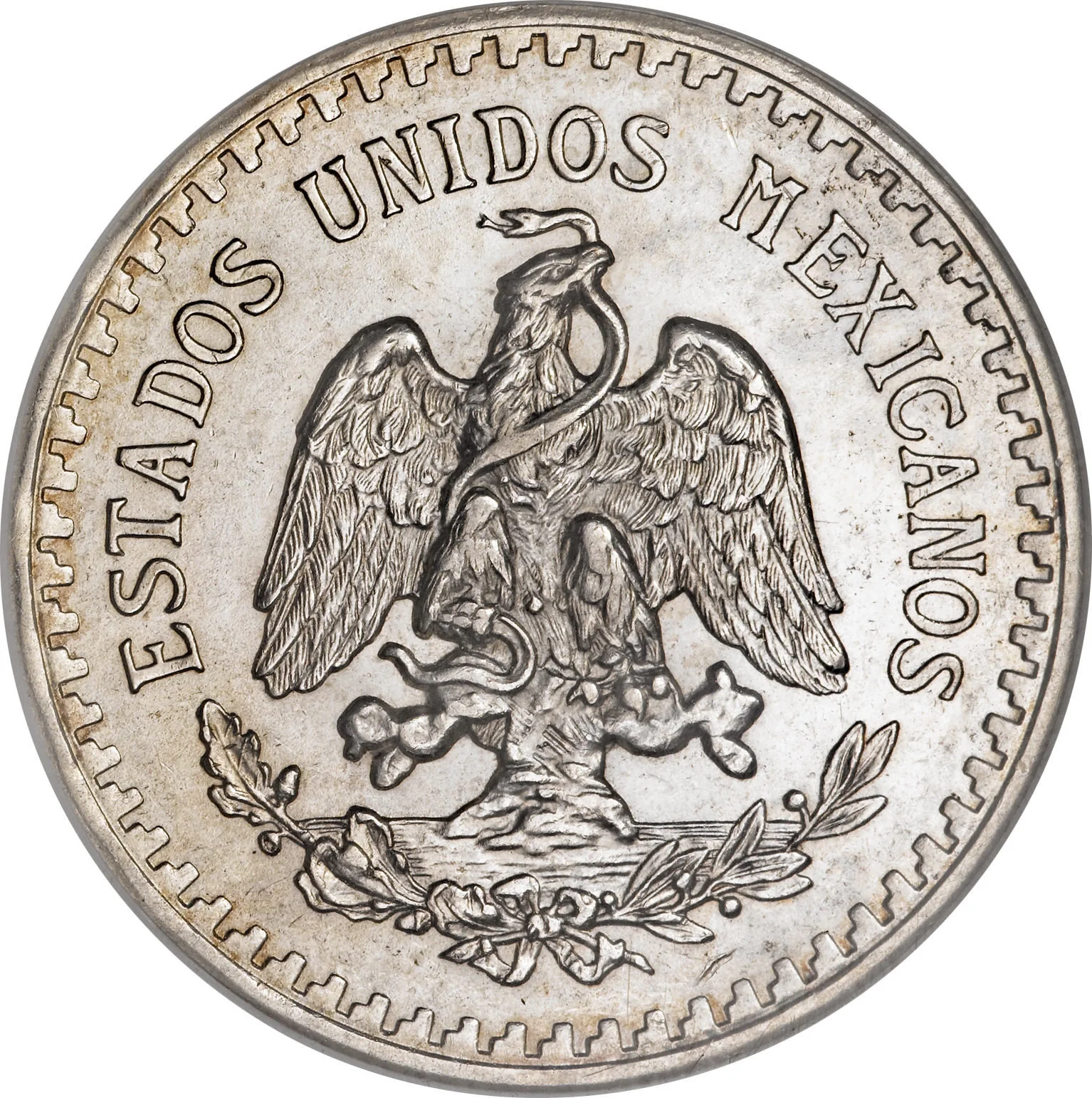
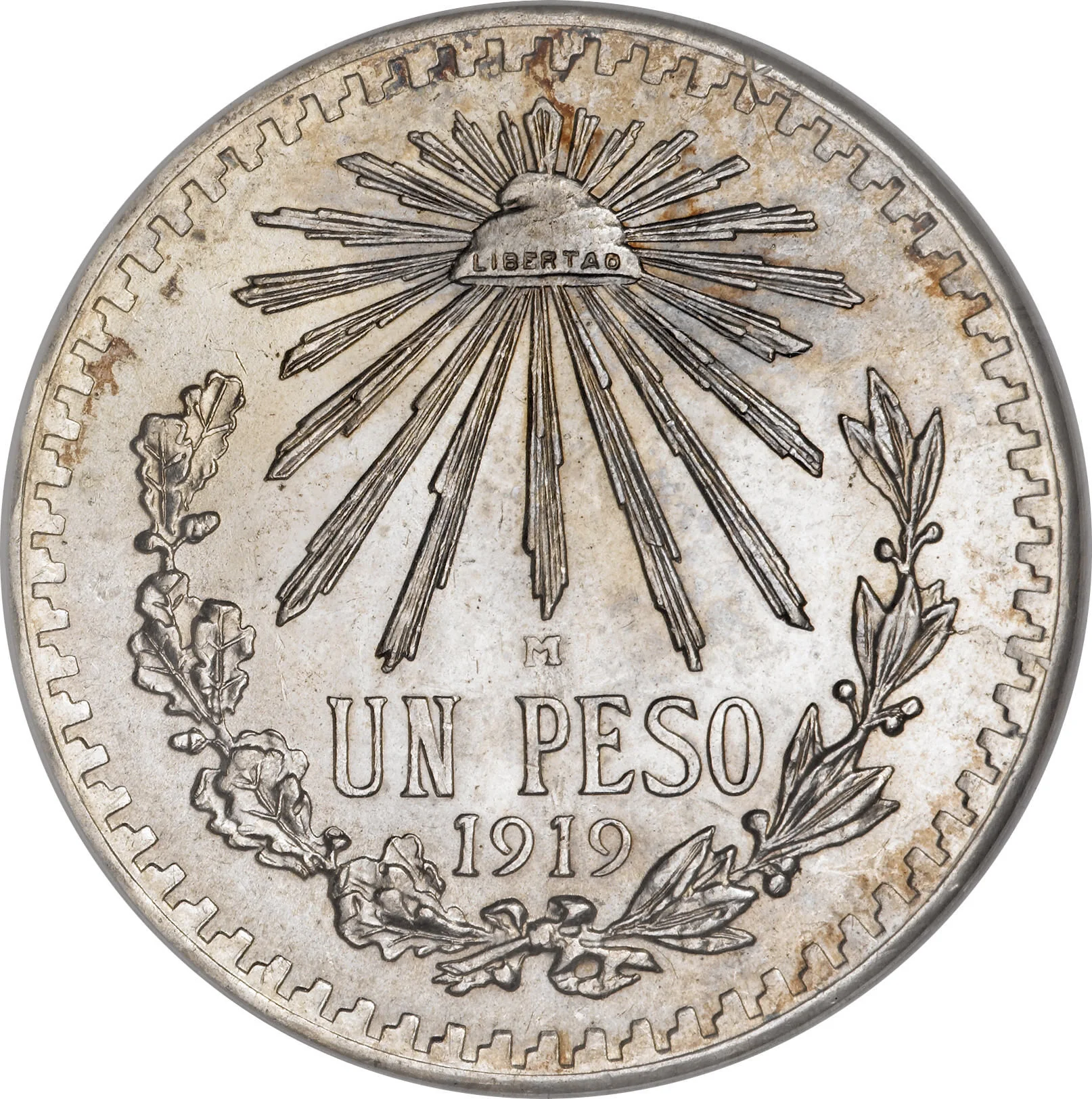
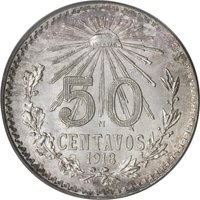
Obverse
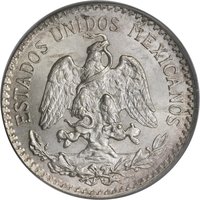
Reverse
Edge
Mints
| Name | Mark |
|---|---|
| Mexican Mint | (M) |
Mintings
| Year | Mint Mark | Mintage | Quality | Collection |
|---|---|---|---|---|
| 1918 | M | 3,050,000 | ||
| 1919 | M | 6,151,000 |
Historical background
In 1918, Mexico's currency situation was a direct and chaotic legacy of the decade-long Mexican Revolution (1910-1920). The fiscal discipline of the Porfirio Díaz regime had long since collapsed, and the country was fractured among competing factions—Constitutionalists under Venustiano Carranza, the Conventionists, and various regional armies like the Zapatistas and Villistas. Each faction, needing to fund its war efforts, resorted to printing its own paper money, often with little to no backing. This resulted in a proliferation of disparate banknotes—bilimbiques—from multiple issuing authorities, which circulated with wildly fluctuating and generally plummeting value. Public trust in paper currency was virtually nonexistent, leading to widespread reliance on barter and a stubborn preference for silver coinage, when it could be found.
The official government in Mexico City, led by Carranza, faced a dire financial crisis. Its paper currency, the infalsificable note, was heavily discounted and suffered from rampant counterfeiting. Crucially, the revolution had destroyed the banking system and severed access to international credit. With tax collection minimal and the economy in ruins, the state's primary revenue came from printing more money, fueling a vicious cycle of inflation. The situation was exacerbated by a global shortage of silver due to World War I, which drove the precious metal out of circulation as it was either hoarded or exported, leaving the public with ever-more worthless paper.
Consequently, Mexico in 1918 operated with a fractured and unstable dual monetary system. In daily transactions, especially outside major cities, people rejected paper and clung to the silver peso fuerte or even pre-revolutionary gold coins for any significant exchange, while a flood of dubious paper notes circulated for lack of alternatives. This monetary anarchy severely hampered economic recovery and trade, reflecting the broader political instability. It was a problem that would only begin to be resolved after the revolution's end with the consolidation of political power and the founding of the Bank of Mexico in 1925, which established a sole issuer of currency.
The official government in Mexico City, led by Carranza, faced a dire financial crisis. Its paper currency, the infalsificable note, was heavily discounted and suffered from rampant counterfeiting. Crucially, the revolution had destroyed the banking system and severed access to international credit. With tax collection minimal and the economy in ruins, the state's primary revenue came from printing more money, fueling a vicious cycle of inflation. The situation was exacerbated by a global shortage of silver due to World War I, which drove the precious metal out of circulation as it was either hoarded or exported, leaving the public with ever-more worthless paper.
Consequently, Mexico in 1918 operated with a fractured and unstable dual monetary system. In daily transactions, especially outside major cities, people rejected paper and clung to the silver peso fuerte or even pre-revolutionary gold coins for any significant exchange, while a flood of dubious paper notes circulated for lack of alternatives. This monetary anarchy severely hampered economic recovery and trade, reflecting the broader political instability. It was a problem that would only begin to be resolved after the revolution's end with the consolidation of political power and the founding of the Bank of Mexico in 1925, which established a sole issuer of currency.
🌟 Uncommon