

10 markkaa – Finland
Add to wishlist
Finland
Context
Years: 1878–1913
Issuer: Finland
Ruler: Alexander II
Currency:
(1860—1963)
Demonetized: Yes
Total mintage: 1,481,000
Material
References
KM: #
Numista: #22278
Value
Bullion value: $443.53
Obverse
Description:
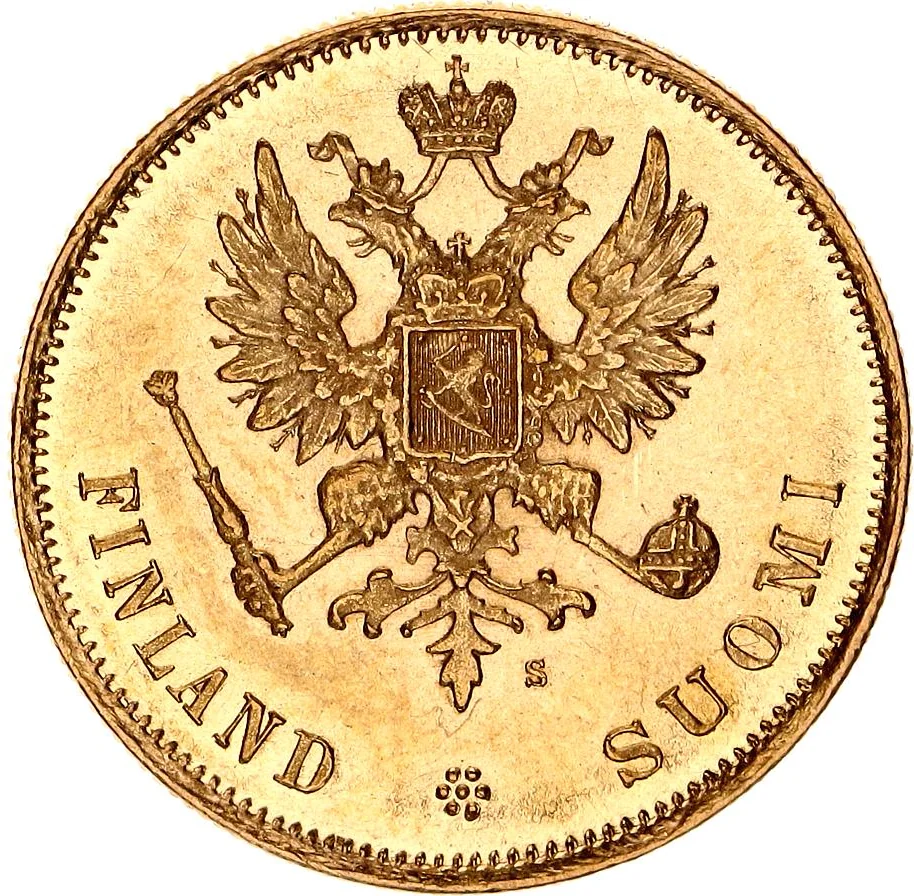
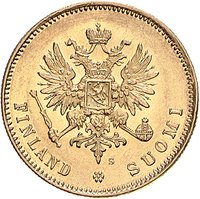
Double-headed eagle with crown, holding orb and scepter, surrounded by legend.
Inscription:
S
FINLAND SUOMI
FINLAND SUOMI
Script: Latin
Reverse
Description:
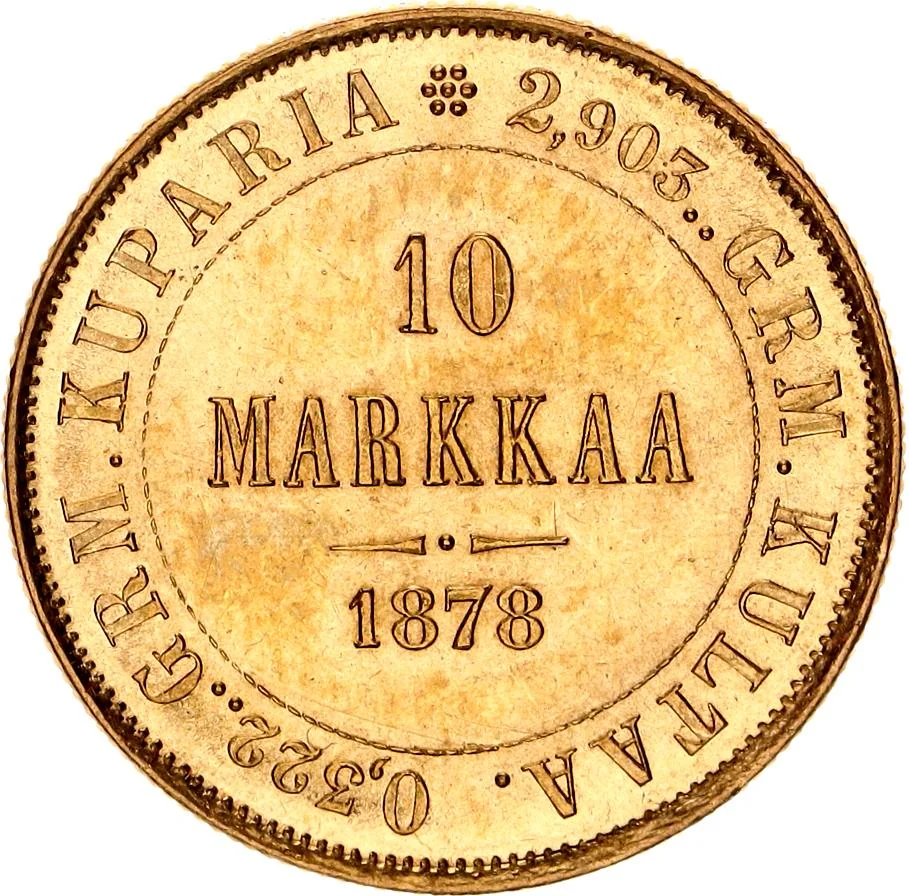
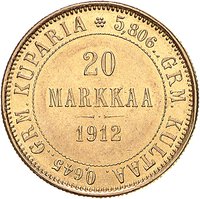
Denomination above date inside circle, legend around.
Inscription:
0,322..GRM.KUPARIA * 2,903..GRM.KULTAA.
10
MARKKAA
1881
10
MARKKAA
1881
Script: Latin
Edge
Reeded
Categories
| Symbol> Double-headed eagle |
| Object> Globus cruciger |
| Animal> Bird |
| Symbol> Crown |
| Symbols> Coat of Arms |
Mints
| Name | Mark |
|---|---|
| Mint of Finland | — |
Mintings
| Year | Mint Mark | Mintage | Quality | Collection |
|---|---|---|---|---|
| 1878 | — | 254,000 | ||
| 1879 | — | 200,000 | ||
| 1881 | — | 100,000 | ||
| 1882 | — | 386,000 | ||
| 1904 | — | 102,000 | ||
| 1905 | — | 43,000 | ||
| 1913 | — | 396,000 |
Historical background
In 1878, Finland operated under a distinct monetary system as an autonomous Grand Duchy within the Russian Empire. The official currency was the Finnish markka (markka in Finnish, mark in Swedish), which had been introduced in 1860, replacing the Russian ruble as part of a broader strategy to strengthen Finnish economic autonomy. This new currency was pegged to silver, adhering to the international silver standard, with one markka defined as a specific weight of fine silver. The Bank of Finland, founded in 1811, held the exclusive right to issue banknotes and managed the currency's stability.
However, the global monetary landscape was shifting. The 1870s saw many major nations, notably Germany, moving from a silver to a gold standard, causing the value of silver to fluctuate and decline. This created a period of uncertainty for Finland's silver-based markka, as its external value became less stable against gold-backed currencies. While the Finnish system functioned domestically, international trade and financial calculations became more complex, prompting early discussions among Finnish officials and economists about the potential need to follow the global trend toward gold.
Thus, the currency situation in 1878 was one of established autonomy but growing external pressure. The Finnish markka was a symbol of national identity and self-governance, yet its foundation on the silver standard was becoming increasingly anachronistic. The year fell within a transitional decade where Finland enjoyed a stable and functional currency, but the seeds for a future monetary reform—the eventual adoption of the gold standard in 1877-1878 for international transactions and formally in 1886—were being sown in response to these international economic currents.
However, the global monetary landscape was shifting. The 1870s saw many major nations, notably Germany, moving from a silver to a gold standard, causing the value of silver to fluctuate and decline. This created a period of uncertainty for Finland's silver-based markka, as its external value became less stable against gold-backed currencies. While the Finnish system functioned domestically, international trade and financial calculations became more complex, prompting early discussions among Finnish officials and economists about the potential need to follow the global trend toward gold.
Thus, the currency situation in 1878 was one of established autonomy but growing external pressure. The Finnish markka was a symbol of national identity and self-governance, yet its foundation on the silver standard was becoming increasingly anachronistic. The year fell within a transitional decade where Finland enjoyed a stable and functional currency, but the seeds for a future monetary reform—the eventual adoption of the gold standard in 1877-1878 for international transactions and formally in 1886—were being sown in response to these international economic currents.
🌟 Limited