


50 pesos uruguayos (Independence) – Uruguay
Add to wishlist
Circulating commemorative coins
Commemoration: 200th Anniversary of Independence
Uruguay

Obverse
Description:
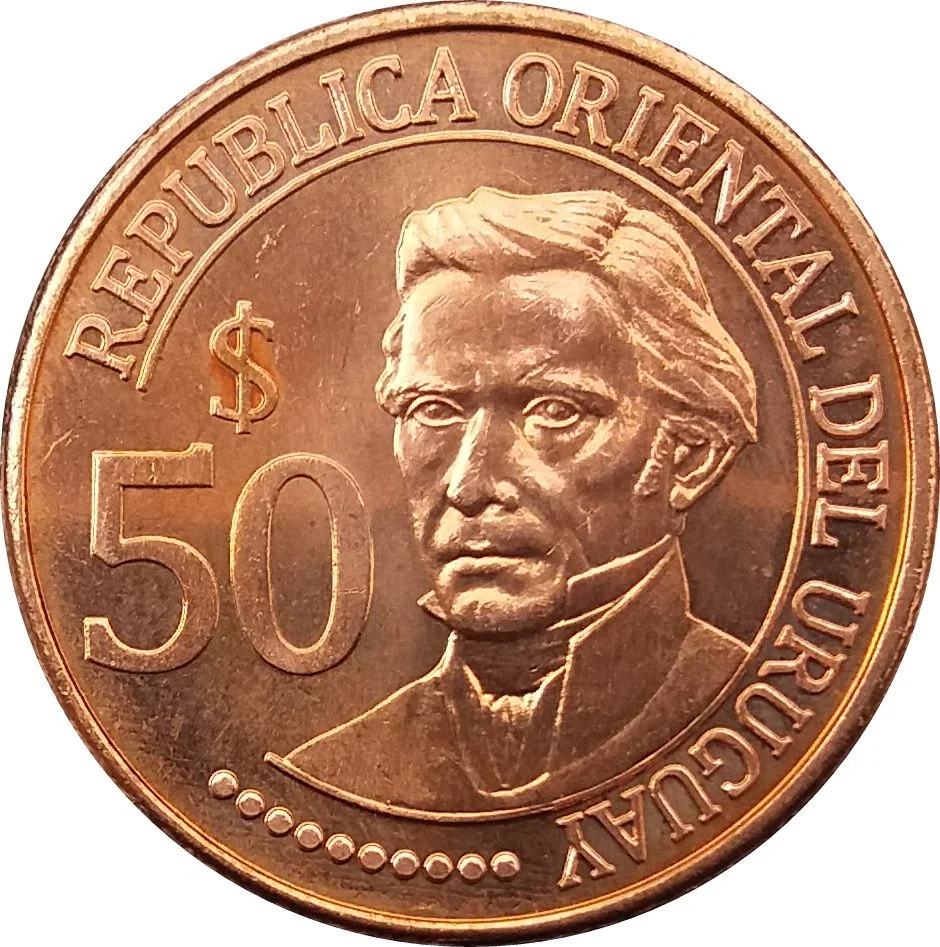
Portrait of José Gervasio Artigas by Blanes, facing left. Country name arcs top-right, face value at left.
Inscription:
REPUBLICA ORIENTAL DEL URUGUAY ••••••••••
$
50
$
50
Translation:
ORIENTAL REPUBLIC OF URUGUAY ••••••••••
$
50
$
50
Script: Latin
Language: Spanish
Engraver: Dalibor Schmidt
Reverse
Description:
Radiant sun with face, event name encircled, years beneath.
Inscription:
BICENTENARIO DE LOS HECHOS HISTORICOS
• 1811-2011 •
• 1811-2011 •
Translation:
Bicentenary of the Historical Events
• 1811-2011 •
• 1811-2011 •
Script: Latin
Language: Spanish
Engraver: Dalibor Schmidt
Edge
Reeded
Categories
| Person> Military leader |
| Person> Politician |
| Symbol> Sun |
Mints
| Name | Mark |
|---|---|
| Kremnica | — |
Mintings
| Year | Mint Mark | Mintage | Quality | Collection |
|---|---|---|---|---|
| 2011 | — | 1,000 | In sets | |
| 2011 | — | 1,000 | Proof | |
| 2011 | — | 9,999,000 |
Historical background
In 2011, Uruguay's currency situation was characterized by a sustained period of peso appreciation and strong capital inflows, presenting both opportunities and policy challenges for the left-wing government of President José Mujica. The Uruguayan peso had been steadily strengthening against the US dollar since the mid-2000s, a trend that continued into 2011, driven by high global prices for the country's key exports (beef, soy, dairy), a booming tourism sector, and attractive interest rates that drew substantial foreign investment into local debt markets. This appreciation helped control inflation by making imports cheaper but simultaneously pressured the competitiveness of Uruguayan exports and local industries facing cheaper imported goods.
The government and the Central Bank of Uruguay (BCU) responded with a multi-pronged strategy focused on managed exchange rate flexibility. Key interventions included aggressive accumulation of foreign reserves—which grew significantly throughout the year—to curb the pace of appreciation. Furthermore, the BCU implemented a unique system of "non-remunerated reserve requirements" for foreign capital entering the country for short-term investments, aiming to deter speculative "hot money" and reduce volatility. These measures were part of a broader macroprudential framework designed to maintain financial stability without resorting to full capital controls.
Overall, the 2011 currency dynamic reflected Uruguay's robust post-2008 crisis recovery and its attractiveness as a stable investment destination in the region. However, it underscored the ongoing tension for a small, open commodity-exporting economy: managing inflationary pressures and capital inflows while attempting to safeguard the export sector from an excessively strong currency. The policies of that year were largely seen as successful in preventing disruptive volatility, though the structural challenge of a strong peso remained a central topic of economic debate.
The government and the Central Bank of Uruguay (BCU) responded with a multi-pronged strategy focused on managed exchange rate flexibility. Key interventions included aggressive accumulation of foreign reserves—which grew significantly throughout the year—to curb the pace of appreciation. Furthermore, the BCU implemented a unique system of "non-remunerated reserve requirements" for foreign capital entering the country for short-term investments, aiming to deter speculative "hot money" and reduce volatility. These measures were part of a broader macroprudential framework designed to maintain financial stability without resorting to full capital controls.
Overall, the 2011 currency dynamic reflected Uruguay's robust post-2008 crisis recovery and its attractiveness as a stable investment destination in the region. However, it underscored the ongoing tension for a small, open commodity-exporting economy: managing inflationary pressures and capital inflows while attempting to safeguard the export sector from an excessively strong currency. The policies of that year were largely seen as successful in preventing disruptive volatility, though the structural challenge of a strong peso remained a central topic of economic debate.

🌱 Common