

Obverse
Description:
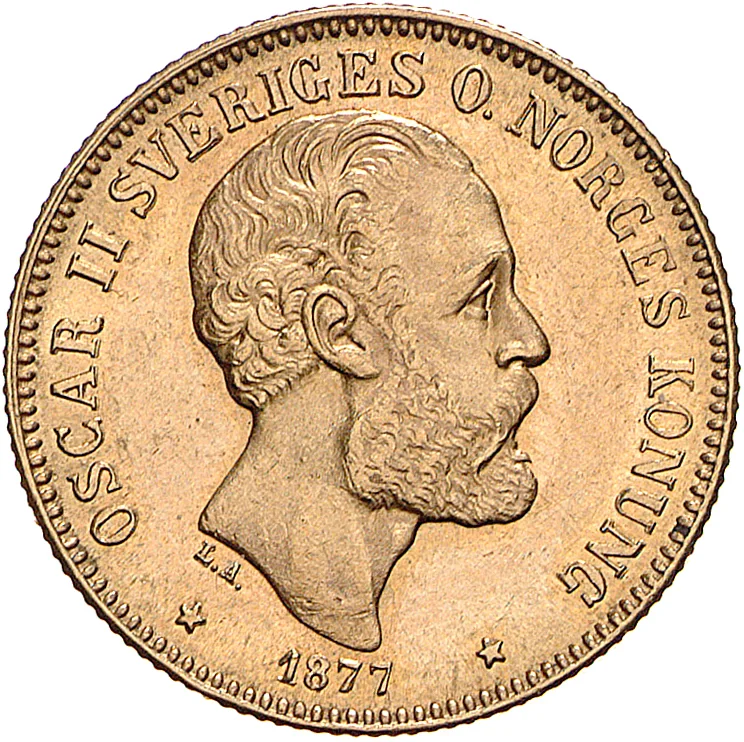
Oscar II facing right, inscription surrounding. Date between stars below.
Inscription:
OSCAR II SVERIGES O. NORGES KONUNG
L.A.
★ 1877 ★
L.A.
★ 1877 ★
Translation:
Oscar II Sweden's and Norway's King
L.A.
★ 1877 ★
L.A.
★ 1877 ★
Script: Latin
Engraver: Lea Ahlborn
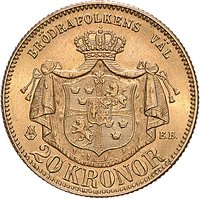
Reverse
Description:
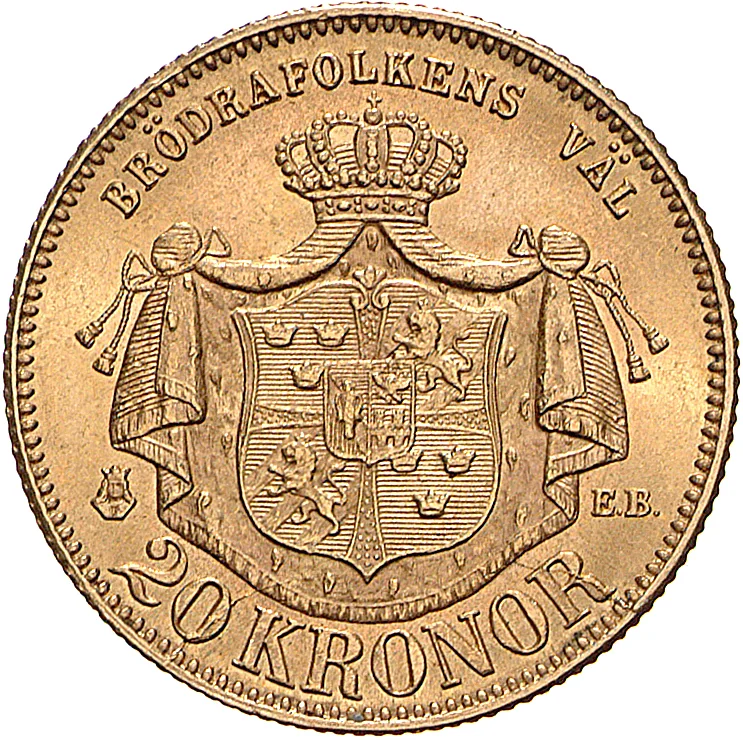
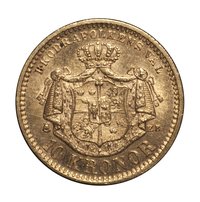
Crowned mantle with royal arms divides mintmarks, motto above, value below.
Inscription:
BRODRAFOLKENS VÄL
E.B.
20 KRONOR
E.B.
20 KRONOR
Translation:
For the welfare of the brother peoples
E.B.
20 Kronor
E.B.
20 Kronor
Script: Latin
Language: Swedish
Engraver: Lea Ahlborn
Edge
Reeded
Mints
| Name | Mark |
|---|---|
| Kungliga Myntet | — |
Mintings
| Year | Mint Mark | Mintage | Quality | Collection |
|---|---|---|---|---|
| 1876 | — | 213,750 | ||
| 1877 | — | 103,009 |
Historical background
In 1876, Sweden was on the cusp of a significant monetary transformation, moving from a complex dual-currency system to a modern, unified one. For centuries, the nation had operated with both the Riksdaler Riksmynt (the domestic currency for everyday transactions) and the Riksdaler Specie (a higher-value currency used for international trade and large-scale banking). This system was cumbersome, with a fixed but awkward exchange rate between the two, creating unnecessary complication for commerce and economic planning. The intellectual and political push for reform was driven by the ideals of the Scandinavian Monetary Union, a proposed alliance with Denmark and Norway to facilitate trade and stability by adopting a common currency standard based on gold.
The pivotal reform was the Currency Act of 1876, which legally established the Swedish krona (plural: kronor) as the sole monetary unit, replacing the Riksdaler. The krona, meaning "crown," was introduced at a rate of 1 krona = ½ Riksdaler Riksmynt, effectively simplifying the old decimal system. Crucially, Sweden joined the Scandinavian Monetary Union (formally established in 1873) by pegging the new krona to the gold standard at the same parity as the Danish and Norwegian crowns. This meant the currencies of the three nations were legally fixed to gold and accepted at par within the union, aiming to function almost as a single currency area.
The immediate background in 1876, therefore, was one of implementation and transition. While the legal framework and new coinage were introduced, the full practical effects of this shift to a gold-backed krona within a multinational union unfolded in the following years. The reform symbolized Sweden's integration into the international financial system and its commitment to monetary orthodoxy and stability, which would underpin the country's rapid industrial expansion in the late 19th century. The Scandinavian Monetary Union itself functioned smoothly for decades before effectively dissolving in the economic turmoil following World War I, though the krona remained Sweden's national currency.
The pivotal reform was the Currency Act of 1876, which legally established the Swedish krona (plural: kronor) as the sole monetary unit, replacing the Riksdaler. The krona, meaning "crown," was introduced at a rate of 1 krona = ½ Riksdaler Riksmynt, effectively simplifying the old decimal system. Crucially, Sweden joined the Scandinavian Monetary Union (formally established in 1873) by pegging the new krona to the gold standard at the same parity as the Danish and Norwegian crowns. This meant the currencies of the three nations were legally fixed to gold and accepted at par within the union, aiming to function almost as a single currency area.
The immediate background in 1876, therefore, was one of implementation and transition. While the legal framework and new coinage were introduced, the full practical effects of this shift to a gold-backed krona within a multinational union unfolded in the following years. The reform symbolized Sweden's integration into the international financial system and its commitment to monetary orthodoxy and stability, which would underpin the country's rapid industrial expansion in the late 19th century. The Scandinavian Monetary Union itself functioned smoothly for decades before effectively dissolving in the economic turmoil following World War I, though the krona remained Sweden's national currency.
💎 Very Rare