

6 Rigsdaler courant – Denmark
Denmark
Context
Years: 1854–1855
Issuer: Denmark 
Ruler: Frederick VII
Currency:
(1854—1873)
Subdivision: 6 Rigsdaler courant = 1 Rigsdaler
Demonetized: Yes
Material
References
KM: #Click to copy to clipboard760
Numista: #22192
Value
Bullion value: $35.94
Obverse
Description:
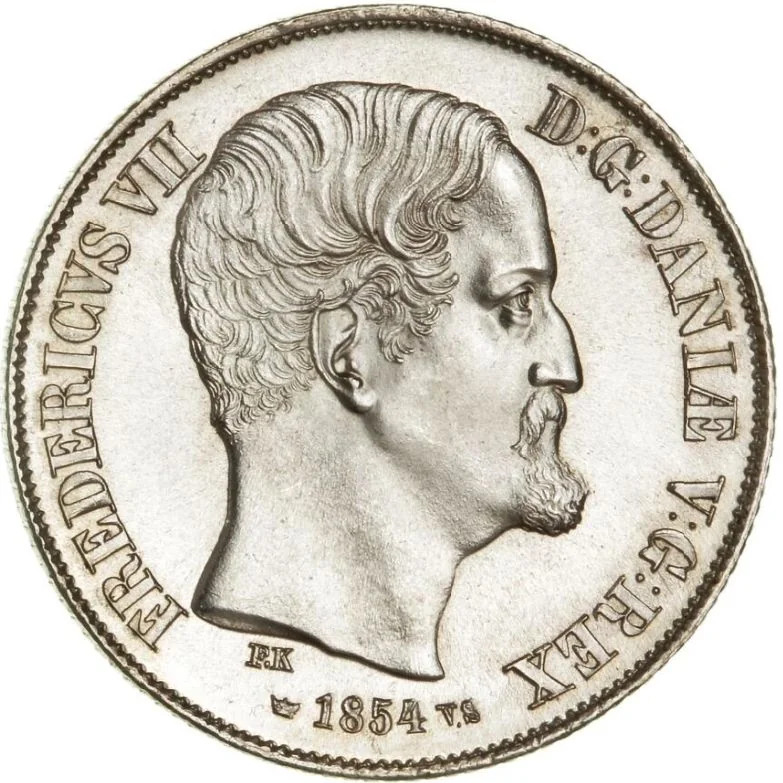
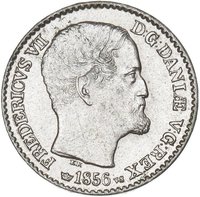
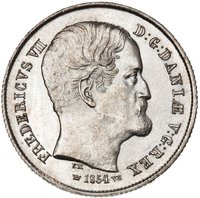
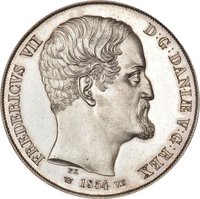
King Frederik VII right. Date below neck, between mintmark and Mint Master initials.
Inscription:
FREDERICVS VII | D:G:DANIÆ V:G:REX
F.K.
♔1854 V.S.
F.K.
♔1854 V.S.
Translation:
Frederick the Seventh, by the Grace of God, King of Denmark, the Wends and the Goths.
F.K. (Fredericus, Konge)
1854 V.S.
F.K. (Fredericus, Konge)
1854 V.S.
Script: Latin
Engraver: Frederik Christopher Krohn
Reverse
Description:
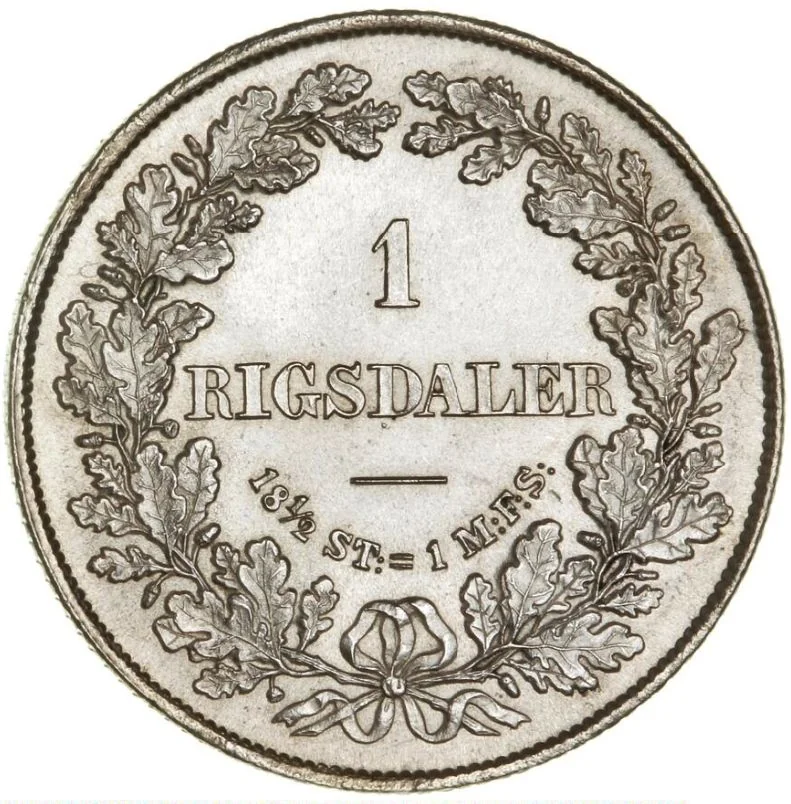
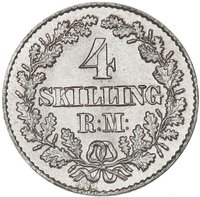
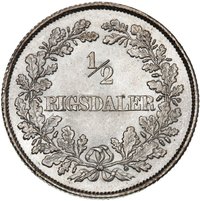
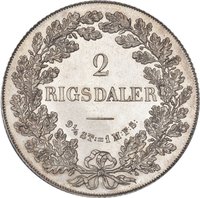
Silver value within a wreath of crossed oak branches.
Inscription:
1
RIGSDALER
18½ ST: = 1 M:F:S:
RIGSDALER
18½ ST: = 1 M:F:S:
Script: Latin
Engraver: Frederik Christopher Krohn
Edge
Reeded
Mints
| Name | Mark |
|---|---|
| Altona, Schleswig-Holstein | ♁ |
| Royal Danish Mint | ♔ |
Historical background
In 1854, Denmark’s currency system was in a state of transition, caught between the old and the emerging modern European financial order. The country was part of the Scandinavian Monetary Union in spirit but not yet in law; that formal union with Sweden and Norway would not be established until 1873. Instead, Denmark operated on a silver standard, with the rigsdaler as its primary unit. However, the system was complex, with both rigsdaler courant (used for everyday transactions) and rigsdaler specie (a higher-value unit tied to silver) circulating simultaneously, a duality that often caused public confusion and inefficiency in commerce.
This period was marked by significant economic strain, which directly pressured the currency. The costly First Schleswig War (1848-1851) had just ended, leaving the Danish state with a heavy burden of debt and a need for fiscal stability. Furthermore, the mid-19th century saw a major European shift from silver to gold as the basis for currency, driven by discoveries of gold in California and Australia. Denmark, feeling the economic pull of its major trading partners, was beginning to seriously debate abandoning its silver standard to adopt gold, a move seen as crucial for facilitating international trade and investment.
Consequently, the currency situation in 1854 was one of quiet preparation for major reform. The government and financial elites were actively studying and planning for a new, decimalized currency system anchored on gold, which would eventually materialize two decades later with the creation of the krone. Thus, the year represents a pivotal moment not of crisis, but of deliberate contemplation, laying the administrative and intellectual groundwork for the modern Danish monetary system that would emerge from the economic and political challenges of the era.
This period was marked by significant economic strain, which directly pressured the currency. The costly First Schleswig War (1848-1851) had just ended, leaving the Danish state with a heavy burden of debt and a need for fiscal stability. Furthermore, the mid-19th century saw a major European shift from silver to gold as the basis for currency, driven by discoveries of gold in California and Australia. Denmark, feeling the economic pull of its major trading partners, was beginning to seriously debate abandoning its silver standard to adopt gold, a move seen as crucial for facilitating international trade and investment.
Consequently, the currency situation in 1854 was one of quiet preparation for major reform. The government and financial elites were actively studying and planning for a new, decimalized currency system anchored on gold, which would eventually materialize two decades later with the creation of the krone. Thus, the year represents a pivotal moment not of crisis, but of deliberate contemplation, laying the administrative and intellectual groundwork for the modern Danish monetary system that would emerge from the economic and political challenges of the era.
Series: 1854 Denmark circulation coins
⭐ Somewhat Rare