

5 rand – South Africa
Add to wishlist
South Africa
Context
Year: 2010
Issuer: South Africa
Period:
(since 1961)
Currency:
(since 1961)
Total mintage: 8,065,563
Material
References
KM: #
Numista: #21986
Value
Exchange value: 5 ZAR
Inflation-adjusted value: 10.73 ZAR
Obverse
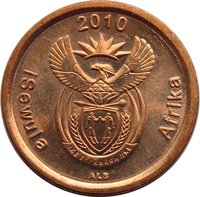
Description:
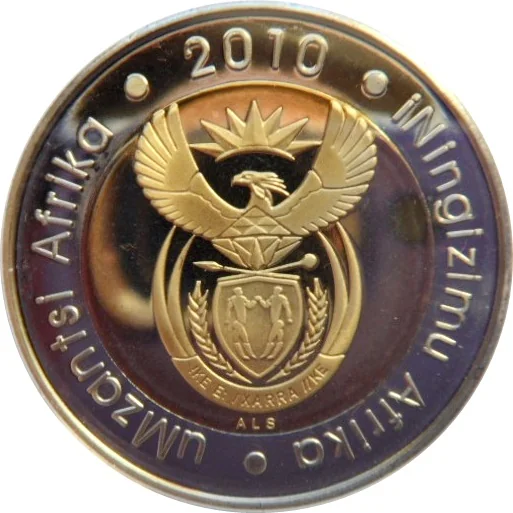
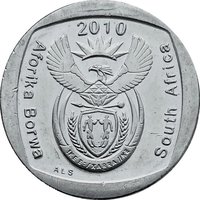
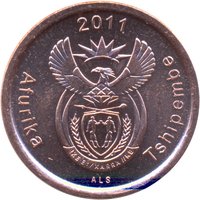
New national coat of arms with Xhosa and Zulu legend.
Inscription:
uMzantsi Afrika • 2010 • iNingizimu Afrika •
ǃKE E: ǀXARRA ǁKE
ALS
ǃKE E: ǀXARRA ǁKE
ALS
Translation:
South Africa • 2010 • South Africa •
Diverse People Unite
Diverse People Unite
Script: Latin
Engraver: Arthur Sutherland
Reverse
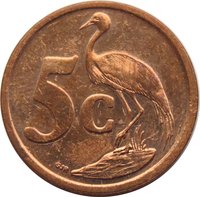
Description:
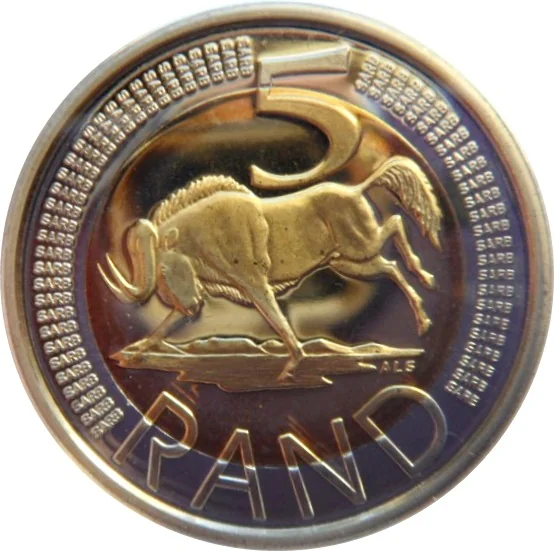
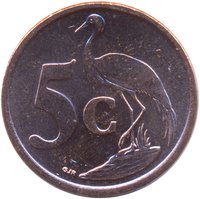
Wildebeest design with 'SARB' repeated 32 times on the left and 25 on the right.
Inscription:
5
ALS
RAND
ALS
RAND
Script: Latin
Engraver: Arthur Sutherland
Edge
Legend:
SARB R5 SARB R5 SARB R5 SARB R5 SARB R5 SARB R5 SARB R5 SARB R5 SARB R5 SARB R5
Mintings
| Year | Mint Mark | Mintage | Quality | Collection |
|---|---|---|---|---|
| 2010 | — | 8,064,000 | ||
| 2010 | — | — | BU | |
| 2010 | — | — | Proof | |
| 2010 | CW | 1,563 |
Historical background
In 2010, South Africa's currency, the rand (ZAR), was characterized by significant volatility and strength, largely influenced by global capital flows rather than domestic economic fundamentals. Emerging from the 2008-09 global financial crisis, the rand rebounded sharply, appreciating nearly 30% against the US dollar between March 2009 and the end of 2010. This surge was primarily driven by "risk-on" investor sentiment, as South Africa's relatively high interest rates and deep, liquid financial markets attracted substantial foreign capital seeking yield, particularly into the bond and stock markets.
This strong currency presented a complex dilemma for policymakers and the economy. On one hand, it helped contain inflation by making imports cheaper, providing the South African Reserve Bank (SARB) room to keep interest rates at historically low levels to support post-crisis recovery. On the other hand, it severely pressured exporters and manufacturers, whose goods became more expensive on the global market, undermining the government's goals for industrial growth and job creation. The strong rand was a contentious issue, with labour unions and industry leaders frequently calling for intervention to weaken the currency and protect local industries.
Underpinning this situation were persistent structural challenges, including a large current account deficit, which hovered around -3% of GDP, making the rand vulnerable to sudden shifts in global investor sentiment. The government and the SARB generally maintained a policy of a floating exchange rate, with limited direct intervention, focusing instead on accumulating foreign reserves. As the year closed, the currency's strength amid high domestic unemployment and inequality highlighted the disconnect between financial markets and the real economy, setting the stage for continued debate over currency management in the years following the 2010 FIFA World Cup.
This strong currency presented a complex dilemma for policymakers and the economy. On one hand, it helped contain inflation by making imports cheaper, providing the South African Reserve Bank (SARB) room to keep interest rates at historically low levels to support post-crisis recovery. On the other hand, it severely pressured exporters and manufacturers, whose goods became more expensive on the global market, undermining the government's goals for industrial growth and job creation. The strong rand was a contentious issue, with labour unions and industry leaders frequently calling for intervention to weaken the currency and protect local industries.
Underpinning this situation were persistent structural challenges, including a large current account deficit, which hovered around -3% of GDP, making the rand vulnerable to sudden shifts in global investor sentiment. The government and the SARB generally maintained a policy of a floating exchange rate, with limited direct intervention, focusing instead on accumulating foreign reserves. As the year closed, the currency's strength amid high domestic unemployment and inequality highlighted the disconnect between financial markets and the real economy, setting the stage for continued debate over currency management in the years following the 2010 FIFA World Cup.
🌱 Common