

20 cashes – Kirin Province
Add to wishlist
China
Context
Year: 1903
Country: China
Issuer: Kirin Province
Ruler: Guangxu
Currency:
(1898—1909)
Demonetized: Yes
Material
References
Y: #
Numista: #21920
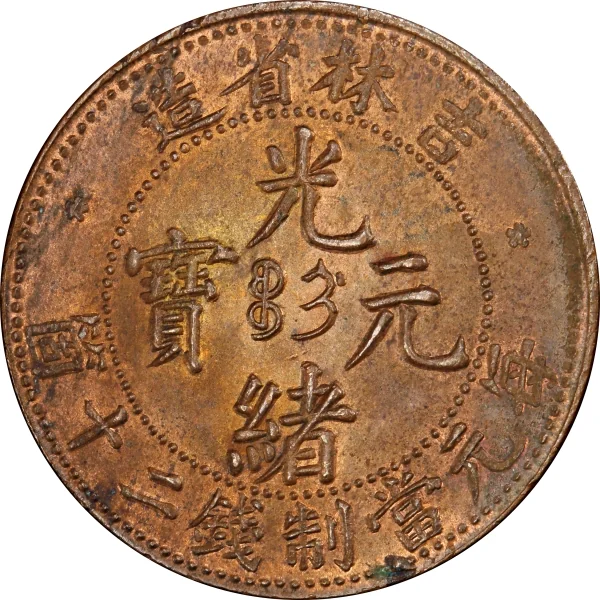
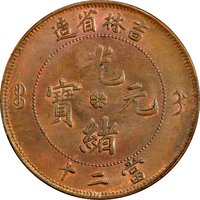
Obverse
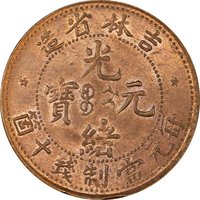
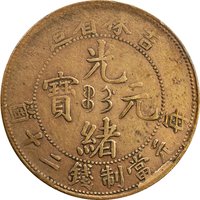
Description:
Chinese ideograms top to bottom, right to left, with central Manchu text, all encircled by more Chinese characters.
Inscription:
造省林吉
光
寶 ᠪᠣᠣ ᡬᡳ 元
緒
箇十二錢制當元每
光
寶 ᠪᠣᠣ ᡬᡳ 元
緒
箇十二錢制當元每
Translation:
Made by the Board of Public Works
Guangxu
Boogi Yuan
[Coin] equivalent to ten-two [i.e., twelve] candareens per Yuan
Guangxu
Boogi Yuan
[Coin] equivalent to ten-two [i.e., twelve] candareens per Yuan
Scripts: Chinese, Mongolian / Manchu
Languages: Manchu, Classical Chinese
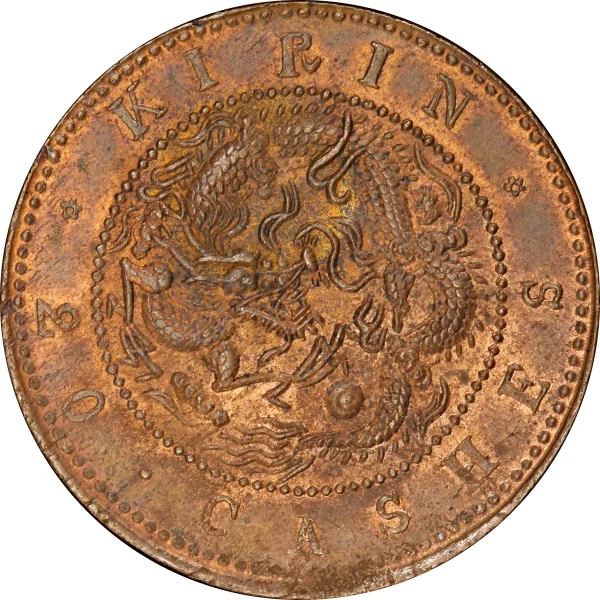
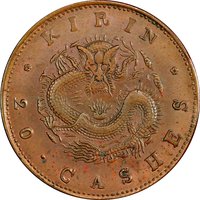
Reverse
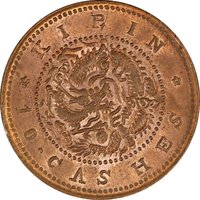
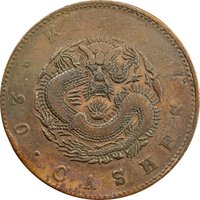
Description:
Dragon encircling a pearl, surrounded by English text.
Inscription:
KIRIN
20 CASHES
20 CASHES
Script: Latin
Edge
Plain
Categories
| Mythology> Fantastic animal |
Mintings
| Year | Mint Mark | Mintage | Quality | Collection |
|---|---|---|---|---|
| 1903 | — | — |
Historical background
In 1903, the currency situation in Kirin (Jilin) Province was a complex and unstable reflection of the wider crisis of the late Qing dynasty. The primary medium of exchange was a chaotic mix of official and local currencies. Officially, the province used silver in bulk form (sycee), valued by weight and purity, alongside copper-alloy cash coins strung in diao. However, the scarcity of official minting led to a proliferation of local, privately minted cash coins of debased quality, causing severe inflation and confusion in everyday retail transactions. This unstable metallic system was further strained by the increasing circulation of foreign silver dollars, particularly the Mexican "Eagle" dollar, which circulated widely due to its standardized weight and reliability.
Complicating this picture was the growing influence of foreign powers, particularly Russia and Japan, whose economic interests competed for dominance in the strategically vital province. The Russian ruble, backed by the Chinese Eastern Railway which cut through northern Kirin, circulated heavily in railway zones and trade hubs like Harbin. Meanwhile, Japanese yen and banknotes from the Yokohama Specie Bank began to penetrate southern areas, anticipating the coming imperial rivalry. This foreign currency intrusion undermined Qing monetary sovereignty, creating zones of economic influence that operated outside Chinese control.
The provincial authorities attempted to address the chaos by authorizing local institutions to issue paper money. Official Bank of Kirin (Jilin Official Bank) notes and various tiao-piao (credit notes) from local merchants and pawnshops flooded the market. However, these notes were often issued without sufficient reserve backing, leading to frequent depreciation and loss of public confidence. Consequently, by 1903, Kirin’s monetary environment was a fragmented and inflationary patchwork of debased copper, competing silver standards, unsecured paper, and foreign currencies—a system on the brink of collapse, mirroring the political fragility of the region on the eve of the Russo-Japanese War (1904-1905).
Complicating this picture was the growing influence of foreign powers, particularly Russia and Japan, whose economic interests competed for dominance in the strategically vital province. The Russian ruble, backed by the Chinese Eastern Railway which cut through northern Kirin, circulated heavily in railway zones and trade hubs like Harbin. Meanwhile, Japanese yen and banknotes from the Yokohama Specie Bank began to penetrate southern areas, anticipating the coming imperial rivalry. This foreign currency intrusion undermined Qing monetary sovereignty, creating zones of economic influence that operated outside Chinese control.
The provincial authorities attempted to address the chaos by authorizing local institutions to issue paper money. Official Bank of Kirin (Jilin Official Bank) notes and various tiao-piao (credit notes) from local merchants and pawnshops flooded the market. However, these notes were often issued without sufficient reserve backing, leading to frequent depreciation and loss of public confidence. Consequently, by 1903, Kirin’s monetary environment was a fragmented and inflationary patchwork of debased copper, competing silver standards, unsecured paper, and foreign currencies—a system on the brink of collapse, mirroring the political fragility of the region on the eve of the Russo-Japanese War (1904-1905).
💎 Extremely Rare