

15 Dollars – Australia
Australia
Context

Material
Diameter: 16.1 mm
Weight: 3.14 g
Gold weight: 3.14 g
Thickness: 1.5 mm
Shape: Round
Composition: 99.99% Gold
Standard: Gold tenth ounce
Magnetic: No
Technique: Milled
Alignment: Medal alignment
flip
References
KM: #Click to copy to clipboard166
Numista: #218600
Value
Exchange value: 15 AUD = $10.68
Bullion value: $523.48
Inflation-adjusted value: 36.29 AUD
Obverse
Description:
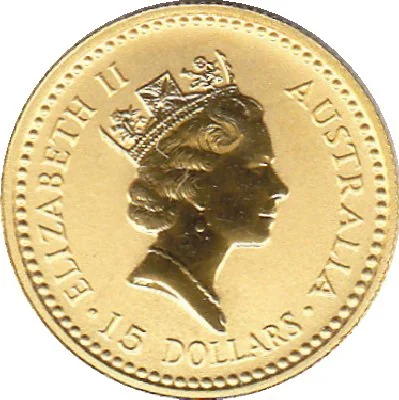
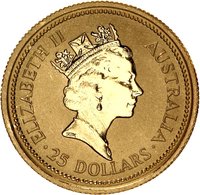
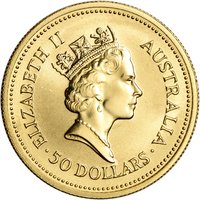
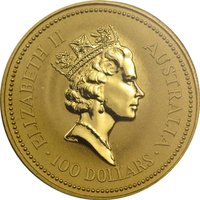
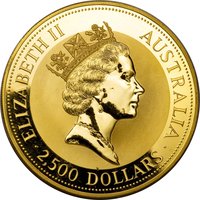
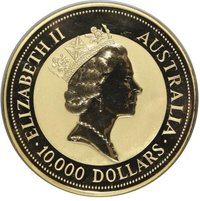
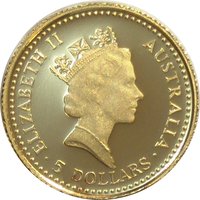
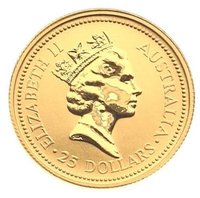
Queen Elizabeth III facing right in the King George IV State Diadem.
Inscription:
ELIZABETH II
AUSTRALIA
15 DOLLARS
RDM
AUSTRALIA
15 DOLLARS
RDM
Script: Latin
Designer: Raphael David Maklouf
Reverse
Description:
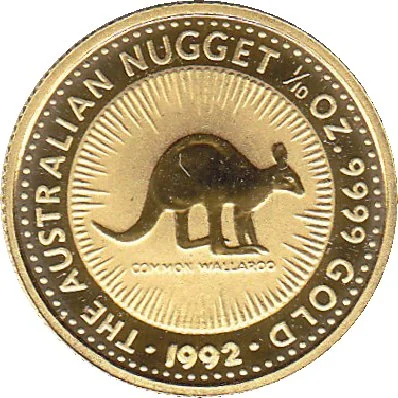
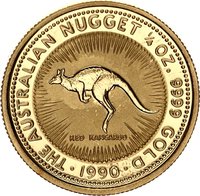
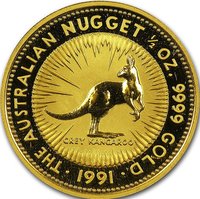
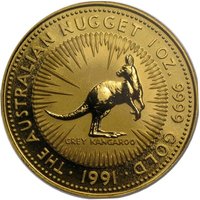
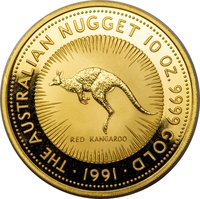
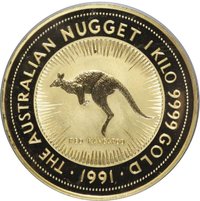
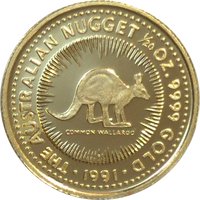
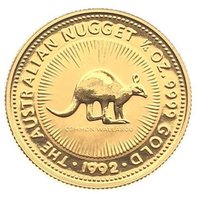
Wallaroo crouching in center circle, surrounded by text, date below.
Inscription:
THE AUSTRALIAN NUGGET 1/10 OZ. 9999 GOLD
COMMON WALLAROO
1992
COMMON WALLAROO
1992
Script: Latin
Designer: Stuart Devlin
Edge
Reeded
Mints
| Name | Mark |
|---|---|
| Perth Mint | — |
Mintings
| Year | Mint Mark | Mintage | Quality | Collection |
|---|---|---|---|---|
| 1991 | — | 526 | Proof | |
| 1992 | — | — | BU |
Historical background
In 1991, Australia’s currency situation was defined by its operation within a managed float, a system adopted in December 1983 when the Australian dollar was finally de-pegged from a trade-weighted basket of currencies. This shift to a floating exchange rate, overseen by the Reserve Bank of Australia (RBA), meant the dollar's value was primarily set by market forces of supply and demand. However, the RBA maintained a policy of "leaning against the wind," intervening in the foreign exchange market to smooth out excessive volatility and disorderly conditions, rather than targeting a specific exchange rate level.
The economic context of 1991 was challenging, as Australia was in the depths of the "recession we had to have," a term coined by Treasurer Paul Keating in 1990. High interest rates, implemented to curb a persistent current account deficit and inflationary pressures from the late 1980s, had contributed to a severe economic downturn. Consequently, the Australian dollar faced downward pressure throughout the year, reflecting weak domestic demand, rising unemployment (which would peak above 10%), and diminished investor confidence. The currency traded in a broad range, but its general trajectory was weak, influenced by both domestic recessionary forces and global economic uncertainty.
This period solidified the floating exchange rate as a crucial adjustment mechanism for the Australian economy. The depreciating dollar, while a symptom of economic weakness, also provided a necessary stimulus by making exports more competitive and import-competing industries more viable. This automatic stabiliser helped lay the groundwork for eventual recovery, underscoring the RBA's view that the float allowed the economy to better absorb external shocks. The experience of 1991 reinforced the commitment to a market-determined exchange rate, with discretionary intervention, as a cornerstone of Australia's monetary policy framework.
The economic context of 1991 was challenging, as Australia was in the depths of the "recession we had to have," a term coined by Treasurer Paul Keating in 1990. High interest rates, implemented to curb a persistent current account deficit and inflationary pressures from the late 1980s, had contributed to a severe economic downturn. Consequently, the Australian dollar faced downward pressure throughout the year, reflecting weak domestic demand, rising unemployment (which would peak above 10%), and diminished investor confidence. The currency traded in a broad range, but its general trajectory was weak, influenced by both domestic recessionary forces and global economic uncertainty.
This period solidified the floating exchange rate as a crucial adjustment mechanism for the Australian economy. The depreciating dollar, while a symptom of economic weakness, also provided a necessary stimulus by making exports more competitive and import-competing industries more viable. This automatic stabiliser helped lay the groundwork for eventual recovery, underscoring the RBA's view that the float allowed the economy to better absorb external shocks. The experience of 1991 reinforced the commitment to a market-determined exchange rate, with discretionary intervention, as a cornerstone of Australia's monetary policy framework.
Series: Australian Nugget
💎 Extremely Rare