

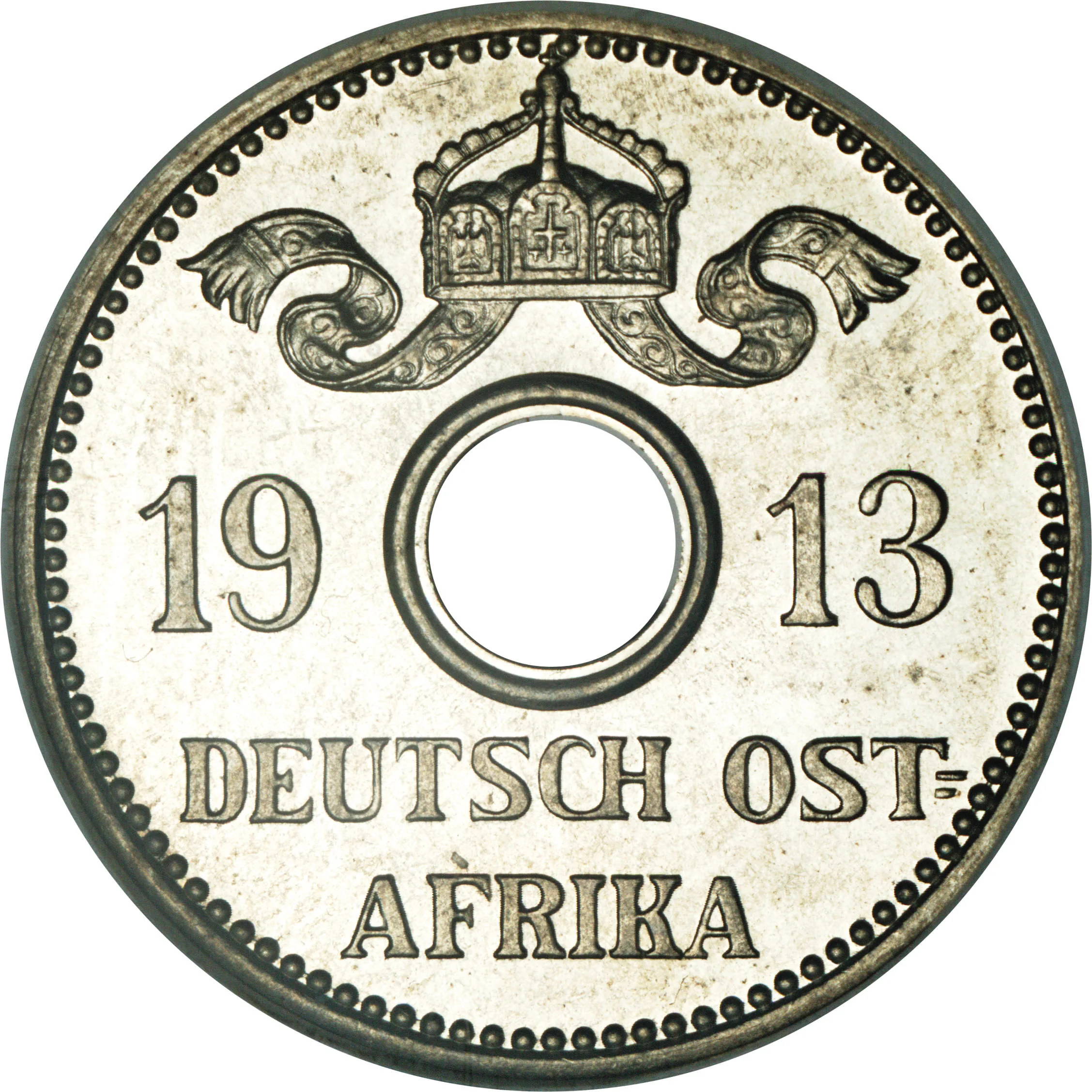
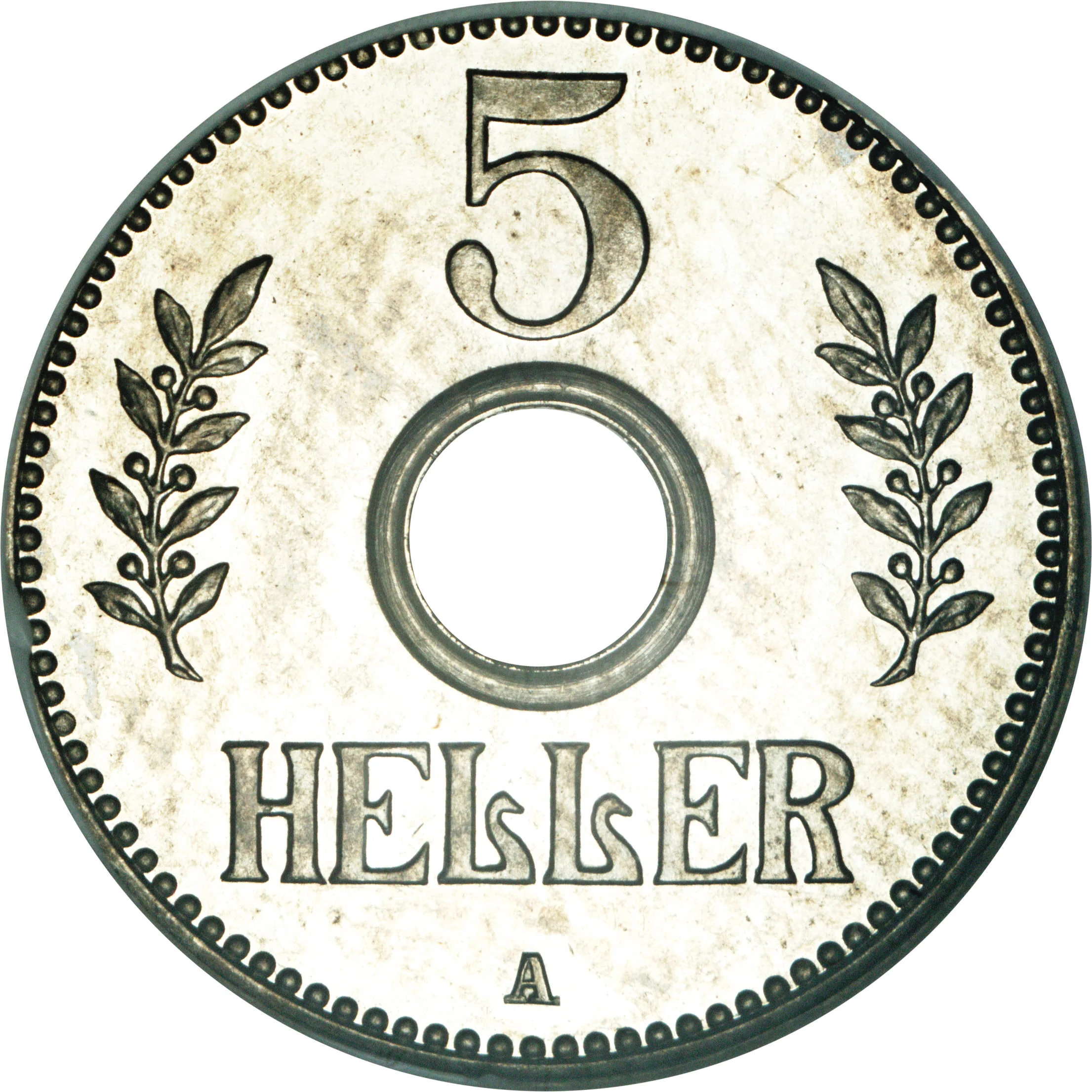
5 Heller – German East Africa
Tanzania
Context
Years: 1913–1914
Country: Tanzania 
Issuer: German East Africa
Ruler: William II
Currency:
(1904—1916)
Demonetized: Yes
Total mintage: 3,000,000
Material
Diameter: 21 mm
Weight: 3.13 g
Shape: Round with a round hole
Composition: Copper-nickel
Standard: Gold tenth ounce
Technique: Milled
Alignment: Medal alignment
flip
References
KM: #Click to copy to clipboard13
Numista: #21768
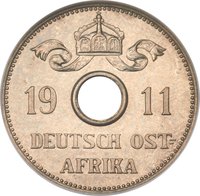
Obverse
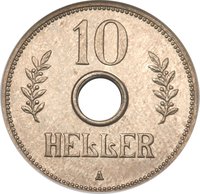
Reverse
Edge
Plain
Mintings
| Year | Mint Mark | Mintage | Quality | Collection |
|---|---|---|---|---|
| 1913 | A | 1,000,000 | ||
| 1913 | A | — | Proof | |
| 1913 | J | 1,000,000 | ||
| 1913 | J | — | Proof | |
| 1914 | J | — | Proof | |
| 1914 | J | 1,000,000 |
Historical background
In 1913, the currency situation in German East Africa was a complex and dual system, reflecting both colonial economic ambitions and local realities. The official currency was the German East African rupie (rupien), introduced in 1890 to replace the diverse array of foreign coins and trade goods in use. It was a silver-based currency, pegged to the Indian rupee to facilitate trade with the neighboring British territories and the Indian Ocean trade network. This rupie was issued by the Deutsch-Ostafrikanische Bank, established in 1905, and circulated in the form of coins and banknotes, forming the backbone of the colonial administration's fiscal operations and European commercial activity.
Alongside this official system, a traditional barter economy and pre-colonial currencies remained deeply entrenched, particularly in the interior. The most prominent of these was the Heller (or Händlerheller), not to be confused with the German pfennig also called heller. These were rolls of cloth, typically merikani (unbleached cotton) or kaniki (dark blue cloth), which served as a widely accepted unit of account and medium of exchange for everyday transactions among the African population. This duality meant that while taxes and government business required rupien, much of the local economy and labour payments, especially on plantations, were conducted using these cloth currencies or direct barter.
This monetary duality created persistent challenges. The colonial government struggled to fully supplant the established cloth currency, as the supply of silver rupien was often insufficient for the entire economy, and its use was less intuitive for many inhabitants. Furthermore, the fixed exchange rate between the silver rupie and the German mark (at 1 rupie = 1.33 marks) created economic distortions, especially as the global price of silver fluctuated. Thus, on the eve of World War I, German East Africa's currency system was an unstable hybrid, caught between the colony's integration into the global imperial economy and the enduring practicalities of its regional and internal markets.
Alongside this official system, a traditional barter economy and pre-colonial currencies remained deeply entrenched, particularly in the interior. The most prominent of these was the Heller (or Händlerheller), not to be confused with the German pfennig also called heller. These were rolls of cloth, typically merikani (unbleached cotton) or kaniki (dark blue cloth), which served as a widely accepted unit of account and medium of exchange for everyday transactions among the African population. This duality meant that while taxes and government business required rupien, much of the local economy and labour payments, especially on plantations, were conducted using these cloth currencies or direct barter.
This monetary duality created persistent challenges. The colonial government struggled to fully supplant the established cloth currency, as the supply of silver rupien was often insufficient for the entire economy, and its use was less intuitive for many inhabitants. Furthermore, the fixed exchange rate between the silver rupie and the German mark (at 1 rupie = 1.33 marks) created economic distortions, especially as the global price of silver fluctuated. Thus, on the eve of World War I, German East Africa's currency system was an unstable hybrid, caught between the colony's integration into the global imperial economy and the enduring practicalities of its regional and internal markets.
🌱 Fairly Common