

20 Euro – Italy
Non-circulating coins
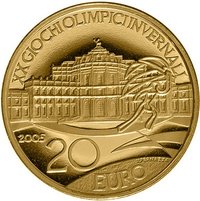
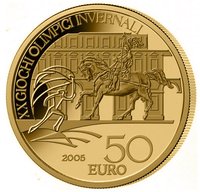
Commemoration: XX Olympic Winter Games 2006 in Turin: The Stupinigi hunting lodge.
Series: 2006 XX Winter Olympics
Italy
Context
Material
References
KM: #Click to copy to clipboard269
Numista: #109570
Value
Exchange value: 20 EUR = $23.63
Bullion value: $969.83
Inflation-adjusted value: 29.08 EUR
Obverse
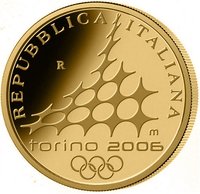
Description:
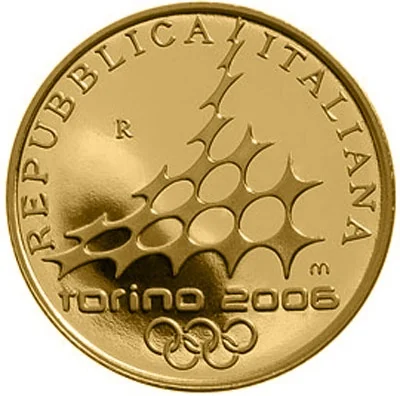
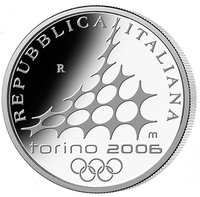
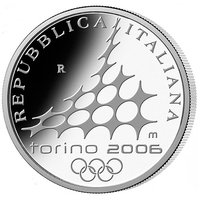
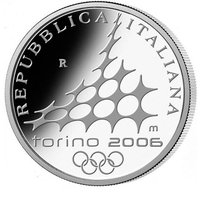
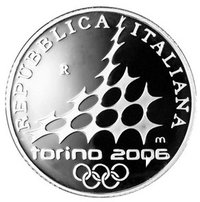
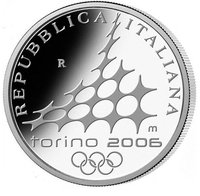
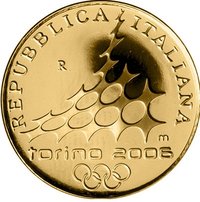
XX Winter Games logo, artist initial right, mintmark left.
Inscription:
REPUBBLICA ITALIANA
R m
torino 2006
R m
torino 2006
Translation:
Italian Republic
Rome Mint
Turin 2006
Rome Mint
Turin 2006
Script: Latin
Language: Italian
Engraver: Roberto Mauri
Reverse
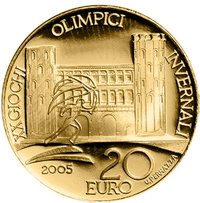
Description:
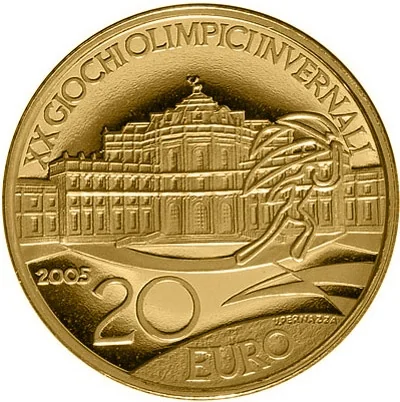
Front view of Stupinigi Hunting Palace, with Olympic torchbearer logo at right. Below are the value, date, and author's name.
Inscription:
XX GIOCHI OLIMPICA INVERNALI
2005
20
EURO
U.PERNAZZA
2005
20
EURO
U.PERNAZZA
Translation:
XX WINTER OLYMPIC GAMES
2005
20
EURO
U.PERNAZZA
2005
20
EURO
U.PERNAZZA
Script: Latin
Language: Italian
Engraver: Uliana Pernazza
Edge
Reeded
Categories
| Building> Palace |
| Sport> Winter Olympic Games |
Mints
| Name | Mark |
|---|---|
| Rome | R |
Mintings
| Year | Mint Mark | Mintage | Quality | Collection |
|---|---|---|---|---|
| 2005 | R | 7,500 | Proof |
Historical background
In 2005, Italy's currency situation was defined by its full integration into the Eurozone, having adopted the euro as its physical currency in 2002. The period was one of post-transition adjustment, where the Italian lira was a memory and all domestic prices, wages, and contracts were firmly denominated in euros. This shift had brought tangible benefits, including the elimination of exchange rate risk within the Eurozone, lower interest rates due to convergence with German bunds, and greater price transparency for trade and travel. However, the permanence of the change was still being felt by the public, with many continuing to mentally convert prices back to lire, a phenomenon known as "lira nostalgia," due to a persistent perception that the euro had caused a sharp, one-time increase in the cost of living.
Economically, the single currency exposed underlying structural weaknesses in Italy's economy without the former cushion of periodic lira devaluations. By 2005, Italy was struggling with stagnant growth, declining competitiveness, and a high public debt burden—the second largest in the Eurozone—which hovered around 106% of GDP. The fixed exchange rate regime of the euro meant Italy could no longer devalue its currency to boost exports, forcing a necessary but painful internal adjustment through wage moderation and productivity reforms. This "straitjacket" effect was a topic of intense domestic debate, as the country faced pressure to comply with the EU's Stability and Growth Pact while its economy underperformed the Eurozone average.
Politically, the euro enjoyed broad institutional support, but public sentiment was increasingly skeptical. The center-right government of Prime Minister Silvio Berlusconi was a firm proponent of European integration, yet it frequently critiqued EU fiscal rules as overly restrictive. This tension culminated in 2005 when Italy, along with France and Germany, had effectively rendered the Stability and Growth Pact's enforcement mechanism flexible, a move that highlighted the conflict between national economic pressures and Eurozone rules. Thus, 2005 was a year of consolidation for the euro in Italy, but also one where the challenges of life without monetary sovereignty became clearly apparent, setting the stage for future fiscal and political debates.
Economically, the single currency exposed underlying structural weaknesses in Italy's economy without the former cushion of periodic lira devaluations. By 2005, Italy was struggling with stagnant growth, declining competitiveness, and a high public debt burden—the second largest in the Eurozone—which hovered around 106% of GDP. The fixed exchange rate regime of the euro meant Italy could no longer devalue its currency to boost exports, forcing a necessary but painful internal adjustment through wage moderation and productivity reforms. This "straitjacket" effect was a topic of intense domestic debate, as the country faced pressure to comply with the EU's Stability and Growth Pact while its economy underperformed the Eurozone average.
Politically, the euro enjoyed broad institutional support, but public sentiment was increasingly skeptical. The center-right government of Prime Minister Silvio Berlusconi was a firm proponent of European integration, yet it frequently critiqued EU fiscal rules as overly restrictive. This tension culminated in 2005 when Italy, along with France and Germany, had effectively rendered the Stability and Growth Pact's enforcement mechanism flexible, a move that highlighted the conflict between national economic pressures and Eurozone rules. Thus, 2005 was a year of consolidation for the euro in Italy, but also one where the challenges of life without monetary sovereignty became clearly apparent, setting the stage for future fiscal and political debates.
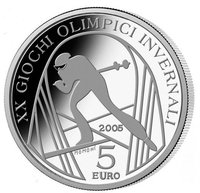
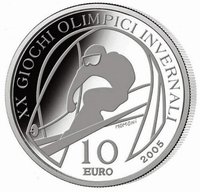
Series: 2006 XX Winter Olympics
💎 Extremely Rare