

1 euro cent – Cyprus
Add to wishlist
Cyprus
Obverse
Description:
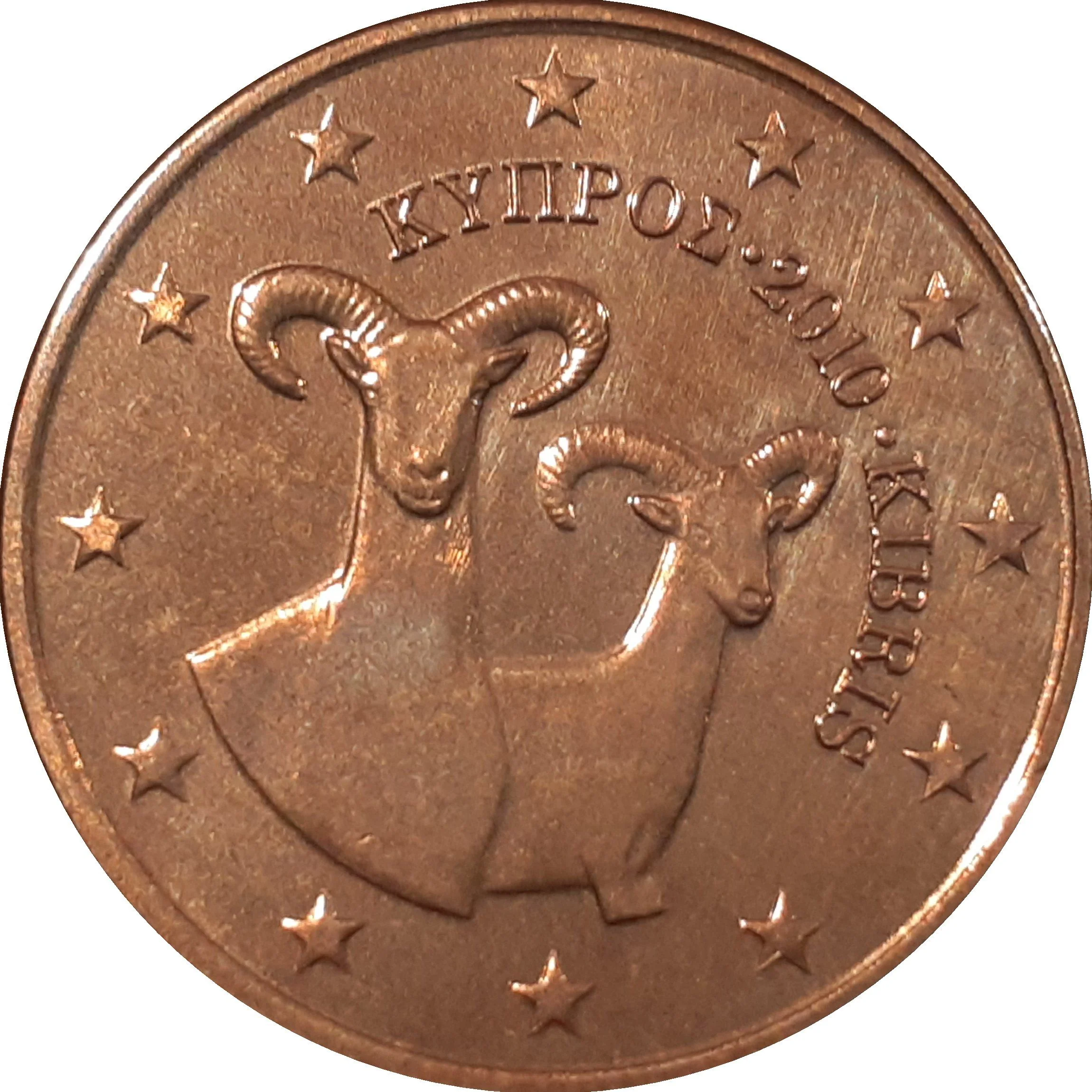
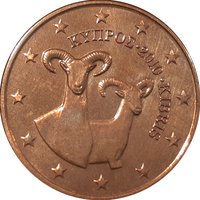
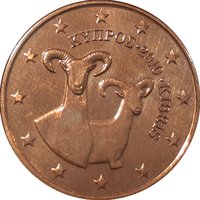
Cyprus mouflons with European stars, bilingual legend.
Inscription:
ΚΥΠΡΟΣ · 2010 · KIBRIS
Translation:
Cyprus · 2010 · Cyprus
Script: Latin
Engravers: Tatiana Sotiropoulou, Erik Maell
Reverse
Edge
Plain
Mints
| Name | Mark |
|---|---|
| Mint of Finland | — |
| National Mint of the Bank of Greece | — |
Mintings
| Year | Mint Mark | Mintage | Quality | Collection |
|---|---|---|---|---|
| 2008 | — | 40,070,000 | ||
| 2008 | — | 70,000 | BU | |
| 2009 | — | 19,985,000 | ||
| 2009 | — | 15,000 | BU | |
| 2010 | — | 200,000 | ||
| 2011 | — | 10,000 | BU | |
| 2011 | — | 15,190,000 | ||
| 2012 | — | 200,000 | ||
| 2012 | — | 12,000 | BU | |
| 2013 | — | 90,000 | ||
| 2013 | — | 10,000 | BU | |
| 2014 | — | 100,000 | ||
| 2014 | — | 7,000 | BU | |
| 2015 | — | 7,093,000 | ||
| 2015 | — | 7,000 | BU | |
| 2016 | — | 8,000,000 | ||
| 2016 | — | 7,000 | BU | |
| 2017 | — | 95,000 | ||
| 2017 | — | 5,000 | BU | |
| 2018 | — | 5,000 | BU | |
| 2018 | — | 18,100,000 | ||
| 2019 | — | 11,095,000 | ||
| 2019 | — | 5,000 | BU | |
| 2020 | — | 7,995,000 | ||
| 2020 | — | 5,000 | BU | |
| 2021 | — | 9,150,000 | ||
| 2021 | — | 5,000 | BU | |
| 2022 | — | 5,000 | BU | |
| 2022 | — | 9,905,000 | ||
| 2023 | — | 595,000 | ||
| 2023 | — | 5,000 | BU | |
| 2024 | — | 100,000 | ||
| 2024 | — | — | BU |
Historical background
In 2008, Cyprus entered the global financial crisis as a prosperous eurozone member, but with an economy exhibiting significant vulnerabilities. Its banking sector, having grown to nearly eight times the size of the national GDP, was heavily exposed to the Greek economy through large holdings of Greek government bonds and private debt. Furthermore, the country's business model relied on attracting foreign deposits, particularly from Russia and other non-EU states, offering high interest rates and light-touch regulation, which created a bloated financial system.
The immediate trigger for Cyprus's currency-related crisis was its banks' catastrophic losses on their Greek bondholdings following the 2011-2012 Greek debt restructuring ("Private Sector Involvement" or PSI). This write-down eroded the capital bases of Cyprus's major banks, particularly the two largest, Laiki Bank and the Bank of Cyprus. The government's attempt to recapitalize these banks by mid-2012 overwhelmed its own finances, leading to a loss of market access and necessitating an international bailout request to the European Stability Mechanism (ESM).
Consequently, while the currency itself—the euro—remained stable, the crisis manifested as a severe banking and sovereign debt crisis that threatened the island's entire financial system. The situation culminated in March 2013 with a unique and controversial bailout agreement with the Eurogroup and the IMF. This deal infamously included a one-time "bail-in" of uninsured depositors (those with over €100,000) in the two troubled banks, leading to significant losses for large savers and the imposition of strict capital controls. These controls, unprecedented in the eurozone, temporarily restricted euro withdrawals and transfers, effectively creating a distinction between "Cyprus euros" and euros elsewhere, despite the currency union.
The immediate trigger for Cyprus's currency-related crisis was its banks' catastrophic losses on their Greek bondholdings following the 2011-2012 Greek debt restructuring ("Private Sector Involvement" or PSI). This write-down eroded the capital bases of Cyprus's major banks, particularly the two largest, Laiki Bank and the Bank of Cyprus. The government's attempt to recapitalize these banks by mid-2012 overwhelmed its own finances, leading to a loss of market access and necessitating an international bailout request to the European Stability Mechanism (ESM).
Consequently, while the currency itself—the euro—remained stable, the crisis manifested as a severe banking and sovereign debt crisis that threatened the island's entire financial system. The situation culminated in March 2013 with a unique and controversial bailout agreement with the Eurogroup and the IMF. This deal infamously included a one-time "bail-in" of uninsured depositors (those with over €100,000) in the two troubled banks, leading to significant losses for large savers and the imposition of strict capital controls. These controls, unprecedented in the eurozone, temporarily restricted euro withdrawals and transfers, effectively creating a distinction between "Cyprus euros" and euros elsewhere, despite the currency union.
Series: 2008 Cyprus circulation coins
🌱 Very Common